









BlogSEO
SEO Funnel 2026: From Search Visibility to AI Recommendations
5 October 2026
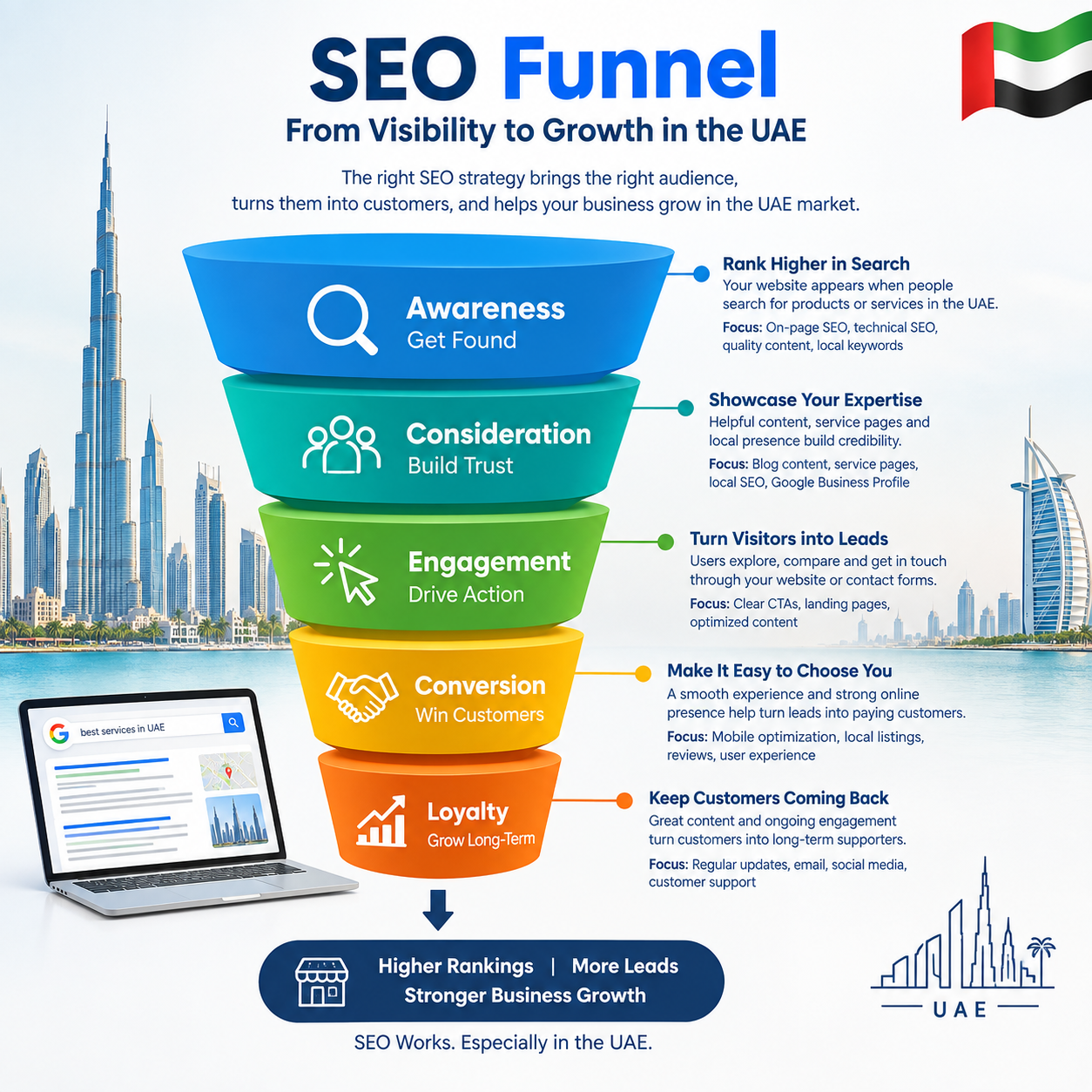
The SEO Funnel in 2026 is changing as customers move from traditional search results toward AI-powered answers, recommendations, reviews, and multiple digital touchpoints. A modern SEO Funnel connects search visibility, helpful content, brand authority, and the signals that help search engines and AI systems understand a business. Instead of focusing only on rankings and clicks, marketers need to understand how people discover, evaluate, trust, and ultimately choose a brand.
What is the SEO Funnel in 2026?
The traditional SEO Funnel followed a simple journey: a person searched for a keyword, discovered a website, clicked through, and eventually became a lead or customer. In 2026, that journey can include Google AI Overviews, conversational AI platforms, social media, reviews, business directories, comparison websites, and third-party publications.
This has made the SEO Funnel broader and more interconnected. Search visibility remains important, but appearing as a blue link is no longer the only opportunity. A business can appear in traditional search results, become a cited source in an AI-generated answer, or be mentioned when someone asks an AI assistant to recommend a service.
For businesses, the objective is to build a digital presence that can be discovered, understood, evaluated, and trusted across different search environments.
Stage 1: Discovery Through Search Visibility
The first stage of the SEO Funnel is discovery. People continue to use search engines to research problems, compare businesses, find services, and understand products.
Businesses need technically accessible websites, logical page structures, relevant keywords, helpful content, internal links, optimized metadata, and strong topical coverage. Search intent should guide every page.
For example, someone searching for “AI digital marketing services” may still be researching the category. Someone searching for “AI Digital Marketing Agency Dubai” may already be comparing providers. These searches represent different levels of intent and should be addressed with different content.
A successful SEO Funnel connects informational, commercial, and transactional content so users can move naturally from learning to evaluation and conversion.
Stage 2: Answer Visibility With AEO
The second stage of the SEO Funnel moves beyond ranking toward answering. Answer Engine Optimization, or AEO, focuses on making information easy for search engines and answer systems to understand and extract.
Content should use descriptive headings, direct answers, logical formatting, concise explanations, FAQs, and relevant structured data where appropriate.
A strong SEO Funnel should answer genuine customer questions such as:
- What is an AI digital marketing strategy?
- How does SEO support AI search?
- How can a business improve visibility in AI answers?
- What makes content useful for AI search systems?
- How can businesses measure AI search visibility?
SEO, AEO, and GEO can work together rather than being treated as completely separate strategies. SEO supports discoverability, AEO supports direct answers, and GEO supports visibility within generative search experiences.
Stage 3: Build Authority and Entity Recognition
Ranking for a keyword does not automatically mean an AI system will recommend a business. AI-generated responses can draw information from multiple sources, making brand consistency and authority increasingly important.
This is an important part of the SEO Funnel because AI systems need context about who a business is, what it offers, where it operates, and why it may be relevant.
Business names, services, locations, expertise, authors, customer information, and brand references should remain consistent across relevant digital properties.
For example, a Dubai-focused page targeting “SEO Agency Dubai” should not exist in isolation. It should explain the company’s services, areas served, expertise, process, case studies, FAQs, and supporting information.
Relevant reviews, business profiles, industry references, and authoritative third-party mentions can strengthen the broader digital footprint.
The goal of this SEO Funnel stage is not simply to create more backlinks. It is to establish a consistent and trustworthy digital identity that both customers and AI systems can understand.
Stage 4: From Search Results to AI Recommendations
One of the biggest changes in the modern SEO Funnel is the move from search results toward recommendations.
A user may previously have searched, “Which websites rank for SEO services?” Today, they may ask an AI assistant, “Which agencies can help my business with SEO in Dubai?”
This changes the customer journey. The user is no longer simply looking for a webpage. They are asking for a shortlist, explanation, comparison, or recommendation.
To support this stage of the SEO Funnel, businesses should publish content that demonstrates genuine expertise. Service guides, comparison content, detailed FAQs, case studies, original insights, author information, and trustworthy third-party references can help create a stronger information ecosystem.
For example, content targeting “search engine optimization agency in dubai” should explain what an SEO agency does, who needs SEO, what an engagement can include, how results are measured, and what questions businesses should ask before selecting a provider.
The same approach applies to “Best PPC Agency Dubai.” Rather than making unsupported claims, useful content should explain how to evaluate PPC providers, which campaign metrics matter, how paid search management works, and what separates strategic campaign management from basic ad setup.
Stage 5: Consideration and Trust
After discovery and AI recommendations, users enter the evaluation stage. This is where the SEO Funnel moves from “Who can help me?” to “Which option is right for me?”
Businesses should support this stage with detailed service pages, transparent processes, FAQs, testimonials, case studies, pricing information where appropriate, and clear evidence of expertise.
A business targeting Top AI Digital Marketing Service in UAE should make the phrase meaningful through useful information instead of repeating it unnecessarily. The page should explain the services provided, problems solved, role of AI, human expertise, and methods used to measure performance.
Similarly, an “AI Digital Marketing Agency Dubai” page should give potential customers enough information to understand the agency’s capabilities without making them visit several unrelated pages.
This creates a smoother SEO Funnel because users can find the information they need at the moment they are evaluating a provider.
Stage 6: Conversion and Customer Relationships
The final stage of the SEO Funnel is conversion. Depending on the business, this may involve booking a consultation, requesting a proposal, calling the company, completing a form, or starting a sales conversation.
Conversion optimization is important at this point. Calls to action should be clear, forms should be simple, and service pages should address common concerns before asking visitors to take action.
The customer journey does not necessarily end after conversion. Satisfied customers can contribute reviews, testimonials, referrals, case studies, and brand mentions.
These signals can support future discovery and create a new cycle within the SEO Funnel.
How AEO and GEO Fit Into the SEO Funnel
AEO and GEO should not be viewed as replacements for SEO. SEO helps content become discoverable and accessible, AEO focuses on direct answers, and GEO focuses on visibility within generative AI experiences.
Conductor’s 2026 benchmark reported that AI referrals represented 1.08% of website traffic across the ten industries it analyzed. Its separate Google analysis found that 25.11% of 21.9 million analyzed searches produced an AI Overview. These figures are dataset-specific rather than universal benchmarks, but they demonstrate why marketers are beginning to monitor AI visibility alongside traditional search performance.
A connected SEO Funnel brings these activities together. Technical SEO supports discoverability. Helpful content supports relevance. AEO-friendly structures support answer extraction. Entity signals and third-party references support credibility. Conversion-focused pages turn visibility into measurable business outcomes.
How to Measure the SEO Funnel
Traditional SEO metrics such as rankings, organic impressions, clicks, and conversions remain valuable. However, businesses should also monitor AI-search signals where reliable measurement is available.
Useful metrics include:
- Organic impressions
- Non-branded keyword rankings
- Branded searches
- AI Overview visibility
- AI-generated brand mentions
- AI citations
- AI referral traffic
- Service-page engagement
- Qualified enquiries
- Lead conversion rate
Businesses can also create a fixed set of customer questions and test them regularly across relevant AI platforms.
For each test, record whether the brand appears, how it is described, which sources are cited, and whether the information is accurate.
This creates a practical way to monitor the SEO Funnel without assuming that one AI response represents every searcher.
Common SEO Funnel Mistakes to Avoid
One common mistake is treating AI visibility as a completely separate marketing channel. Many fundamentals remain the same: useful information, clear structure, technical accessibility, expertise, and credibility.
Another mistake is producing content only for keywords. Modern users want useful answers rather than pages written to repeat phrases. Keyword research should identify demand and intent, while the final content should read naturally.
A third mistake is making unsupported claims such as “number one,” “best,” or “guaranteed AI recommendations.” AI search is dynamic, and recommendations can change based on the query, location, user context, available sources, and platform.
A strong SEO Funnel should therefore focus on usefulness and credibility rather than attempting to manipulate AI-generated results.
The Future of Search Visibility
The future of the SEO Funnel is less about moving users through a straight line and more about being present across connected moments.
A customer may discover a brand through Google, validate it through an AI answer, check reviews, visit the website, compare alternatives, and return through a branded search before converting.
For a brand like Maninder Wave, this means connecting SEO, AI-driven marketing, useful content, paid campaigns, social media, and lead generation to create a consistent digital journey across different discovery channels.
The opportunity is to build a connected information system instead of isolated SEO pages. Every important page should answer a genuine question, reinforce the brand entity, support user intent, demonstrate expertise, and make the next action clear.
Maninder Wave follows this broader approach by combining SEO, content marketing, PPC, social media, and AI-enabled marketing strategies to help businesses attract and convert relevant audiences.
As AI search continues to evolve, businesses that combine traditional search optimization with AEO, GEO, strong brand signals, and conversion-focused content can build a more complete digital presence.
The goal is not simply to rank for a keyword. The goal is to become a useful and credible source that people can discover, understand, trust, and ultimately choose.
Final Thought
The future of search will reward businesses that connect visibility with usefulness and trust. A modern search strategy should help customers move naturally from discovery to evaluation and action while keeping information clear for both people and AI systems. When paid search is added to this broader journey, Pay-Per-Click UAE can support faster visibility for high-intent audiences.
Businesses should continue reviewing how their audiences search, which questions they ask, and which channels influence their decisions. By combining useful organic content, clear answers, strong brand information, and targeted paid campaigns, companies can create a search experience that remains helpful at every stage of the customer journey.
Frequently Asked Questions
The new SEO funnel is a modern approach to search optimization that connects traditional search visibility with AEO, GEO, AI recommendations, brand authority, consideration, and conversion. Instead of focusing only on rankings and clicks, it considers the complete customer journey from discovery to decision-making.
AI is changing the SEO funnel by giving users direct answers, summaries, comparisons, and recommendations instead of requiring them to visit multiple search results. Businesses therefore need content that is easy for both users and AI systems to understand, while maintaining strong technical SEO, expertise, and brand credibility.
SEO focuses on improving a website’s visibility in search engines. AEO focuses on providing clear, direct answers that can be used in answer-based search experiences. GEO focuses on improving a brand’s visibility and representation in generative AI responses. These approaches can work together as part of one search strategy.
A business can improve its chances of appearing in AI recommendations by maintaining accurate business information, publishing useful and authoritative content, demonstrating expertise, building a consistent digital presence, earning relevant third-party mentions, and clearly explaining its products or services. However, AI recommendations can vary by platform, query, location, and available sources.
Brand mentions can help create a broader digital context around a business. Consistent information across the company’s website, business profiles, reviews, industry publications, and other relevant sources can make it easier for users and AI systems to understand the company’s identity, services, expertise, and location.
