



BlogPPC
AI Max for Google Search: The Future of PPC Advertising?
18 September 2026
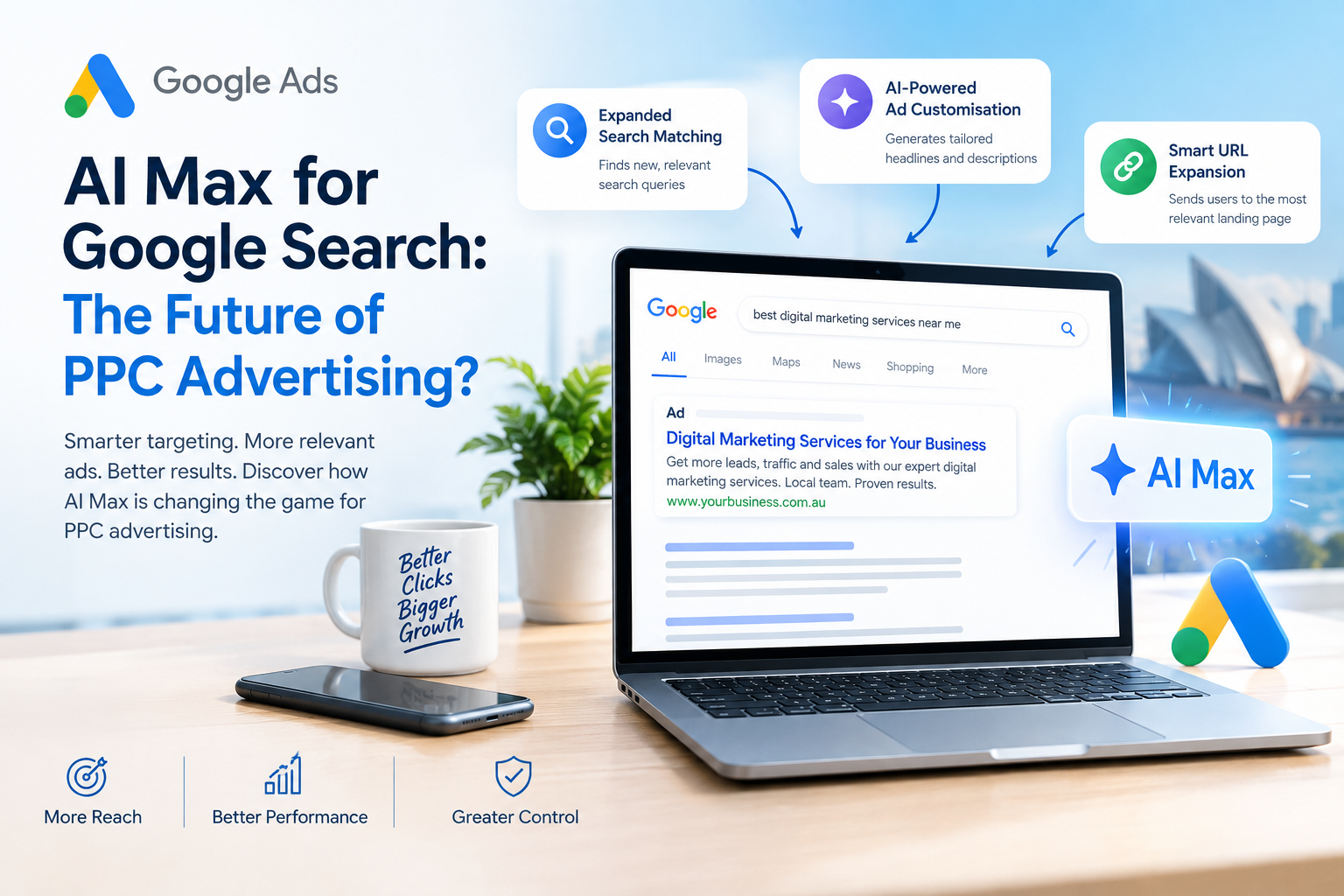
Pay per click advertising has always relied on precision. Advertisers chose exact keywords, wrote tightly targeted ad copy and sent traffic to carefully matched landing pages. That model is changing quickly, and AI Max for Google Search is one of the clearest signs of where PPC advertising is heading next.
Launched by Google as an optimisation layer for Search campaigns, AI Max blends automation with a level of control that Performance Max campaigns never offered. For Australian businesses managing tight advertising budgets, understanding what AI Max actually does, and whether it genuinely improves results, is now an essential part of any modern pay per click strategy.
What Is AI Max for Google Search?
AI Max for Search is not a new campaign type. It is an optimisation layer that sits on top of existing Google Ads Search campaigns, using artificial intelligence to expand reach, generate creative assets and route traffic to the most relevant landing pages. Rather than replacing manual campaign management entirely, it works alongside existing keywords, creatives and settings to find additional opportunities that a standard search campaign might otherwise miss.
The feature suite is built around three core components. Search term matching uses broad match and what Google calls keywordless technology to expand beyond an advertiser’s existing keyword list, learning from current keywords, ad creatives and URLs to surface new, relevant search queries. Text customisation, previously known as automatically created assets, uses generative AI along with existing ad copy and landing page content to produce tailored headlines and descriptions. Final URL expansion automatically sends users to the most relevant page on a website based on their specific search intent, rather than always directing traffic to a single fixed landing page.
Why Google Introduced AI Max Now
Search behaviour has changed dramatically over the past few years. Queries are longer, more conversational and harder to predict with a fixed keyword list. At the same time, advertisers have grown frustrated with Performance Max campaigns which offer strong automation but very limited transparency over where ads appear and which search terms trigger them.
AI Max was designed to sit between these two extremes. It gives advertisers the automation benefits associated with Performance Max while preserving the reporting detail, brand controls and geographic targeting that Search campaigns are known for. Google has reported that advertisers using the full AI Max feature suite see meaningful gains in conversions or conversion value at a similar cost per acquisition, and Google has continued expanding the rollout since its 2025 launch, including automatically upgrading Dynamic Search Ads and automatically created asset campaigns to AI Max as part of its broader push to modernise search advertising.
How AI Max Changes the PPC Advertising Landscape
For businesses running pay per click campaigns, AI Max represents a shift in how targeting decisions are made. Traditional PPC advertising relied heavily on the advertiser predicting which exact keywords a customer might type. AI Max instead allows Google’s systems to identify relevant search queries in real time, based on signals from existing account data, then dynamically match ad creative and landing pages to that query.
This has clear advantages for capturing incremental traffic that a fixed keyword list would otherwise miss. It also introduces new considerations around control, since broader matching naturally means less predictability over which exact search terms trigger an ad. This is why AI Max includes brand controls and location of interest settings at the ad group level, giving advertisers a way to maintain guardrails around geography and brand safety while still benefiting from expanded reach.
Businesses reassessing their overall approach to paid search should treat this shift as an opportunity to refine campaign structure rather than simply switching a toggle. A well-managed pay per click strategy still needs clear account structure, strong landing pages and disciplined budget management. AI Max works best as an enhancement layer on top of these fundamentals, not a replacement for them.
Balancing Automation With E-E-A-T and Trust
Google’s broader quality standards, summarised through Experience, Expertise, Authoritativeness and Trustworthiness, are increasingly relevant to paid advertising as well as organic search. As AI Max generates more ad copy automatically and expands targeting beyond fixed keywords, the underlying website and landing page content matter more, not less.
Landing pages that clearly demonstrate real business information, credible service descriptions and accurate, well-structured content give AI Max stronger material to work with when generating creative assets and choosing final URLs. Businesses with clear content structure and strong topical depth on their website, the same principles that support search engine optimisation and organic visibility, tend to see better outcomes from automated PPC advertising tools as well, since both systems reward clarity, relevance and genuine expertise over generic, thin content.
Should Australian Businesses Adopt AI Max Now?
For most Australian advertisers already running Search campaigns, AI Max is worth testing in a controlled way rather than adopting across an entire account immediately. Starting with a single campaign or ad group, monitoring search term reports closely and reviewing which additional queries are being captured gives businesses a clearer picture of how AI Max performs against their specific goals and local market conditions.
Australian businesses should also pay close attention to geographic targeting settings, since accurate location of interest configuration matters for campaigns focused on specific cities, regions or service areas within Australia. Pairing this careful rollout with a broader digital marketing strategy that includes strong organic content, clear internal linking and E-E-A-T-aligned landing pages tends to produce more consistent, sustainable results than treating AI Max as a standalone solution.
Final Thoughts
AI Max for Google Search reflects a broader direction in PPC advertising, one where automation and control are no longer treated as opposites. It gives advertisers a genuine opportunity to capture additional relevant traffic while keeping meaningful oversight over brand safety, geography and reporting. For Australian businesses, the smartest path forward is a measured one: test AI Max deliberately, keep core landing page and content quality strong, and treat it as part of a wider strategy rather than a shortcut.
Businesses wanting a structured, data-informed approach to adopting AI Max within a broader paid and organic strategy can work with Maninder Wave to build a plan suited to their specific goals, budget and local market.
Frequently Asked Questions
What is AI Max for Google Search?
AI Max for Search is an optimisation layer within Google Ads Search campaigns that uses AI to expand keyword reach, generate tailored ad creative and automatically direct users to the most relevant landing page, without requiring a completely new campaign type.
Is AI Max the same as Performance Max?
No, AI Max works within existing search campaigns and keeps many of the reporting and control features. Search campaigns are known for control, while Performance Max is a fully automated campaign type with far less visibility over placements and search terms.
Does AI Max replace the need for keyword research?
Not entirely. AI Max expands reach beyond a fixed keyword list using broad match and keywordless technology, but starting with a strong, relevant keyword foundation still helps the system understand an advertiser’s intent and target audience more accurately.
How does AI Max affect PPC advertising budgets?
AI Max does not require a separate budget structure, since it works within existing Search campaigns. However, businesses should monitor performance closely after enabling it, since expanded search term matching can change which queries consume budget.
Is AI Max suitable for small Australian businesses?
It can be, particularly for businesses with limited time to manage granular keyword lists. Starting with a small test campaign and reviewing search term reports regularly helps smaller businesses assess whether the expanded reach delivers genuine, relevant conversions.
Do I need strong landing pages to benefit from AI Max?
Yes, since AI Max uses existing landing page content to generate ad copy and decide where to send traffic, clear, well-structured and accurate landing pages generally lead to better creative output and more relevant final URL selection.
