










Blog
Microsoft’s New AI Doctor-Style Diagnosis Tool: What It Does and Why It Matters
23 October 2026
Imagine a detective who is handed every clue at once, and a second detective who walks the scene, asks questions, follows leads, and revises the theory as evidence appears. The second one is closer to how real investigation works. That is the difference at the heart of a new AI diagnosis tool from Microsoft, described in a paper in the journal Science on October 22, 2026.
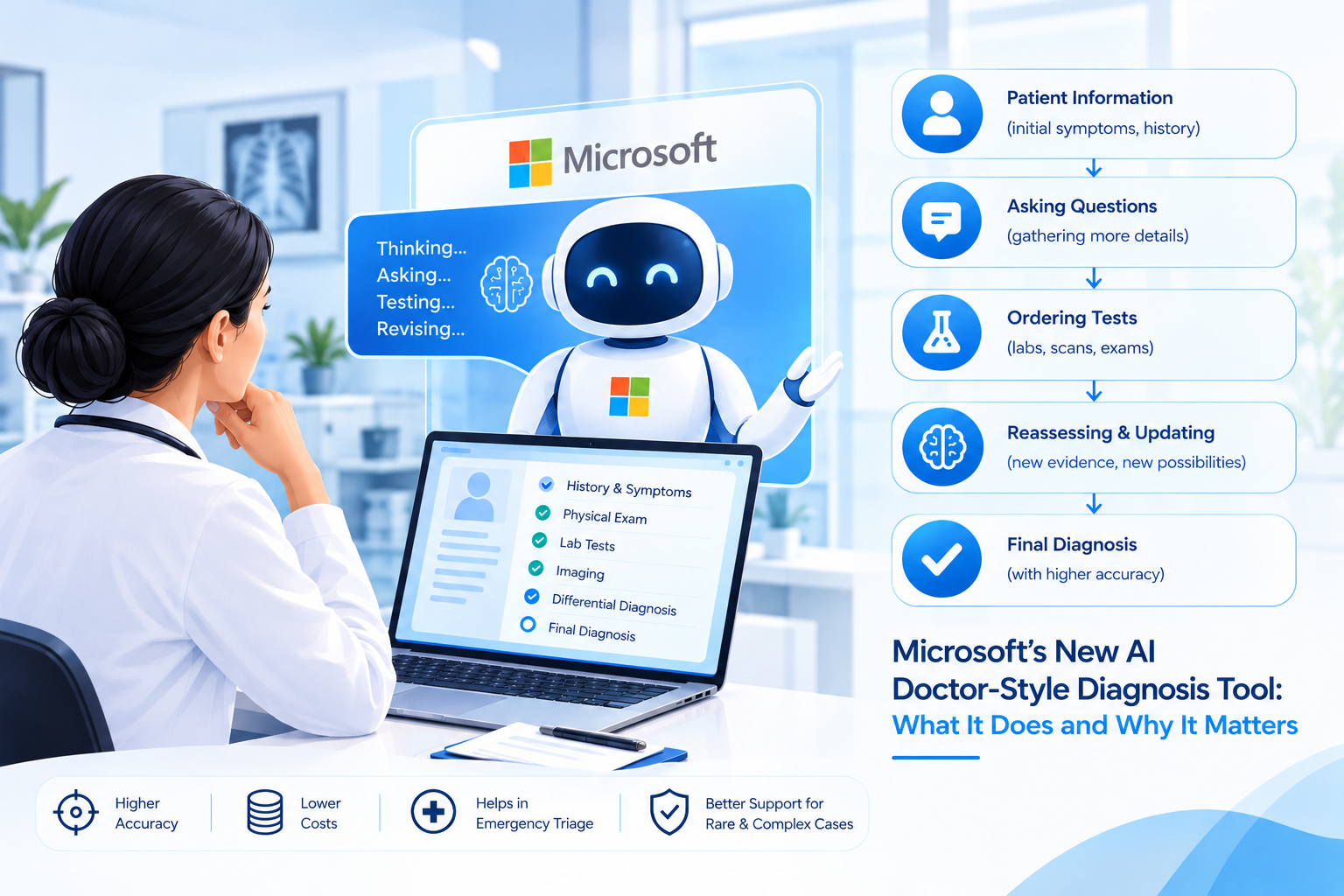
The system does not take a patient file and spit out an answer. It works through a case in stages, the way a clinician does. Early results suggest this approach beats general physicians on tough cases by a wide margin. Here is a plain-language look at what was built, what the numbers really say, and what still needs proving.
The Quick Summary
- Who: Researchers at Microsoft AI
- What: An AI system that diagnoses patients step by step through a coordinating “orchestrator”
- Test: More than 300 rare and puzzling medical cases
- Headline result: More than double the accuracy of general physicians who had access to textbooks and online searches
- Extra findings: Better performance on emergency-room-style scenarios, and lower-cost work-ups
- Next stop: Testing triage in hospital emergency waiting rooms
Diagnosis Is a Process, Not a Single Answer
Many people picture medical diagnosis as a quiz: symptoms in, disease out. In practice, a doctor starts with a vague complaint and very little certainty. She asks about the timeline, notices something during the exam, orders one test, gets a surprising result, and changes direction.
Most earlier medical AI was built for the quiz version. It was handed a complete bundle of information and asked to name the condition. That can be impressive, but it skips the hardest skill in medicine: deciding what to find out next.
Microsoft’s system is designed around that missing skill. It begins with limited facts, then chooses its own questions and tests. This is why it is described as sequential diagnosis AI.
Inside the Orchestrator: An AI Case Conference
The core idea is a coordinating layer called an orchestrator. Think of a hospital case conference where several specialists sit around a table and debate a difficult patient. The orchestrator recreates that setup with multiple simulated clinical experts, each contributing a perspective.
The coordinator keeps the group organized. At each stage it helps decide:
- What to ask the patient next
- Which physical findings deserve attention
- Which lab tests or scans are worth ordering
- How new results change the list of likely causes
- Whether to keep investigating or commit to a conclusion
Throughout the process, the system keeps revising its working theories and plans. That constant updating is what separates it from tools that simply classify a finished data set.
Why Exam-Style Benchmarks Can Mislead
For a long time, medical AI has been graded using multiple-choice tests, and top models now score near perfect marks. The trouble is that these tests quietly do the difficult work for the AI. The question is neatly written, the irrelevant details are removed, and the answer is hiding among four choices.
Real patients do not come with answer options. They come with messy stories, missing records, and symptoms that overlap across many conditions. By evaluating the AI on open-ended case work-ups, the researchers tried to measure something far closer to bedside reality. If this style of testing catches on, it could change how the whole field judges medical AI accuracy.
Reading the Numbers Carefully
“More than twice as accurate” is a striking claim, so it helps to look at what it covers.
What it shows:
- On a set of more than 300 unusually difficult cases, the AI reached the right diagnosis far more often than general physicians.
- Those physicians were not handicapped. They could consult textbooks and search the internet.
- The tool also did better than human doctors on scenarios built from a large database of emergency admissions.
What it does not show:
- It does not prove the AI beats specialists who focus on one disease area.
- It does not prove the tool is safe on live, unpredictable patients.
- It does not cover every kind of case, population, or healthcare setting.
In short, this is strong evidence that the method works in a controlled study. It is not yet proof of better outcomes for patients.
The Money Question
Healthcare spending is often inflated by tests that did not change the final decision. Each extra scan or lab panel costs money, takes time, and can add stress or risk for the patient.
The researchers tracked not only whether the AI was right but how efficiently it got there. According to the study, work-ups planned by the orchestrator were cheaper than those planned by human doctors. That suggests the tool is not just brute-forcing its way to answers by ordering everything. It appears to choose tests with purpose.
For hospitals and insurers under cost pressure, an accurate and economical approach to diagnostic testing is especially appealing.
Where This Could Help First
Even if broad clinical use is still some way off, a few settings stand out as natural early fits.
Emergency departments. Crowded waiting rooms force staff to decide quickly who needs urgent attention. The Microsoft team plans to work with Beth Israel Deaconess Medical Center in Boston to test exactly this: AI-assisted triage for patients waiting in the emergency room.
Rare or confusing cases. No single doctor has seen every unusual disease. A system that reasons across many specialties could help surface possibilities a busy clinician might not consider.
Under-resourced clinics. Where specialists are scarce, a decision-support tool could give general practitioners an extra layer of expert-style reasoning.
In each case, the realistic role is clinical decision support: a second pair of eyes, not an autopilot.
The Questions That Still Need Answers
Promising research always comes with open questions. Before tools like this reach patients, the healthcare world will want clear answers to several of them.
- Does it work outside the lab? Real records are incomplete, handwriting is unclear, and patients forget details. Performance has to hold up under those conditions.
- Who is responsible for mistakes? If an AI suggestion leads to harm, accountability must be clearly defined.
- Is it fair across groups? Medical tools must be tested on different ages, genders, ethnic groups, and regions to avoid hidden bias.
- How will doctors and patients trust it? Transparency about how the AI reached a conclusion will be essential.
- What approvals are required? Regulators will likely demand rigorous evidence before clinical rollout.
None of these are reasons to dismiss the work. They are the normal hurdles any medical innovation has to clear.
What Patients Should Take Away
Do not expect an AI orchestrator to appear at your clinic next month. What you can take from this story is a sense of direction. Over time, patients may benefit from:
- Quicker identification of unusual conditions
- Fewer unnecessary tests and lower bills
- Doctors who cross-check their thinking with an AI partner
- More organized triage during busy emergency visits
Until then, the safest habit is unchanged: share your symptoms honestly with a qualified professional, and treat any online AI tool as a source of general information, not a final verdict.
The Bigger Picture: AI Is Moving From Answers to Workflows
This study reflects a wider shift in how AI is being built. The first wave of AI tools focused on answering questions. The next wave focuses on managing multi-step work: planning, gathering information, checking results, and adjusting course. Medicine is a natural test bed because it is full of exactly that kind of layered decision-making.
If the orchestrator approach keeps proving itself, expect to see similar designs in other fields where careful sequencing matters, from financial analysis to engineering troubleshooting. Healthcare simply happens to be where the stakes, and the scrutiny, are highest.
Final Thoughts
Microsoft’s orchestrator-based system is a notable step in AI for healthcare because it targets the real shape of clinical work: gather information, form theories, test them, and adjust. The study results are impressive, but they come from a research setting, and the true test will be hospitals and live patients, beginning with emergency room triage.
The sensible stance is hopeful but careful. If the technology proves safe and fair, it could make diagnosis faster, cheaper, and more consistent, with doctors firmly in the driver’s seat.
get found in the age of AI.
Frequently Asked Questions
An AI diagnostic system that handles a case in stages, deciding what to ask, which tests to order, and how to interpret results, using a coordinating orchestrator and a simulated panel of expert agents.
In the journal Science, on October 22, 2026.
More than 300 unusual and difficult medical cases.
It was more than twice as accurate as general physicians who were allowed to use textbooks and the internet. It also did better on emergency-room-style scenarios.
It means reaching a diagnosis through successive steps, collecting new information at each stage and updating the working theory, instead of analyzing all the data at once.
It organizes the process, keeping the simulated experts focused and deciding which question or test should come next.
In the study, diagnostic work-ups planned by the orchestrator cost less than those planned by human doctors.
Unlikely. The more realistic outcome is AI supporting clinicians, who remain responsible for judgment, communication, and patient care.
No. It is a research system. It would need further testing, safety checks, and regulatory approval before real-world use.
A collaboration with Beth Israel Deaconess Medical Center in Boston to evaluate AI triage for patients in emergency department waiting rooms.
