










Blog
Halliburton Launches Agile Asset Management: How AI Is Changing Oil and Gas Investment Decisions
3 November 2026
Quick answer:
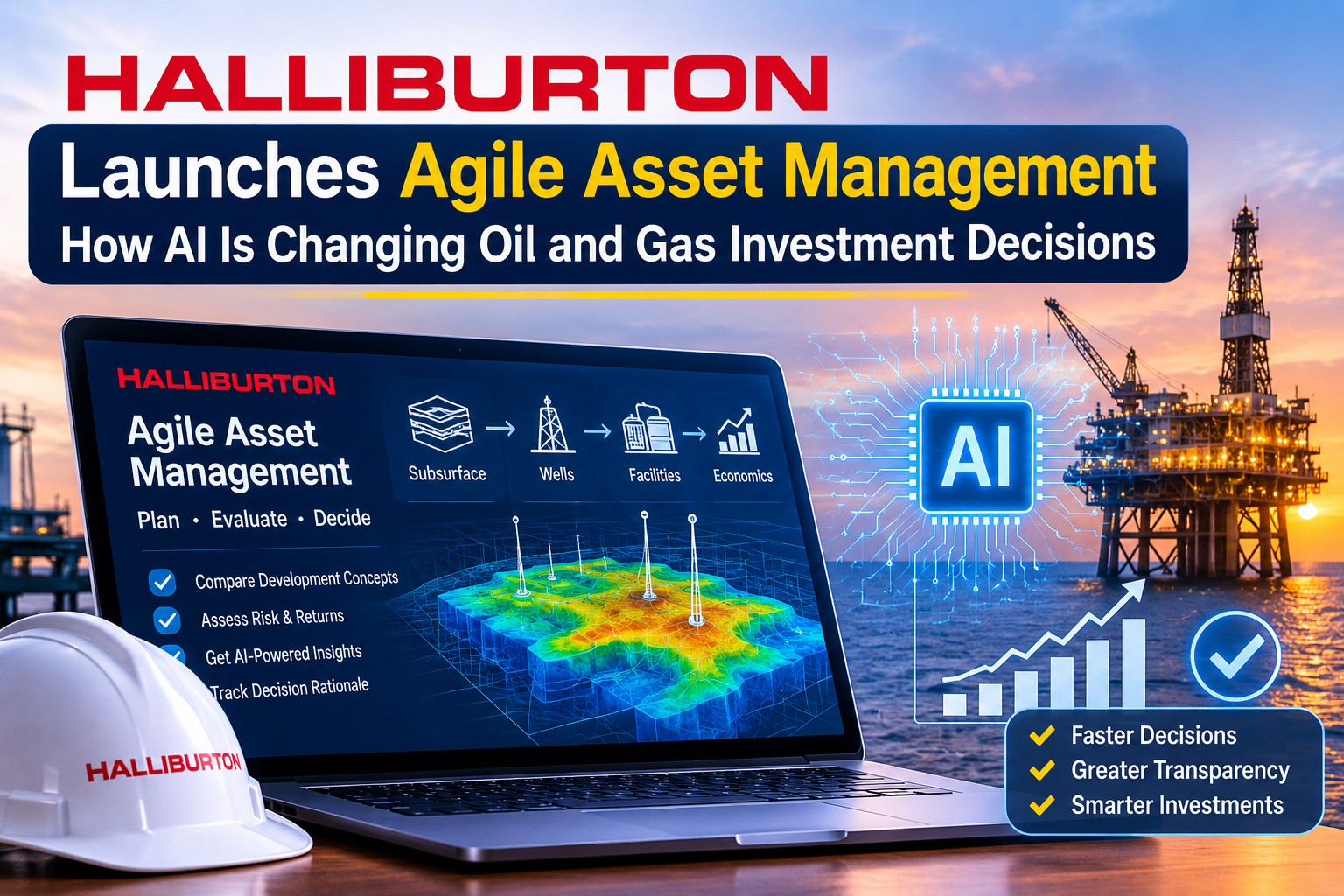
Agile Asset Management (AAM) is a cloud-based, AI-powered software solution from Halliburton’s Landmark business, introduced in early November 2026. It helps oil and gas companies test different field development concepts, measure each one against their own business targets, and pick the investment case that makes the most sense. It also keeps a clear record of why that choice was made.
Key Takeaways
- AAM is built for the earliest and most expensive stage of a project, when a company decides how to develop a field.
- It links subsurface, wells, facilities and economics in one shared workspace instead of separate teams and files.
- AI agents handle data retrieval, quality checks and user guidance, while engineers and managers keep the final say.
- Aker BP co-developed the platform and is already tied to its goal of reaching first oil faster.
- The launch fits a wider Halliburton push toward cloud-native, AI-supported software.
What Did Halliburton Actually Announce?
Halliburton introduced Agile Asset Management as a Landmark solution aimed at operators who need to decide where to put their capital. The software lets teams build and evaluate several development concepts side by side, then compare them against the metrics their own company cares about, such as returns, risk and timing.
The idea is simple. Before a company drills a single well or builds a platform, it must choose a plan. That choice locks in billions of dollars. AAM tries to make that choice faster, better documented and easier to defend.
The Problem AAM Is Trying to Solve
Field development planning has long been slow and fragmented. Geoscientists study the reservoir, drilling engineers design wells, facilities teams size the equipment, and finance teams model the economics. Each group often uses its own tools, its own data and its own assumptions.
That creates three familiar headaches:
- Handoffs take time. A change in one discipline can force others to redo their work.
- Fewer options get tested. When every scenario takes weeks, teams settle on a handful of ideas.
- Decisions are hard to trace. Months later, executives or partners may struggle to see which assumptions drove the final call.
AAM targets all three by putting the technical and commercial work into one connected environment.
How Agile Asset Management Works
One workspace across disciplines
According to Halliburton, AAM connects subsurface, wells, facilities and economic workflows. A team can adjust a concept and see the knock-on effects across disciplines earlier, rather than discovering them late in the process.
Agentic AI for the groundwork
The platform uses Halliburton’s own AI to link data and workflows. Agentic AI, meaning AI that carries out defined tasks on its own, supports three jobs: pulling data, checking its quality, and guiding users through the process. That removes a lot of routine effort, so experts can spend more time on analysis.
Comparing options against company goals
Rather than ranking ideas on engineering merit alone, teams can compare alternatives against their corporate metrics. This keeps technical work tied to what leadership actually wants to achieve.
A traceable record
Landmark’s senior vice president, Tony Antoun, stressed that management gets a clear trail showing the data and assumptions behind the preferred development case. For companies answering to boards, partners and regulators, that audit trail may be just as valuable as the speed.
People still decide
Halliburton is careful to say that scientific analysis and management judgment stay central. AAM supports the decision. It does not make it.
Why Aker BP’s Role Matters
Aker BP, the Norwegian oil and gas producer, helped co-develop the platform. Its senior vice president Tommy Sigmundstad described AAM as a key enabler of the company’s ambition to reach first oil sooner.
This matters because a tool built with a working operator is more likely to match real workflows than one designed in isolation. It also gives the launch a live reference customer, which is what buyers in this industry usually look for before adopting new software.
Why This Matters for the Wider Energy Industry
Capital discipline is the new priority
Oil and gas companies face pressure to spend carefully and show returns. A tool that tests more scenarios in less time helps them avoid weak projects early and back stronger ones with more confidence.
Speed from concept to decision
Every month of delay on a major project has a cost. Cutting the time between concept and investment decision can bring forward production and revenue.
Better teamwork
When geoscience, engineering and finance work from the same model, disagreements surface sooner and get resolved with shared data rather than competing spreadsheets.
A signal about AI in heavy industry
AI in energy is moving beyond monitoring equipment and optimizing wells. It is now entering boardroom-level questions about where to invest. That is a notable shift in how seriously the industry treats AI as a decision-support layer.
Part of a Bigger Digital Strategy
AAM does not stand alone. Halliburton has been expanding its Landmark software portfolio through acquisitions and partnerships. It bought Norway-based InformatiQ AS, which deepens AAM’s reach into well planning, regulatory documentation and logistics workflows. It also announced the purchase of Keystone AS, which adds AI-native well planning and rig execution tools. A collaboration with Shape Digital adds AI-driven operational intelligence for asset performance.
Taken together, these moves show a company building a connected chain of software from the first planning idea through to the rig and into production.
Risks and Questions to Watch
No new platform is a magic fix. Buyers and observers should keep a few points in mind:
- Data quality: AI outputs are only as reliable as the data feeding them. Companies with messy or siloed data may need cleanup first.
- Adoption: Teams used to their own tools must be willing to change habits.
- Proof in practice: Early results from Aker BP and other customers will show whether the speed and traceability promises hold up on real projects.
- Competition: Other oilfield service and software firms are also investing heavily in AI, so differentiation will matter.
What It Means for Investors and Industry Watchers
For people following the sector, this launch is one more sign that digital software is becoming a larger part of how oilfield service companies compete. It is a product announcement, not a financial result, so it should be read as strategy context rather than a prediction about the share price. This article is general information and not investment advice.
Conclusion
Halliburton’s Agile Asset Management is aimed at one of the most consequential moments in the oil and gas lifecycle: choosing how to develop a field. By joining technical and economic work in a single cloud environment, adding AI agents for the groundwork, and leaving final judgment to people, it promises faster and more transparent investment decisions.
Whether it delivers will depend on adoption, data quality and results from early users like Aker BP. Still, the launch shows where the industry is heading. AI is no longer just about running equipment better. It is becoming part of how energy companies decide where to put their money.
Frequently Asked Questions
It is an AI-powered, cloud-based solution from Halliburton’s Landmark business that helps oil and gas operators evaluate field development concepts and identify the best investment case.
Halliburton introduced it in early November 2026.
It is built for oil and gas operators and their multidisciplinary asset teams, including geoscientists, drilling and facilities engineers, and finance and planning staff.
It uses proprietary AI to connect data and workflows, and agentic AI to support data retrieval, quality checks and user guidance.
No. Halliburton says scientific analysis and management judgment remain central. The software supports people and does not replace them.
Aker BP co-developed Agile Asset Management with Halliburton.
