










Blog
AI Data Center Boom After the US Midterms: Why the Build-Out Faces a New Reality
5 November 2026
Quick Answer
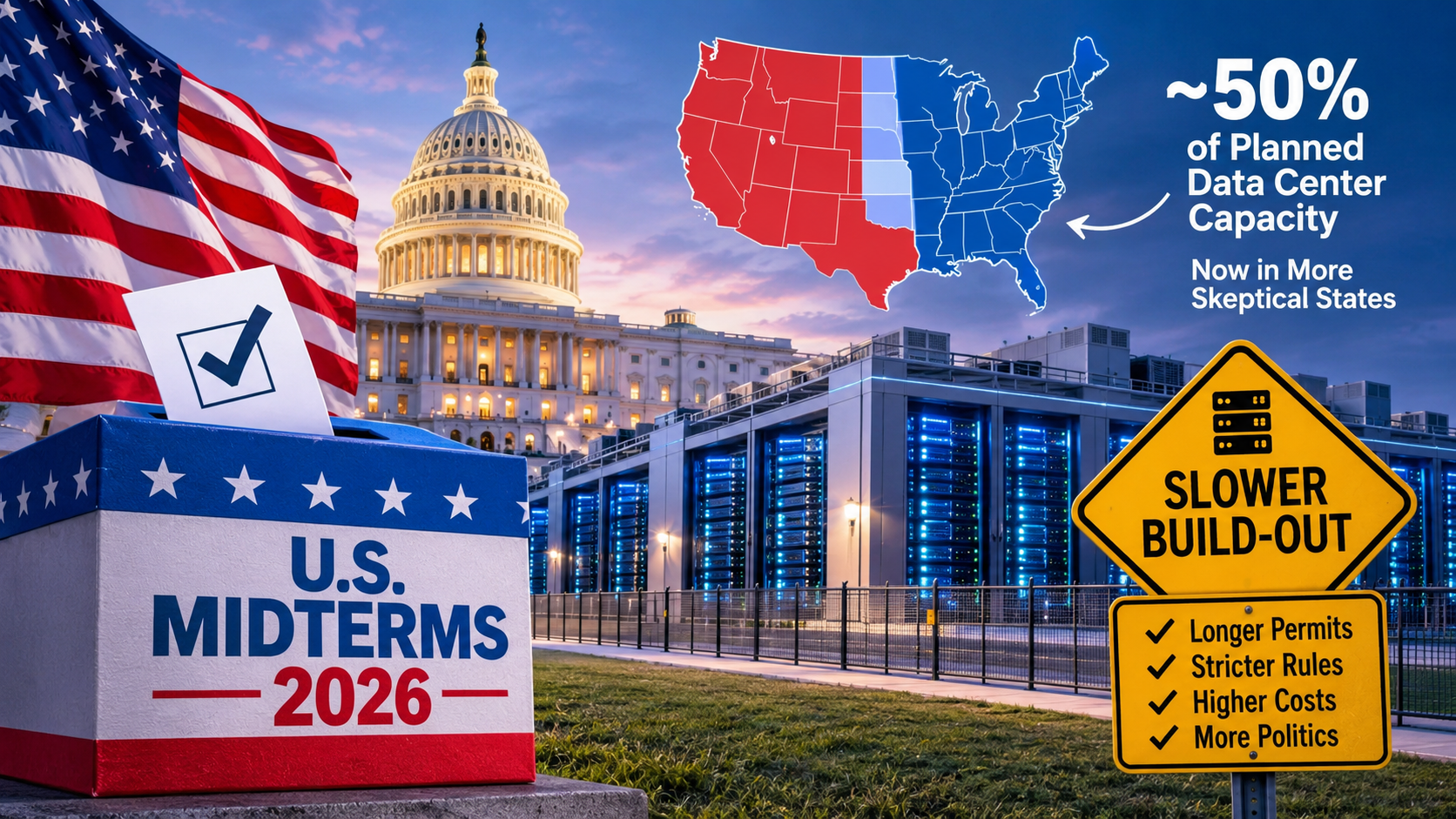
The US midterm elections have changed the politics of AI infrastructure. Democrats won both chambers of Congress and several governor’s races in states with big data center pipelines, including Texas, Georgia, Ohio and Pennsylvania. Bloomberg’s analysis suggests that around half of the planned US data center capacity now sits in places where local scrutiny, moratoriums and stricter rules are more likely. The boom is not over, but building will probably get slower, costlier and more political.
What Happened on Election Night
For two years, the AI story in America was about chips, models and money. This week it became a story about ballots.
Democrats took control of the House and the Senate, and they also won governorships in states that matter most for data center construction. Texas, a state long seen as the friendliest place in the country for large power-hungry projects, elected a Democratic governor and a Democratic senator. Wins in Georgia, Ohio and Pennsylvania added to the shift.
Many of these candidates campaigned on a simple message: data centers should not raise your electric bill or drain your local water supply. Voters in several places also backed local measures that pause or limit new projects. Reports after the vote describe dozens of such moratoriums being approved.
This matters because the people who won are the people who control permits, utility oversight and state incentives.
Why Half of Planned Capacity Is Now Exposed
Bloomberg’s key finding is a geographic one. The states where Democrats won governorships are the same states where developers have lined up the largest number of planned gigawatts. When you overlay the election map on the data center map, roughly half of proposed new capacity lands in states with a more sceptical executive.
That does not mean half the projects get cancelled. It means half the projects now face a higher chance of:
- Longer permitting timelines
- Stricter requirements on power sourcing and water use
- Local zoning fights and public hearings
- Calls to end or reduce tax breaks
- Conditions that force developers to pay more for grid upgrades
Each of these adds cost or delay. For a business that depends on building quickly to meet demand, delay alone can change the maths.
Why Voters Pushed Back
It would be a mistake to read this as an anti-technology vote. The strongest driver was affordability.
Households have watched power bills climb. Communities near large campuses have raised concerns about noise, land use, diesel backup generators and heavy water consumption for cooling. Many residents also noticed that these facilities employ relatively few people once construction ends, even though they receive large tax breaks.
In that context, a data center stopped looking like a symbol of progress and started looking like a neighbor that uses a lot and gives back little. Politicians picked up on this quickly.
It is also not purely partisan. Concern about data centers exists among Republican voters too, even if the opposition is stronger on the Democratic side. That is one reason analysts expect the debate to continue regardless of which party holds power in a particular statehouse.
How Markets Reacted
Investors did not wait for policy details. Shares of data center operators fell in early trading after the results, along with utilities and equipment suppliers tied to the boom. Several major chip and memory makers in Asia also slipped. At the same time, clean energy stocks rose, as traders bet that tougher rules on grid demand would push more power projects toward renewables and storage.
The reaction shows how much of the AI trade depends on the assumption that construction will keep accelerating. The build-out has been described as a multi-trillion-dollar effort, and any threat to its pace gets priced in fast.
Elon Musk responded in his usual style, joking online that data centers in space looked more attractive now. It was a quip, but it points at a real question: if land, power and politics on Earth get harder, where does compute go?
What the New Congress Can and Cannot Do
It is important not to overstate the immediate impact. Democrats do not have unlimited power. The White House has been a strong supporter of data center expansion, arguing that AI infrastructure is essential for American competitiveness. Federal legislation that restricts the industry would need to get past a president who holds the opposite view.
The real action is likely to be at the state and local level, where many of the decisions that matter are made anyway:
- Utility commissions decide who pays for new power lines and generation.
- State governments control tax incentives and environmental review.
- Counties and cities control zoning and building permits.
Congress can still hold hearings, ask tough questions and influence the conversation. But a governor with a clear position on data centers can change project timelines much faster than a bill in Washington.
What This Means for Big Tech
Companies like Nvidia, Microsoft, Amazon, Google and Meta have committed enormous budgets to AI infrastructure. Their plans assume steady access to land, electricity and water. The election raises a few practical issues for them.
Site selection gets harder. Developers will look more carefully at local politics before they buy land. A site that looked ideal six months ago might now carry political risk.
Power becomes the main constraint. Companies may need to bring their own generation, sign long-term clean power deals or fund grid upgrades to win approval. That raises capital needs.
Community deals matter more. Expect more promises on local jobs, water recycling, noise controls and ratepayer protection. Firms that engage early with communities will likely move faster than those that don’t.
Efficiency becomes a selling point. If every new campus has to justify its resource use, models and chips that deliver more output per watt gain a strategic advantage.
Who Could Benefit
Every disruption creates winners. Possible beneficiaries include:
- Renewable energy developers, as demand for clean, fast-to-build power grows.
- Energy storage companies, since batteries help data centers reduce strain on the grid.
- Developers in friendlier regions, including other US states and overseas markets that offer faster approvals.
- Efficiency-focused chip and software firms, which help customers do more with less power.
- Cooling and water-recycling technology providers, as environmental rules tighten.
Meanwhile, companies that rely on rapid expansion and cheap local power may see slower growth or higher costs.
What to Watch Next
Several signals will show how big the shift really is:
- Early moves by new governors. Executive orders, appointments to utility boards and statements on tax breaks will set the tone.
- New moratoriums and local votes. The number and spread of pauses will show whether this is a few headline cases or a wider pattern.
- Project announcements and cancellations. Watch whether developers relocate or delay planned campuses.
- Electricity price trends. If bills keep rising, political pressure will rise too.
- Federal-state conflict. A clash between a pro-expansion White House and sceptical statehouses could end up in court.
- Company earnings calls. Management comments on capital spending will reveal whether plans are changing.
How Businesses and Content Creators Should Read This
If you run a business that uses AI tools, this story is a reminder that the technology sits on top of physical infrastructure. Costs, outages and policy changes in the data center world can eventually reach cloud pricing and AI service availability. Teams that plan for flexible vendors and efficient usage will be better prepared than those that assume prices will only fall.
For analysts, marketers and publishers covering this topic, the angle that will matter most in the coming months is not “AI versus regulation.” It is the practical question of where the power will come from, who pays for it and which communities say yes.
Final Takeaway
The AI data center boom is not ending, but its easy phase may be over. For the past two years, the main questions were about chips and demand. After this election, the main questions are about power, water, politics and public consent. Companies that treat communities as partners, invest in efficiency and diversify where they build will be the best positioned for what comes next.
Frequently Asked Questions
Democratic victories in Congress and in governor’s races across Texas, Georgia, Ohio and Pennsylvania have raised the odds of tougher oversight. Analysis suggests about half of planned US data center capacity is now in states where stricter scrutiny is more likely.
No. A nationwide ban is very unlikely. The more probable outcome is a patchwork of local pauses, new conditions on power and water use, and slower approvals in some states.
The main concerns are rising electricity bills, heavy water use, noise, land use and the small number of permanent jobs compared with the tax breaks these projects often receive.
Texas, Georgia, Ohio and Pennsylvania stand out because they combine large planned capacity with newly elected Democratic governors.
Data center stocks, utilities and some chip makers fell after the results, while clean energy shares rose on expectations of a shift toward renewable and storage-based power.
Not on its own. The White House supports expansion, so major federal limits face a high bar. State and local governments have more direct control through permits, zoning, taxes and utility rules.
