










Blog
Apple Cuts Internal AI Budgets: Why Even Big Tech Is Rationing AI Spend
5 November 2026
Quick answer
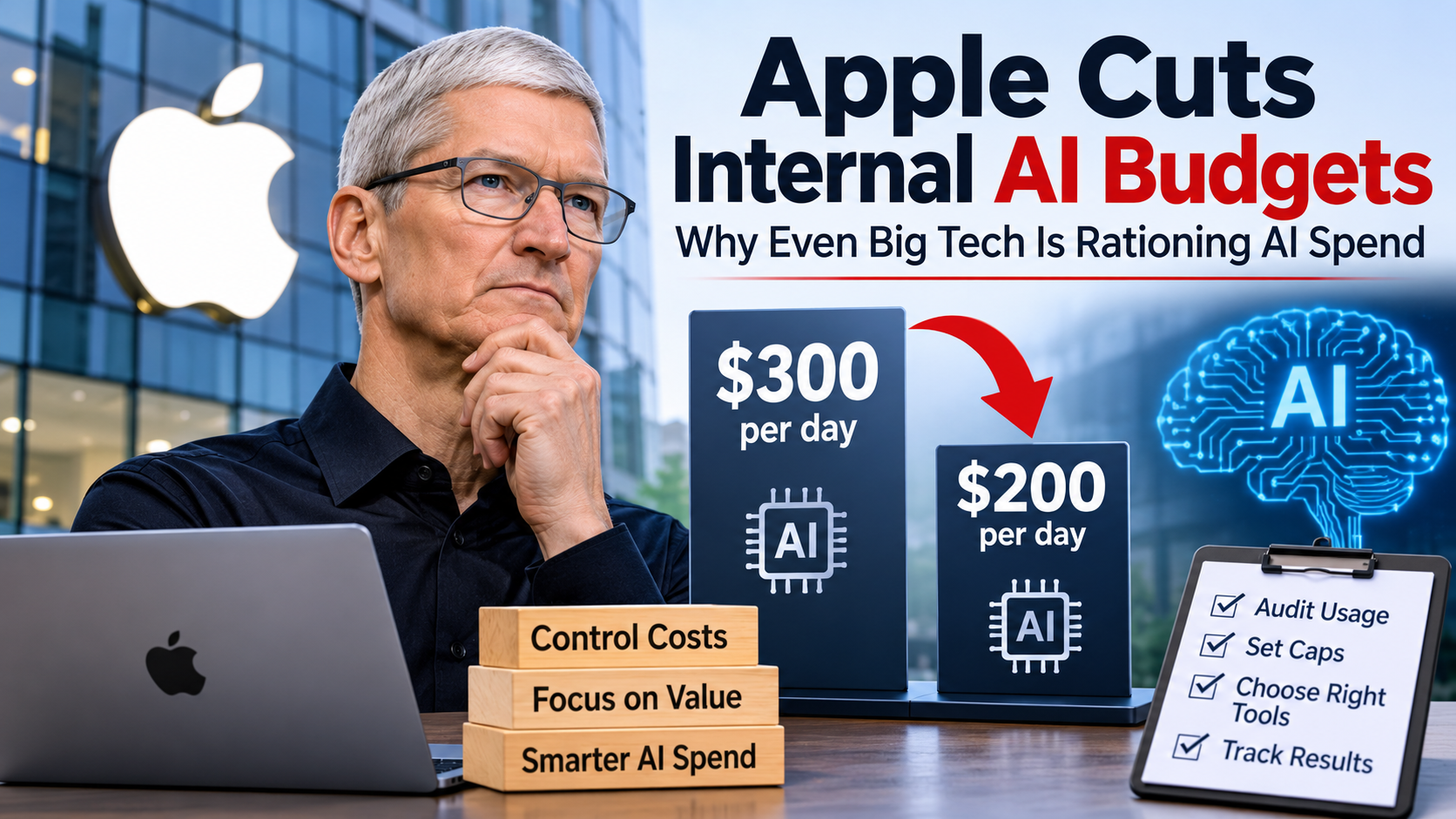
Apple has reportedly reduced the daily AI spending limit for some of its engineers from $300 to $200, according to a Bloomberg report published on November 4, 2026. Further cuts are said to be under consideration, with some teams possibly dropping to $100 a day or even lower. The move appears to be part of a wider cost-control push under CEO John Ternus. Apple has not publicly detailed the change, so the information rests on people familiar with the matter.
What Exactly Happened at Apple?
According to the report, Apple quietly lowered the daily amount some engineers can spend on AI models. The allowance, which previously sat at $300 per person per day, was trimmed to $200 last month. Coverage from several outlets adds that more reductions may follow, with certain engineering groups reportedly being looked at for caps near $100 and a few teams possibly as low as $25.
Two details make this story more interesting than a routine budget trim:
- The cut reportedly applies to only some engineers, not the whole company.
- Exceptions are said to be available for heavier users who can justify more usage.
So this is not a ban on AI tools. It is a ceiling on how much computing power each person can consume in a day.
Why Is Apple Reducing AI Spending?
Nobody at Apple has laid out an official explanation, but the context points to a few clear drivers.
1. A leaner-company mandate. Reports describe John Ternus, Apple’s new CEO, as pushing for a faster, more efficient organization. Trimming recurring operating costs is a natural step in that direction.
2. Rising R&D bills. Reporting around the story notes that Apple’s research and development costs climbed sharply, roughly a third higher year over year, as AI and infrastructure spending grew. When a cost line grows that fast, finance teams start asking tough questions.
3. Usage-based pricing adds up quickly. Most advanced AI models charge by the token, which means every prompt, every answer, and every automated coding step has a price tag. When thousands of engineers run AI assistants all day, even a small per-person cap becomes a very large number across the company.
4. A shift from experimentation to accountability. Earlier in 2026, there were reports that Apple encouraged teams to use AI heavily. Encouraging adoption is one phase. Proving that the spend produces results is the next one, and that is where budgets get reviewed.
Apple Is Not Alone in Tightening AI Costs
The same story shows up across the tech industry, which suggests this is a trend rather than a one-company quirk.
- Tesla is reported to have set a weekly AI spending limit of around $200 per employee.
- Microsoft has reportedly tightened its internal AI spending allowances.
- Uber has reportedly capped individual developer spending on AI coding tools at $1,500 per month.
Taken together, these reports show that large companies that adopted AI aggressively are now looking for guardrails. The early excitement is giving way to a more practical question: what is each dollar of AI usage actually returning?
A Quick Explainer: Why AI “Tokens” Become Expensive
If you run a business, a marketing team, or a content operation, this matters because the same economics apply to you at a smaller scale.
A token is a small chunk of text, roughly a short word or part of one. AI providers bill for the tokens you send in and the tokens the model sends back. Costs rise fastest when:
- Prompts include long documents or large codebases.
- Tasks run in loops, where an AI agent calls itself repeatedly.
- The most powerful (and most expensive) model is used for simple jobs.
- Many people on a team use AI at the same time without shared limits.
An engineer who uses an AI coding assistant heavily can burn through a surprising amount in a single day. That is how a $300 daily allowance can start to look like a serious line item once you multiply it by headcount and working days.
What This Means for Businesses and Marketing Teams
You do not need Apple’s scale to feel the same pressure. Here is how the story translates to everyday business decisions.
AI is now a cost center you must manage. Subscriptions are easy to ignore, but usage-based AI tools can quietly grow into a large monthly expense.
Output matters more than activity. Using AI more is not the goal. Producing better content, faster support, cleaner code, or higher conversions is the goal.
Tool sprawl is expensive. Paying for several overlapping AI platforms is one of the easiest places to waste money.
Governance is becoming normal. Spending caps, approved-tool lists, and usage dashboards are turning into standard practice, not signs of distrust.
How to Control AI Spend Without Killing Productivity
Apple’s move offers a useful template. Here is a practical approach any team can adopt.
- Audit current usage. List every AI tool, who uses it, and what it costs per month. You will almost always find duplicates.
- Match the model to the task. Use lighter, cheaper models for drafting, summarizing, and formatting. Save the premium models for complex reasoning.
- Set sensible caps with an exception process. A daily or monthly limit per person keeps costs predictable, and a simple approval path for heavy projects prevents frustration.
- Write tighter prompts. Shorter, clearer instructions and smaller inputs reduce token use and often improve results.
- Reuse and cache. Save good outputs, templates, and prompt libraries so people do not pay to regenerate the same thing.
- Track return, not just spend. Tie AI usage to measurable outcomes such as hours saved, tickets resolved, or content shipped.
- Review monthly. Prices, models, and needs change quickly, so a quarterly check is usually too slow.
Does a Budget Cut Mean Apple Is Backing Away From AI?
Probably not. Reporting around this story also notes that Apple has been pushing employees toward wider AI use. The more likely reading is that Apple wants disciplined adoption: keep using AI, but stop treating consumption itself as a success metric.
There is also a workforce angle. Some coverage links the budget cuts to employee worries about possible layoffs under new leadership. That connection is speculation rather than confirmed fact, and readers should treat it that way until there is clear information from the company.
What to Watch Next
- Whether the lower caps spread to more teams, and how low they go.
- Whether other big tech firms announce or leak similar limits.
- How AI vendors respond, for example with cheaper tiers, enterprise discounts, or more efficient models.
- Any official statement from Apple, which would confirm or correct the details in the current reports.
The Bottom Line
Apple’s reported decision to lower some engineers’ daily AI cap from $300 to $200 is a small number with a big message. The industry is moving from “use as much AI as possible” to “use AI where it pays off.” For businesses of every size, the lesson is the same: measure your AI usage, match tools to tasks, and treat AI spending like any other investment that has to earn its place.
Frequently Asked Questions
According to a Bloomberg report that other outlets have echoed, yes. Apple reportedly lowered the daily AI spending cap for some engineers from $300 to $200 last month. The report relies on anonymous sources, and Apple has not issued a detailed public statement.
Reports say further reductions are being considered. Some engineering teams could see limits near $100 per day, and a few may be looked at for even lower amounts such as $25.
AI models are usually billed by usage, so costs rise with every prompt and automated task. As adoption grows, companies want predictable spending and proof that the usage delivers value.
Reports mention Tesla with a weekly cap of around $200 per employee, Microsoft tightening internal AI allowances, and Uber limiting individual developers’ AI coding spend to about $1,500 a month.
Not necessarily. Capping spend is different from abandoning the technology. Companies are still investing in AI, but they are adding cost discipline and asking for measurable results.
Start with a usage audit, remove overlapping tools, pick cheaper models for routine work, write concise prompts, and review spending and results every month.
A token is a small unit of text that AI models read and generate. Providers charge based on the number of tokens processed, which is why long prompts and repeated automated tasks cost more.
