









Blog
AI Search Is a Brand Channel: Why Being Named Matters More Than Being Ranked
27 October 2026
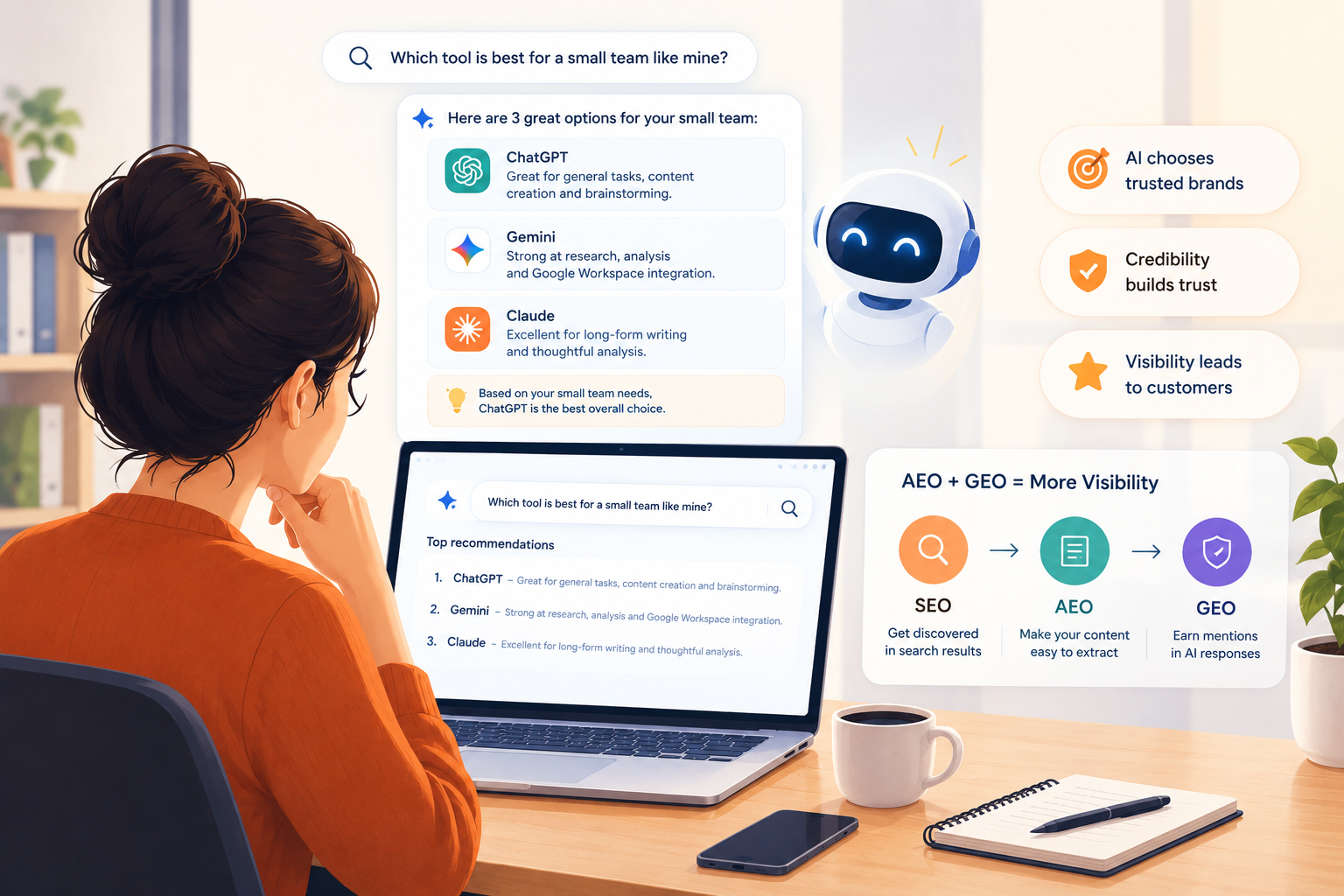
Imagine a buyer typing one question into an AI assistant: “Which tool is best for a small team like mine?”
Within seconds, they get a tidy answer with three names, one line about each, and a clear suggestion. They don’t scroll through ten blue links or open your website. They pick one of those three names and move on.
If your brand was one of the three, you just won a customer you never saw. If it wasn’t, you lost one the same way, and no analytics report will tell you.
AI search is a brand channel: it decides which brands people see, trust, and choose before any click happens. For years, search was treated as a traffic tool. Today it also works as a reputation system, because AI tools read the web, form a picture of each brand, and repeat that picture to users.
Two practices matter most here:
- AEO (Answer Engine Optimization): shaping content so search features and AI assistants can lift a clear, correct answer from it.
- GEO (Generative Engine Optimization): shaping your brand’s presence across the web so generative AI tools mention and recommend you.
This guide explains how AI systems choose brands, where businesses lose visibility without noticing, and how to build a practical AEO and GEO plan.
Key Takeaways
- AI answers shrink the list of options, so being named beats being ranked.
- AI tools trust consistent, well-corroborated brands, not just keyword-optimized pages.
- AEO makes your content easy to extract. GEO makes your brand easy to trust and cite.
- Measure mentions and accuracy in AI answers alongside rankings and clicks.
Why Is Search Now a Brand Channel?
Search is a brand channel because AI summaries present a few trusted names instead of a long list, so familiarity and credibility decide who gets chosen.
Search has always shaped brand perception, since people judge a business by what appears when they look it up. Generative AI makes this obvious. The answer itself now carries the brand message, with a short description, a comparison, and often a recommendation.
Industry reports suggest that a large share of searches already end without a click, and that AI summaries can reduce click-through rates for some publishers. Google has also said AI features increase the number of queries people make. The combined effect is that users search more, read more answers, and visit fewer pages. Your influence now happens inside the answer, not only on your website.
(Verify the latest statistics from original sources before publishing, since these numbers change quickly.)
What Is the Difference Between SEO, AEO, and GEO?
SEO ranks pages, AEO packages answers, and GEO earns mentions in generative AI responses.
| Term | Full Form | Main Goal | Core Tactic |
| SEO | Search Engine Optimization | Rank pages in search results | Relevance, links, technical health |
| AEO | Answer Engine Optimization | Be the extracted answer | Question headings, direct answers, schema |
| GEO | Generative Engine Optimization | Be cited or recommended by AI | Entity clarity, authority, third-party mentions |
These three work as a stack. SEO gets you discovered, AEO makes your content usable, and GEO makes your brand trusted enough to name.
How Do AI Search Engines Decide Which Brands to Mention?
AI search engines interpret the question, gather candidate sources, rank them for relevance and trust, and then write an answer from the most credible information. Four factors drive this process.
- Query fan-out. One question is expanded into several related searches covering features, price, comparisons, and problems. Google has described this approach for AI Overviews and AI Mode. A page that covers only one narrow keyword misses most of these hidden sub-questions.
- Entity understanding. AI systems map companies, people, products, and places as entities with relationships. Your brand is an entity, and clarity about what it is improves your chances of being recommended.
- Retrieval and ranking. Being retrieved only places you in the candidate pool. Ranking decides which sources actually shape the final answer.
- Corroboration. A claim on your own site is a claim. The same claim confirmed by reviews, publications, directories, and community discussions becomes a pattern, and AI systems favor patterns.
What Is the Brand Identity Gap?
A brand identity gap is the mismatch between how your brand describes itself and how the wider web describes it. AI systems read both, and conflicting signals lower their confidence.
Common causes include:
- Different category labels on your website, directories, and social profiles
- Old brand or product names still appearing in third-party articles
- Inconsistent founder, team, or location details
- Outdated reviews and listings
How to close the gap: write one clear definition of your brand, audit every profile and listing, fix mismatches, and update high-authority third-party pages first. This is unglamorous work, yet it is often one of the highest-return GEO activities.
How Do You Optimize Content for AEO?
Optimize for AEO by leading with direct answers, using question-style headings, and structuring information so machines can extract it cleanly.
Use this checklist:
- Place a 40 to 60 word answer directly under each question heading, then expand.
- Write headings as natural-language questions that mirror how people ask.
- Define each key term in one clear sentence.
- Prefer lists, tables, and short paragraphs over dense blocks.
- Add an FAQ section for follow-up questions.
- Implement FAQPage, Article, and Organization schema.
- Show author, publish date, and update date to support trust.
- Keep pages fast, secure, and crawlable, because technical quality supports both user trust and machine processing.
How Do You Optimize Content for GEO?
Optimize for GEO by making your brand a well-defined, consistently described, and widely corroborated entity. Generative engines prefer information they can verify across sources.
- Define your entity. State what you do, who you serve, and where you operate in plain, repeatable language.
- Be quotable. Write self-contained statements, original definitions, and clear data points that an AI can reuse accurately.
- Publish original value. First-hand experience, case studies, benchmarks, and frameworks give AI something distinctive to cite.
- Earn third-party mentions. Reviews, expert quotes, interviews, industry publications, and community discussions all act as corroboration.
- Attribute facts. Link to credible sources for statistics and claims.
- Stay consistent. Use the same brand name, description, and key facts everywhere.
- Keep content fresh. Update important pages so outdated facts do not spread.
Which Topics Should Brands Cover for AI Search?
Brands should cover the full question landscape around their core subject, not just one primary keyword. Because of query fan-out, one prompt can trigger searches on many sub-topics, and some of these show low or zero volume in keyword tools yet still influence AI answers.
Build content clusters around these question types:
- Definition: What is it?
- Process: How does it work?
- Comparison: X vs Y, alternatives, best for specific needs
- Cost and value: Pricing, return on investment, is it worth it
- Problems: Common errors, risks, mistakes
- Decision: How to choose, what to check first
Depth across a topic beats a single page chasing a single phrase.
How Do You Measure AEO and GEO Success?
Measure AEO and GEO by tracking how often and how accurately your brand appears in AI answers, alongside traditional search metrics.
| Metric | What It Shows |
| AI mention rate | How often your brand appears for target questions |
| Citation presence | Whether your pages are linked as sources |
| Description accuracy | Whether AI describes your brand correctly |
| Competitor co-mentions | Which brands appear beside yours |
| Branded search trend | Growing awareness after AI exposure |
| AI referral traffic | Visits arriving from AI platforms |
| Snippet and AI Overview inclusion | AEO extraction success |
A simple method: list 20 to 30 questions your customers ask, run them monthly across major AI tools, and record whether you appear, how you are described, and who else is named.
What Mistakes Should You Avoid?
Avoid manipulation, thin content, inconsistency, and neglecting SEO basics.
- Mass-producing generic AI-written pages with no original insight
- Using hidden text or tricks aimed at AI systems
- Letting brand information drift across platforms
- Ignoring factual errors that AI tools repeat about you
- Dropping technical SEO because “AI replaces search”
Being indexed does not guarantee a place in AI answers, but not being indexed almost guarantees absence.
What Is a Simple 30-Day AEO and GEO Plan?
A 30-day plan can cover audit, rewrite, expansion, and outreach.
- Week 1: Audit how your brand is described on your site, profiles, and directories. List every inconsistency.
- Week 2: Rewrite key pages with direct answers, question headings, and FAQ blocks. Add schema markup.
- Week 3: Publish two or three articles that fill gaps in your topic coverage.
- Week 4: Request reviews, pitch expert commentary, join relevant discussions, and run your first AI visibility baseline.
Conclusion
The old question was, “How do we rank for this keyword?” The new question is, “When someone asks an AI about our category, will it understand who we are, trust what it knows, and say our name?”
That is a branding question as much as an SEO one. Brands that combine AEO, with answer-ready structure, and GEO, with consistent identity and trusted third-party signals, will keep appearing where decisions are made. The rest will be summarized out of the conversation.
Frequently Asked Questions
AEO, or Answer Engine Optimization, means writing and structuring content so search features and AI assistants can pull a clear, direct answer from it.
GEO, or Generative Engine Optimization, means improving the chances that AI tools mention, cite, or recommend your brand in their generated answers.
No. AEO and GEO build on SEO. Crawlability, relevance, quality content, and authority remain the foundation for all three.
Define your brand clearly, keep information consistent across the web, publish answer-first content with schema, and earn reviews and mentions from credible third-party sources.
Query fan-out is when an AI system breaks one user question into several related sub-queries to collect broader information before writing an answer.
An entity is a distinct, identifiable thing such as a company, person, product, or place. AI systems use entities and their relationships to understand context and decide what to recommend.
Conflicting details reduce an AI system’s confidence in who you are and what you offer. Consistent information across sources strengthens trust and the likelihood of being recommended.
FAQ schema helps machines read your questions and answers clearly. It supports answer extraction, though actual visibility depends on content quality, relevance, and search engine policies.
Ask major AI assistants the questions your customers ask, record whether your brand appears and how it is described, and repeat the check every month.
Yes. A clearly defined niche, helpful answer-first content, and genuine customer reviews can make a smaller brand the most relevant answer for specific questions.
