










Blog
Gemini 4 Neon: Google’s Mid-Tier AI Model Takes On Claude Opus 5.5 and GPT-6.2 Sol
19 November 2026
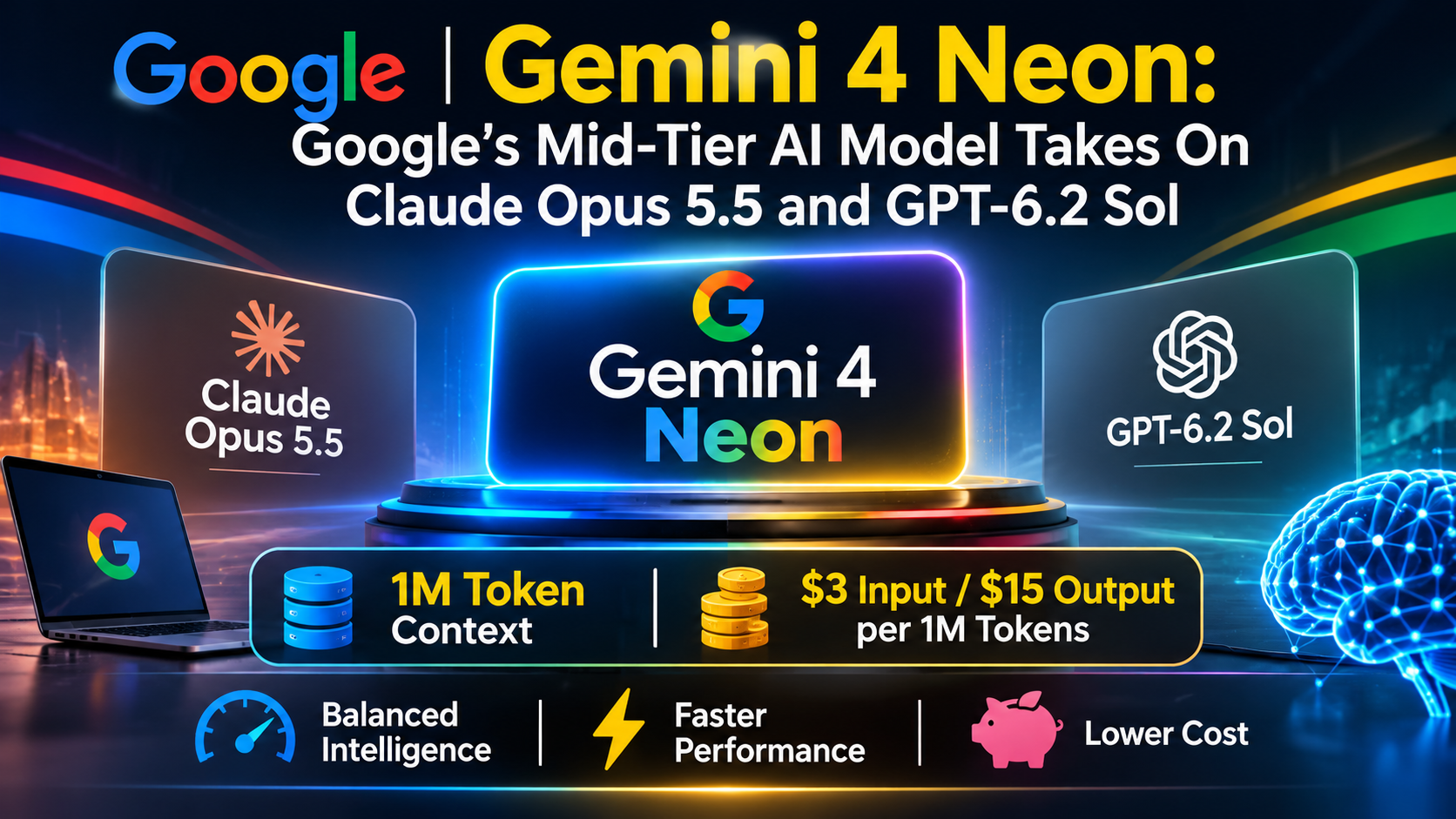
Gemini 4 Neon is a mid-tier AI model from Google, released on November 18, 2026. Google says it delivers near-frontier intelligence for coding, research and everyday knowledge work at a much lower cost per task than the largest models. It costs $3 per million input tokens and $15 per million output tokens, and it supports a 1 million token context window.
What Is Gemini 4 Neon?
Gemini 4 Neon is a new artificial intelligence model in Google’s Gemini 4 family. Google positions it as the balanced option: smart enough for complex coding, science and professional work, but quicker and cheaper than the heaviest models in the lineup.
The Gemini 4 range now has three main models, and the naming can be confusing:
- Gemini 4 Carbon: reserved for the hardest, long-running projects.
- Gemini 4 Neon: the middle option, built for deeper analysis without long waits.
- Gemini 4 Hydrogen: the faster, everyday model for quick help.
In short, Neon sits between the most powerful model and the fastest one. If Carbon is the specialist and Hydrogen is the quick assistant, Neon is the all-rounder.
Who Can Use Gemini 4 Neon Right Now?
Google is rolling Neon out across several products at once. Here is where it appears:
- Gemini app: available to Google AI Pro and Google AI Ultra subscribers. In the model picker it now replaces Argon under the “Deeper analysis” heading, while Hydrogen stays under “Everyday help.”
- Gemini API: available in the paid tier through Google AI Studio and Android Studio.
- Google Antigravity: available to Pro and Ultra subscribers.
- Gemini for business: included for organisations using Google’s workplace offering.
- Vertex AI: listed for verified enterprise customers in the global, US and EU regions.
Free users should not expect to see it in the model menu yet, since the app rollout is tied to the paid plans.
Gemini 4 Neon Pricing and Technical Specs
For developers and businesses, the numbers matter as much as the headlines. Here is the core spec sheet:
| Feature | Details |
| Input price | $3 per million tokens |
| Output price | $15 per million tokens |
| Cached input price | $0.15 per million tokens |
| Context window | 1 million tokens |
| Thinking levels | Four, with “high” as the default |
The cached input rate is worth noticing. If your application sends the same long instructions or documents repeatedly, caching can cut the input bill sharply. The four thinking levels also let you trade depth for speed: lower settings answer quicker, while higher ones reason for longer.
How Does Gemini 4 Neon Compare With Claude Opus 5.5 and GPT-6.2 Sol?
This is the question most readers want answered. According to Google’s own comparison, Neon beats both rivals on the Artificial Analysis Intelligence Index, a widely watched composite score.
| Model | Artificial Analysis Intelligence Index |
| Gemini 4 Neon | 61 |
| Claude Opus 5.5 | 59 |
| GPT-6.2 Sol | 57 |
Google also states that a score of 61 puts Neon in third place overall, behind the larger and slower models in the market. It leads in two other tests as well, scoring 70.9% on the Vals Index and 56.3% on AutomationBench.
But Neon does not win everywhere. Google’s own table shows it trailing Claude Opus 5.5 on Terminal-Bench 4.1 and FrontierCode 2.0, two coding-focused tests. It also trails GPT-6.2 Sol on Chartography. So the honest summary is that Neon leads on broad intelligence and automation scores, while Opus 5.5 keeps an edge in some coding tasks and Sol keeps an edge in chart reading.
Important caveat: these are Google’s own published results. Independent testing may produce different rankings, so treat the table as a starting point rather than the final word.
Is Gemini 4 Neon Cheaper Than Other Frontier Models?
Cost is where Google is making its strongest argument. At its default “high” thinking level, Neon performs roughly on par with Carbon on the same intelligence index, but Google says it does so at a 32% lower cost per task. Against the leading frontier models, Google claims Neon costs 50% to 80% less per task.
Notice the wording: the comparison is per task, not per token. Some models use more tokens to finish a job, so cost per task is often a fairer measure than the price list alone. Even so, you should test your own workloads before assuming the same savings will apply to you.
What Can Gemini 4 Neon Do in Everyday Use?
Google describes Neon as useful for writing, research and the messy day-to-day jobs that eat up time, such as reading through a stack of receipts or checking a utility bill. It can handle spreadsheets, PDFs, charts, audio and video together inside a single prompt, so you do not need to switch tools for each file type.
Inside the Gemini app, Neon also works with Gemini’s Tasks feature and can draw context from Gmail and Docs. Google says this gives it a more personal, connected experience than you get from heavier models like Carbon. That link to your own email and documents is a big part of the pitch for everyday users.
What Is Orchestrator Mode in Google Antigravity?
Developers using Google Antigravity get an extra feature called Orchestrator mode. It pairs Neon’s planning ability with Hydrogen’s fast execution. In simple terms, one model decides what to do and another carries out the steps quickly. This split approach can save both time and money on larger coding projects, because the expensive reasoning is used only where it is needed.
Why Does Gemini 4 Neon Matter?
The AI market has spent the last few years chasing bigger and more expensive models. Neon reflects a different trend: making “good enough for most serious work” cheaper and faster. For many teams, the best model is not the one with the highest absolute score, but the one that delivers solid results without a huge bill or long delays.
That shift has real consequences:
- For developers: lower per-task costs make it more realistic to build AI features into products at scale.
- For businesses: a mid-tier model that approaches top-tier quality can handle routine analysis, drafting and automation without premium pricing.
- For everyday users: paid Gemini subscribers get stronger reasoning for research and writing without waiting on the slowest model.
- For the competition: Anthropic and OpenAI now face pressure to defend their own mid-to-high tier pricing and performance.
Google’s own head of developer relations, Logan Kilpatrick, summed up the launch by saying Neon feels like the right balance of intelligence, speed and usability, and that it performs well above its class. That is a promotional view, of course, but it captures the positioning clearly.
Should You Switch to Gemini 4 Neon?
The answer depends on what you do:
- Choose Neon if you want strong reasoning at a lower cost, work with mixed file types, or already live inside Gmail, Docs and Google’s developer tools.
- Consider Claude Opus 5.5 if your priority is terminal-based or advanced coding work, where it scored higher in Google’s own comparison.
- Consider GPT-6.2 Sol if chart interpretation is central to your workflow.
- Choose Carbon if you face the most difficult long-horizon projects and cost is secondary.
- Choose Hydrogen if you just need fast answers for simple tasks.
The practical advice is to run a small test with your real prompts and documents. Benchmarks are useful, but your own data will tell you more than any leaderboard.
Final Thoughts
Gemini 4 Neon is Google’s attempt to prove that you do not need the most expensive model to get near-frontier results. If Google’s numbers hold up under independent testing, it could become a popular default for developers and paying Gemini users alike. Until then, the smart move is to compare it against Claude Opus 5.5 and GPT-6.2 Sol using your own real-world tasks, and pick the model that gives you the best result for the price.
Frequently Asked Questions
Gemini 4 Neon is a mid-tier AI model from Google, launched on November 18, 2026. It is designed for complex coding, knowledge work and science tasks, with faster responses and lower costs than Google’s largest model.
Through the paid Gemini API, it costs $3 per million input tokens and $15 per million output tokens. Cached input is priced at $0.15 per million tokens.
It supports a context window of 1 million tokens, which allows very long documents, large codebases or lengthy conversations in a single request.
On Google’s own comparison, Neon scores higher on the Artificial Analysis Intelligence Index (61 versus 59). However, Opus 5.5 scored higher on Terminal-Bench 4.1 and FrontierCode 2.0. Neither model is better at everything, and independent tests may differ.
Google reports Neon ahead on the main intelligence index (61 versus 57), but GPT-6.2 Sol is ahead on Chartography. The better choice depends on your task.
No. In the Gemini app it is available to Google AI Pro and Ultra subscribers, and API access is on the paid tier.
Carbon handles the hardest long-running projects, Neon offers a balance of intelligence and speed, and Hydrogen is the faster model for everyday help.
It has four thinking levels, and “high” is the default setting.
