











Blog
Search Everywhere Optimization: How to Get Your Brand Discovered Across AI Platforms
23 November 2026
Your customers no longer start every search on Google. A buyer in Toronto might ask ChatGPT for the best accounting software, check TikTok for reviews, scan Reddit for honest opinions, and then finish with a Google search. If your brand shows up in only one of those places, you are missing most of the journey.
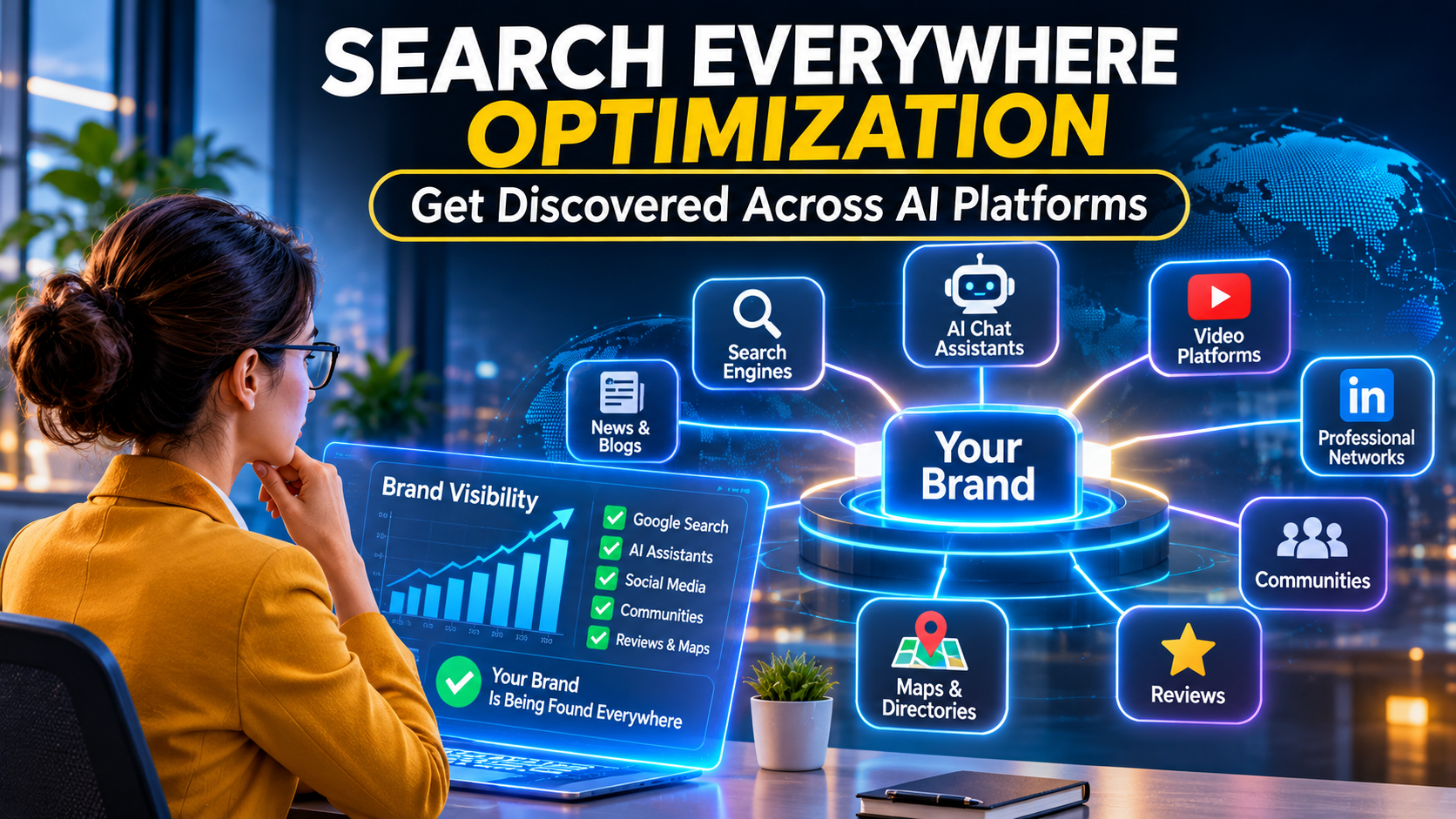
This shift is why Search Everywhere Optimization (SEvO) has become one of the most important ideas in digital marketing. It means making your brand visible, trusted and easy to cite on every platform where people look for answers, including AI assistants.
What Is Search Everywhere Optimization?
Search Everywhere Optimization is the practice of optimizing your brand’s presence across all discovery channels, not just traditional search engines. These channels include:
- Google Search and Google AI Overviews
- AI chat platforms such as ChatGPT, Gemini, Claude, Perplexity and Copilot
- Social platforms such as YouTube, LinkedIn, Instagram, TikTok and Facebook
- Community platforms such as Reddit and Quora
- Review sites, maps and local directories
Traditional SEO is still the foundation. But SEvO builds on it by asking a bigger question: wherever your customer asks, does your brand appear, and is it described accurately?
Why Brand Discovery Is Changing
Three shifts are driving this change.
1. Answers are replacing links. AI platforms summarize information and often cite only a handful of sources. If you are not one of them, you may not appear at all, even if you rank well in classic search.
2. People search in conversations. Instead of typing “SEO company Toronto,” users now ask, “Which SEO agency in Canada is best for a small ecommerce brand?” These longer, natural questions favour content that is clear, direct and well structured.
3. Trust is built across platforms. AI systems pull signals from many places: your website, reviews, social profiles, press mentions and community discussions. A consistent brand story across these sources makes you easier to recommend.
AEO and GEO: The Two Pillars of AI Discovery
To win in this environment, you need two disciplines working together.
Answer Engine Optimization (AEO)
AEO focuses on structuring your content so that search engines and assistants can pull direct answers from it. Think featured snippets, voice answers and AI summaries. AEO rewards content that:
- Answers a specific question in the first one or two sentences
- Uses clear headings phrased as questions
- Includes short lists, tables and step-by-step formats
- Uses FAQ sections and schema markup
Generative Engine Optimization (GEO)
GEO focuses on making your brand more likely to be mentioned, cited and recommended inside AI-generated responses. Generative models draw on authoritative, well-supported and consistent information. GEO rewards:
- Original insights, data and expert opinions
- Clear entity information (who you are, what you do, where you operate)
- Mentions and backlinks from credible third-party sites
- Fresh, regularly updated content
AEO helps you get picked as the answer. GEO helps AI models trust and name your brand. You need both.
A Practical Framework for Search Everywhere Optimization
Here is a step-by-step approach any business can follow.
Step 1: Define your brand entity clearly
AI models need to understand exactly who you are. Make sure your business name, services, location, founders and areas of expertise are described consistently on your website, Google Business Profile, LinkedIn and every directory listing. Add Organization, LocalBusiness and Service schema to your key pages. Inconsistent details confuse both search engines and language models.
Step 2: Build question-led content
Start with the questions your customers actually ask. Use sales calls, support emails, “People Also Ask” boxes and AI platforms themselves to collect them. Then create pages that answer each question directly, with a short answer first and deeper explanation afterwards. This format suits both AEO and GEO.
Step 3: Strengthen topical authority
Instead of publishing random posts, build content clusters around your core services. For example, a pillar page on SEO supported by articles on local SEO, technical SEO, AI search and link building. Connect them with internal links so that both users and crawlers see the relationships between topics.
Step 4: Show real expertise and experience
AI systems favour content that demonstrates first-hand knowledge. Include case studies, original data, named authors with credentials, and clear opinions. Generic, copied or thin content is unlikely to be cited anywhere.
Step 5: Earn mentions beyond your own site
Brand mentions on trusted websites, industry publications, podcasts and community forums act as strong trust signals. Contribute expert comments, publish guest articles, join relevant Reddit and Quora discussions honestly, and encourage genuine customer reviews. Unlinked mentions matter too, because language models learn from text, not just links.
Step 6: Repurpose content for each platform
One idea can become a blog post, a LinkedIn carousel, a YouTube short, a podcast clip and a Quora answer. Each format reaches a different audience and creates another place for AI platforms to find your expertise. Keep the core message consistent while adapting the style to the channel.
Step 7: Optimize technical foundations
None of this works if your site is slow or hard to crawl. Keep pages fast and mobile friendly, use clean site architecture, fix broken links, maintain an XML sitemap, and make sure important content is not hidden behind scripts that crawlers cannot read. Check that you are not accidentally blocking legitimate AI crawlers in your robots.txt if you want visibility in those platforms.
Step 8: Measure visibility beyond rankings
Rankings alone no longer tell the full story. Track:
- Branded search volume and direct traffic
- Referral traffic from AI platforms
- How often your brand is mentioned in AI responses to your target questions
- Share of voice against competitors
- Leads and conversions from all discovery channels
Test your priority questions monthly across ChatGPT, Gemini, Perplexity and Google AI Overviews, and record whether you are cited, how you are described, and who appears alongside you.
Why Canadian Businesses Need to Act Now
Canadian markets add extra layers: bilingual audiences in English and French, strong local intent (think “near me” searches in cities like Vancouver, Calgary, Toronto and Montreal), and competition from large US brands that dominate global AI answers. Businesses that localize their content, keep Canadian listings accurate and publish region-specific expertise have a real chance to stand out.
This is where the right partner makes a difference. A specialist seo marketing agency in Canada understands both the fundamentals of search and the local nuances that influence discovery, from provincial service pages to Canadian review platforms. Meanwhile, an ai digital marketing agency Canada brands can trust will blend technical SEO, content strategy, AEO, GEO and social visibility into one connected plan instead of treating each channel separately.
If you want to see how an integrated approach works in practice, explore the digital marketing services in Canada offered by Maninder Wave, where SEO, AI search optimization and performance marketing are built to work together.
Common Mistakes to Avoid
- Chasing only Google rankings. Strong rankings do not guarantee AI visibility.
- Publishing AI-generated content without editing. Unoriginal text rarely earns citations.
- Ignoring brand consistency. Different descriptions on different platforms weaken trust.
- Skipping structured data. Schema helps machines understand your content.
- Never updating old content. Outdated pages lose credibility with both users and AI systems.
- Treating social media as separate from SEO. Social proof and search visibility now feed each other.
Final Thoughts
Discovery is no longer a single-platform game. Customers move between search engines, AI assistants, videos, forums and reviews, and they expect consistent, trustworthy answers everywhere. Brands that invest in Search Everywhere Optimization, supported by strong AEO and GEO practices, will be the ones that get recommended while competitors stay invisible.
Start by clarifying your brand entity, answering your customers’ real questions, earning mentions beyond your website, and measuring visibility across every platform. The sooner you build that presence, the stronger your position will be as AI search continues to grow.
Frequently Asked Questions
Search Everywhere Optimization is a strategy for making your brand discoverable on every platform customers use to find information, including Google, AI assistants, social networks, forums and review sites.
Traditional SEO focuses mainly on ranking in search engines. SEvO includes SEO but extends to AI platforms, social search and community channels, aiming for visibility and trust across the entire customer journey.
AEO structures content so it can be pulled as a direct answer in snippets, voice results and AI summaries. GEO increases the chance that AI models mention and cite your brand inside generated responses.
Yes. Clear, helpful, locally relevant content with consistent business information and genuine reviews can earn citations even without a huge budget.
Technical and content fixes can show early movement in weeks, but building authority and consistent brand mentions across platforms usually takes three to six months or more.
Not necessarily, but an experienced agency saves time and avoids costly mistakes, especially when coordinating SEO, content, social and AI visibility together.
