











BlogSEO
SEO in 2026: The Impact of Query Expansion on Organic Search Visibility
17 July 2026
SEO has moved far beyond stuffing a page with a single keyword and hoping for the best. Modern search engines interpret entire concepts, not isolated words, and this shift has changed how businesses need to think about ranking. One of the most important and least understood forces behind this change is query expansion. Understanding how it works and how it shapes organic search visibility is now essential for any brand that wants sustainable traffic growth rather than short-lived ranking spikes.
At Maninder Wave, we build content strategies around this exact principle. This article breaks down what query expansion actually is, why it matters for SEO, and how businesses can build content strategies around it using topic clusters, semantic depth, and genuine subject-matter expertise.
Table of Contents
What is Query Expansion?
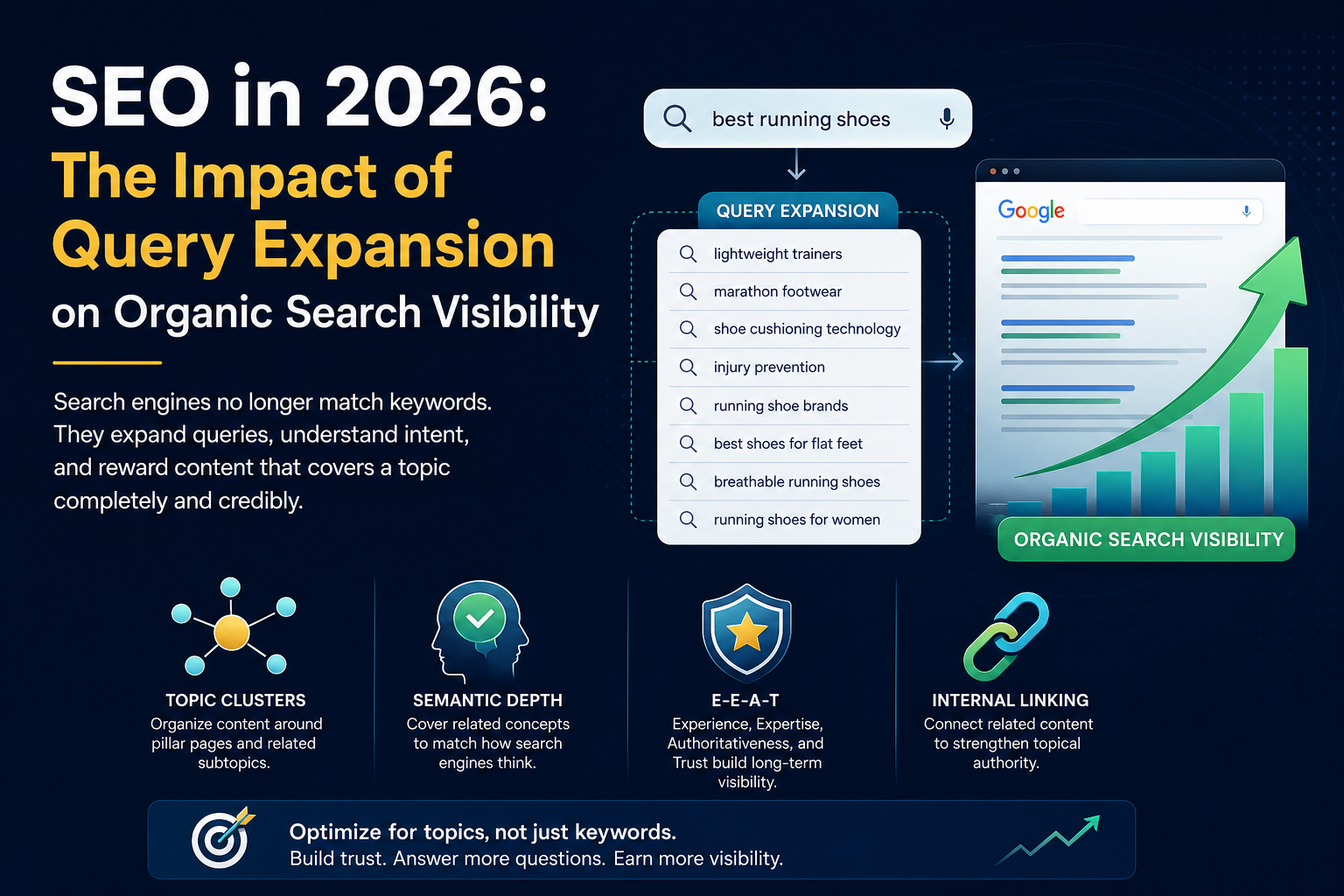
Query expansion is the process search engines use to broaden a user’s original search term into a wider set of related concepts, synonyms, and intent signals before matching it against indexed content. When someone types “best running shoes,” the search engine doesn’t just look for that exact phrase. It also considers related terms such as “lightweight trainers,” “marathon footwear,” “shoe cushioning technology,” and “injury prevention,” because these concepts are commonly associated with the original query.
This matters because SEO has traditionally been taught as a game of exact-match keywords. That approach is outdated. Google’s systems now rely on natural language processing and semantic matching to understand what a searcher actually wants, even when the words on the page don’t match the words typed into the search bar. A page can rank for “SEO” without ever repeating that exact phrase dozens of times, as long as it comprehensively covers the surrounding topic in a way that satisfies user intent.
Why Query Expansion Affects Organic Search Visibility
Organic search visibility is no longer determined purely by keyword density. It’s determined by topical authority: how completely and credibly a page (and the wider website) addresses a subject. Query expansion is the mechanism that rewards this kind of depth. Pages that only target a narrow keyword miss out on the dozens of related searches that expand from it, while pages built around a full topic capture a much wider share of qualified traffic.
For businesses running a SEO strategy, this has three direct implications:
- Content needs semantic breadth, not just keyword repetition. Covering related subtopics, definitions, and use cases signals topical relevance to search engines.
- User intent must be addressed at every stage. Informational, navigational, and transactional intent often overlap within a single expanded query set.
- Internal linking becomes a ranking signal, not just a navigation tool. Linking related pages together helps search engines map out topic clusters across a site.
Building Topic Clusters to Align With Query Expansion
A topic cluster model is one of the most effective ways to work with query expansion rather than against it. Instead of publishing isolated blog posts around single keywords, a topic cluster organises content around a central “pillar” page supported by multiple related “cluster” pages, all interlinked.
For example, a pillar page on SEO might link out to supporting pages covering technical SEO, content marketing, conversion rate optimisation, and local search strategy. Each of these cluster pages targets a related query set, and together they signal to search engines that the website has comprehensive authority on the broader topic. This structure mirrors exactly how query expansion works: a single core concept branches into dozens of related searches, and a well-built site should mirror that same branching structure in its content architecture.
Businesses that want to see this approach applied practically can look at how a content marketing program is structured around pillar and cluster content, since content strategy and technical SEO need to work together for this model to succeed.
E-E-A-T and Why Expertise Still Matters Most
Google’s quality guidelines are built around Experience, Expertise, Authoritativeness, and Trustworthiness, commonly known as E-E-A-T. Query expansion and E-E-A-T are closely connected, because search engines use the breadth and depth of expanded topic coverage as one signal of genuine expertise. A page that only skims the surface of a subject, without addressing the related questions a real expert would naturally cover, is less likely to be seen as authoritative.
This is why credible, well-researched content consistently outperforms thin, keyword-stuffed pages, even when the thin page technically targets the “right” keyword. Search engines are increasingly good at telling the difference between content written by someone with genuine, first-hand experience in a field and content generated purely to game rankings. Demonstrating experience, through case studies, data, original analysis, and clear author expertise, remains one of the strongest ways to build the kind of trust that supports long-term organic visibility.
Agencies that combine search engine optimisation with structured content development tend to produce pages that naturally satisfy both query expansion and E-E-A-T requirements, because the content is built to answer a full range of related questions rather than a single search term.
Practical Steps to Optimise for Query Expansion
Businesses looking to improve organic search visibility through query expansion should focus on a few concrete actions:
- Research related queries, not just the primary keyword. Tools that surface “people also ask” data, related searches, and semantic keyword variations reveal the expanded query set search engines associate with a topic.
- Write comprehensive content that answers the full intent behind a search, rather than optimising for a single phrase in isolation.
- Use clear subheadings and structured formatting so search engines can easily parse which sections answer which parts of the expanded query.
- Build internal links between related pages to reinforce topical relationships across the site.
- Update older content regularly to reflect new related queries as search behaviour evolves.
Pairing this content approach with strong technical foundations and a data-driven PPC and paid advertising strategy can also help validate which expanded query variations actually convert, giving content teams real performance data to prioritise future topics.
Final Thoughts
Query expansion has fundamentally reshaped how organic search visibility is earned. Search engine optimisation is no longer about chasing a single high-volume keyword in isolation; it’s about building genuinely comprehensive, well-linked, expertise-driven content that mirrors the way search engines actually interpret intent. Businesses that adapt their content strategy around topic clusters, semantic depth, and E-E-A-T principles are the ones best positioned to capture the full range of traffic that a single search query can generate.
For businesses that want a structured, data-backed approach to building this kind of visibility, working with an experienced digital marketing team in Australia like Maninder Wave can help translate these principles into a practical content and SEO roadmap tailored to specific industry needs.
Google AI Overviews are also changing how query expansion works in modern search. Learn how businesses can adapt in our detailed guide on How Google AI Overviews Are Changing Local SEO & Lead Generation.
Frequently Asked Questions
What is query expansion in SEO?
Query expansion is the process search engines use to broaden a searcher’s original term into a wider set of related concepts, synonyms, and intent signals. Instead of matching content to one exact phrase, the search engine looks at the full topic surrounding that phrase to find the most relevant results.
How does query expansion affect organic search visibility?
It shifts ranking away from exact keyword matching and towards topical authority. Pages that comprehensively cover a subject, including related subtopics and questions, tend to capture a much wider share of organic traffic than pages built around a single narrow keyword.
What is a topic cluster and why does it matter for SEO?
A topic cluster is a content structure built around one central pillar page supported by several related cluster pages, all linked together. This model mirrors how query expansion works and signals to search engines that a website has genuine depth on a topic, not just one page targeting one keyword.
How is query expansion connected to E-E-A-T?
Search engines use the breadth and depth of topic coverage as a signal of genuine expertise. Content that addresses the full range of related questions, backed by real experience and credible information, aligns naturally with Google’s Experience, Expertise, Authoritativeness, and Trustworthiness guidelines.
Do Australian businesses need a different SEO approach for query expansion?
The core principles are the same, but local intent matters. Australian searches often include location-based and market-specific terms, so content should account for regional language, local competitors, and search behaviour on Google.com.au alongside broader topic coverage.
How can a business start optimising for query expansion?
Start by researching related searches and “people also ask” data around a core keyword, then build content that answers the full intent behind those queries rather than just one phrase. Structuring content with clear subheadings and strong internal linking, an approach the team at Maninder Wave uses across client campaigns, helps reinforce topical relevance to search engines.
