









Blog
Google AI Mode vs Traditional Google Search: What Marketers Need to Know in 2026
29 September 2026
Google Search is changing quickly. For years, marketers focused mainly on keywords, rankings, clicks, and search result pages. In 2026, businesses also need to understand how people discover information through AI-powered search experiences.
Google AI Mode lets users ask longer, more complex questions, follow up with follow-up questions, and explore information from multiple web sources. Google says AI Mode uses a technique called “query fan-out”, where a question can be broken into related subtopics and searched simultaneously.
For businesses targeting customers in the United States, this creates a new consideration: appearing in traditional search results is still important, but content also needs to be useful and understandable enough to support AI-powered discovery.
This guide explains the difference between Google AI Mode and traditional Google Search and what US marketers can do to adapt their SEO and digital marketing strategies.
Google AI Mode vs Traditional Google Search: What Has Changed?
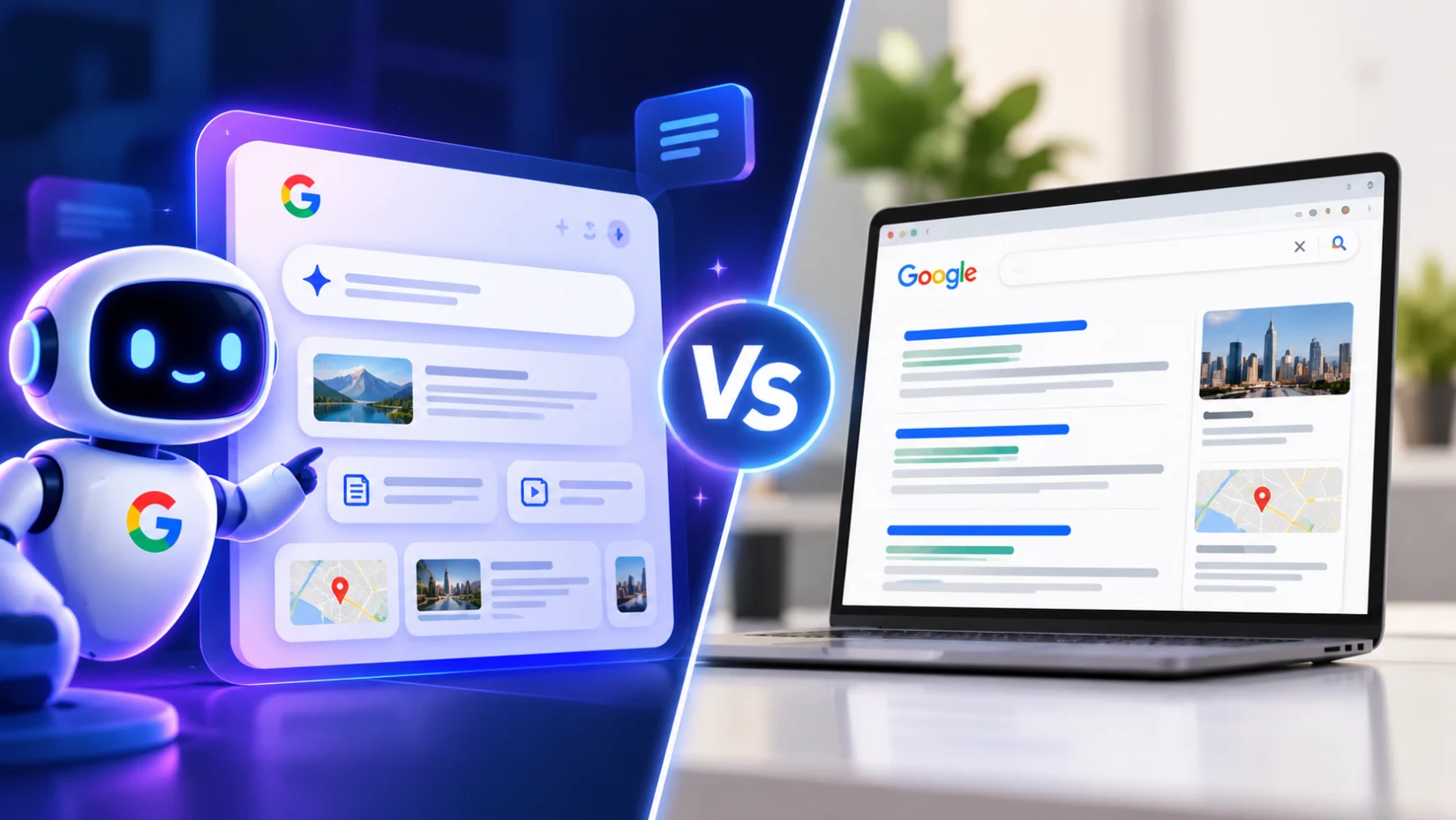
Traditional Google Search generally starts with a keyword or short query. Google then returns a search results page containing organic listings, advertisements, maps, videos, images, and other search features.
Google AI Mode creates a more conversational experience. Users can ask detailed questions instead of breaking a topic into several individual searches. They can also ask follow-up questions while maintaining conversation context.
For example, a traditional search might be:
“Best accounting firms in New York”
A user might then search separately for pricing, services, reviews, and locations.
With AI Mode, the user could ask a longer question such as:
“Find accounting firms in New York that work with small businesses, explain their main services, and compare what I should consider before choosing one.”
This difference matters for marketers because search behaviour is becoming more conversational and research-focused.
How Google AI Mode Is Changing Search for US Businesses
Google AI Mode is particularly relevant to businesses competing for online visibility in the United States. Google reported in May 2026 that AI Mode had surpassed one billion monthly active users globally, while AI Mode queries had more than doubled every quarter since launch.
For US businesses, this means customers may discover brands through a combination of traditional results, AI-generated responses, supporting links, maps, product information, reviews, and other sources.
This does not mean traditional SEO has become irrelevant. Instead, marketers need to think about how their content can serve users across different search experiences.
A strong strategy should therefore focus on:
- Clear and useful website content
- Search intent
- Relevant keywords and topics
- Local business information
- Original insights and experience
- Strong internal linking
- Technical website health
- Trust and credibility
- Regular content updates
The goal should not simply be to create content for an AI system. The content should first be genuinely useful to the person searching.
Google AI Overviews and Their Impact on SEO for US Businesses
Google AI Overviews provide an AI-generated response within Search, while AI Mode provides a deeper conversational search experience. Google has been connecting these experiences more closely, including allowing users to move from an AI Overview into follow-up questions in AI Mode.
For SEO for US businesses, this creates another reason to build pages that clearly answer customer questions.
Suppose a US home services company publishes a page about emergency HVAC repair. Instead of only targeting a keyword such as “emergency HVAC repair”, the page could answer related questions:
- What counts as an HVAC emergency?
- How quickly should a technician respond?
- What does emergency repair usually involve?
- What areas does the company serve?
- What should homeowners check before calling?
- What factors can affect repair costs?
This broader approach gives the page more useful information around the subject instead of focusing on one phrase repeatedly.
Google has also introduced additional ways for AI Search users to discover original content and sources, reinforcing the importance of creating information that provides genuine value.
How AI Search Is Changing SEO in the USA
SEO is moving beyond the simple idea of ranking for individual keywords.
Search engines increasingly need to understand the meaning, context, relationships, and usefulness of information. That makes topical coverage important for businesses targeting competitive US markets.
For example, a dental practice targeting “dentist in Chicago” could create supporting content around:
- Dental exams
- Emergency dentistry
- Cosmetic dentistry
- Dental implants
- Insurance questions
- Treatment costs
- Location and service areas
- Common patient questions
Instead of creating several thin pages targeting slightly different keywords, businesses can develop useful resources that cover real customer needs.
This approach can support both traditional search visibility and AI search optimization USA strategies.
Google AI Mode SEO: What Marketers Need to Know
Google does not provide a guaranteed formula for getting a particular page selected in an AI response. Therefore, marketers should avoid claims that simply adding a certain number of keywords or using a specific AI SEO trick will guarantee visibility.
A more practical approach to Google AI Mode SEO is to strengthen the fundamentals of your website.
1. Answer questions directly
Use clear headings and provide straightforward answers. Avoid making users search through several paragraphs to find basic information.
2. Build topical depth
Cover important aspects of a subject rather than writing a short article around one keyword.
3. Add original value
Include first-hand experience, examples, research, data, comparisons, or useful insights where appropriate.
4. Keep information accurate
Review statistics, prices, services, locations, regulations, and other information that can change over time.
5. Improve website accessibility
Make sure important content can be crawled and understood by search engines.
6. Strengthen internal links
Connect related pages so users and search engines can understand how different topics on your website relate to each other.
How US Businesses Can Optimize for Google AI Mode
If you’re wondering how US businesses can optimize for Google AI Mode, start by looking at the questions your customers actually ask.
Instead of building your content strategy entirely around keyword volume, collect questions from:
- Customer emails
- Sales calls
- Support conversations
- Google Search Console
- Google Business Profile interactions
- Online reviews
- Competitor FAQs
- Industry forums
- Social media discussions
Then create useful pages that answer these questions clearly.
For a local US business, location information is also important. Clearly communicate your service areas, physical location where relevant, contact information, services, operating hours, and other information customers need before taking action.
Google also provides website owners with controls and insights related to generative AI features through Search Console. As of August 31, 2026, Google says its Search generative AI control has rolled out worldwide and covers features including AI Overviews and AI Mode.
AI Search Optimization USA: Content Strategies That Make Sense
A useful AI search optimization USA strategy should combine traditional SEO with a strong focus on user intent.
For example, a US financial services company could create one comprehensive guide explaining a financial topic, followed by supporting pages answering specific customer questions.
The content should be:
- Easy to scan
- Factually accurate
- Organised with descriptive headings
- Supported by relevant internal links
- Written for a specific audience
- Updated when important information changes
- Clear about the business’s services and expertise
It is also worth remembering that AI-generated answers can make mistakes. Google itself notes that AI Mode does not always get things right and recommends checking important information against additional sources.
That makes accuracy and trustworthy content important for publishers and businesses alike.
The Role of AI in Digital Marketing for US Businesses
AI is not only changing search. It is also influencing content planning, customer service, advertising, analytics, social media, and other areas of AI in digital marketing.
A US marketing team might use AI to:
- Analyse customer questions
- Generate content ideas
- Identify content gaps
- Assist with first drafts
- Summarise campaign data
- Personalise customer communications
- Automate repetitive tasks
However, AI-generated content still needs human review. Marketers should check facts, brand messaging, originality, and whether the final content actually helps the intended audience.
AI should support the marketing process rather than replace strategic thinking.
How to Optimize a Website for Google AI Mode
There is no single optimisation checklist that guarantees inclusion in AI responses. However, businesses can improve their overall search readiness by following strong SEO practices.
Start with the basics:
Make your website technically sound.
Check indexing, page speed, mobile usability, broken links, redirects, structured data where appropriate, and other technical issues.
Create useful content.
Focus on real questions and problems faced by your audience.
Demonstrate expertise.
Where relevant, explain who created the content and include useful first-hand information.
Use descriptive headings.
Make it easy for users and search systems to understand what each section covers.
Support important claims.
Link to reliable sources when statistics, research, regulations, or other external information are important.
Keep business information consistent.
This is particularly important for local US businesses.
Measure performance.
Monitor organic traffic, conversions, engagement, search queries, and other meaningful business metrics rather than focusing only on rankings.
What This Means for SEO Agencies and Digital Marketers
For a digital marketing agency in the USA, the changing search environment means SEO strategies need to evolve alongside Google’s search features.
An SEO agency in the USA may need to consider traditional rankings alongside visibility in AI-powered search experiences, while a social media marketing agency USA can help businesses build brand awareness and distribute original content across social platforms.
Paid advertising remains relevant too. Businesses using PPC lead generation in the USA should continue measuring qualified leads, conversion rates, acquisition costs, and revenue rather than assuming that AI Search replaces paid campaigns.
The wider lesson is that businesses should not build their entire marketing strategy around one traffic source.
A stronger approach combines SEO, content, local search, social media, paid advertising, email, and direct customer relationships according to the business’s goals.
Google AI Mode vs Traditional Search: What Should Marketers Do Now?
The practical answer is not to abandon traditional SEO.
Instead, marketers should build a strategy that works across both traditional and AI-powered search.
Focus on creating content that answers real questions, covers topics comprehensively, demonstrates useful expertise, and gives users a reason to visit the website.
At the same time, continue monitoring traditional search performance and conversion data.
Google’s AI Search development is still evolving. Google continues to update AI Mode, AI Overviews, Search interfaces, and website-owner tools, so marketers should avoid relying on fixed tactics that promise permanent results.
Conclusion
The difference between Google AI Mode vs Traditional Google Search is not simply about one replacing the other. Search is becoming more conversational, exploratory, and capable of handling complex questions.
For US businesses, the opportunity is to build a stronger overall digital presence. You can explore more SEO, AI, and digital marketing resources at ManinderWave.
Marketers who focus on helping users rather than chasing individual search features will be better positioned to adapt as AI-powered search continues to develop.
Frequently Asked Questions
Traditional Google Search primarily presents a range of search results and other search features based on a user’s query. Google AI Mode provides an AI-powered conversational experience where users can ask complex questions, ask follow-ups, and explore information from multiple web sources.
Yes. AI Mode still relies on information from the web and Google’s search systems. Businesses should continue investing in technical SEO, useful content, internal linking, local SEO, and other established SEO practices while adapting their content strategy to changing search behaviour.
Start with useful, accurate, well-structured content that answers real customer questions. Maintain strong technical SEO, provide clear business information, develop topical authority, and regularly update important pages. There is no guaranteed method for securing a particular position in an AI-generated response.
No. AI Mode is part of Google Search and can provide AI-powered responses with links to web sources. Google says users can explore supporting content and continue asking follow-up questions. Traditional Search results remain part of the wider Search experience.
AI can help businesses with tasks such as content planning, analysis, customer communication, and workflow automation. The right investment depends on the business’s goals, resources, and marketing needs. Human review and strategic decision-making remain important, particularly for accuracy and brand quality.
