






Blog
How to Get Your Business Mentioned in ChatGPT Search Results
16 November 2026
Ask a friend where they found their last accountant, electrician or marketing agency, and the answer is changing. More Australians now type a question into ChatGPT and read the names it suggests. If your business is not among them, a growing slice of your potential customers never sees you.
This guide explains what ChatGPT brand visibility means, how ChatGPT decides which sources to show, and the practical steps you can take to improve your chances. It also explains what no one can promise you, because honest expectations matter in this area.
What Is ChatGPT Brand Visibility?
ChatGPT brand visibility is how often, and how favourably, your business is mentioned, recommended or cited when people use ChatGPT to research a topic or compare options. A mention can take several forms:
- Your brand named in a list of suggested providers
- A link to one of your pages as a cited source
- A summary of your product or service drawn from your content
- A recommendation within a local or comparison query
This is different from a traditional Google ranking. A search result page offers a list of links for a person to choose from. A ChatGPT answer offers a written response, with a handful of sources behind it. Being one of those few sources is the new goal.
The wider discipline is often called AI search optimisation, and it overlaps with terms such as generative engine optimisation (GEO) and answer engine optimisation (AEO). Whatever the label, the aim is the same: make your business easy for AI systems to find, understand and trust.
How ChatGPT Chooses Which Businesses to Mention
You need a realistic picture of how this works. OpenAI publishes its crawler details but says very little about how sources are actually chosen. OpenAI documents its crawlers and referral tag in detail, yet publishes nothing on how sources are selected. That means anyone who claims a guaranteed formula is guessing.
What we do know comes from official documentation and careful industry testing:
- Crawler access matters. OAI-SearchBot indexes content for ChatGPT search citations, GPTBot gathers content that may be used for training, and ChatGPT-User fetches pages when a person asks ChatGPT to read one. Each can be allowed or blocked separately.
- Opting out has consequences. OpenAI states that sites blocking OAI-SearchBot will not be shown in ChatGPT search answers, though they can still appear as navigational links.
- Other search indexes play a part. Industry analysis suggests ChatGPT’s search draws partly on Bing’s index alongside OpenAI’s own crawling, so a page missing from Bing may be effectively invisible to it. Treat this as an informed observation rather than a confirmed rule.
- Visibility is not fixed. A business may appear for one question and not another, because different prompts need different information.
In short, you cannot buy or force a mention. You can, however, remove obstacles and build the signals that make your business a sensible source to cite.
Step 1: Make Sure ChatGPT Can Access Your Website
Start with the basics. Check your robots.txt file and confirm that OAI-SearchBot is not blocked. Many businesses block every AI crawler by default without realising it also removes them from AI search answers.
A sensible approach for most businesses is to allow the search crawler while making a separate decision about training crawlers. Also confirm that your hosting provider or content delivery network is not blocking legitimate bot traffic and that your pages load quickly and render properly without needing a login.
Because Bing appears to feed into the process, verify your site in Bing Webmaster Tools and submit your sitemap. It takes a few minutes and costs nothing.
Step 2: Build a Strong SEO Foundation
AI search does not replace traditional SEO. It sits on top of it. Pages that are well structured, fast, secure and relevant tend to be easier for every system to interpret. Fix technical issues first: broken links, slow pages, duplicate content and unclear site architecture.
If you need a starting point, our SEO services in Australia cover technical audits, on-page work and local optimisation, all of which feed into AI visibility.
Step 3: Write Answer-First Content
ChatGPT tends to draw on content that answers a specific question clearly. The more direct and self-contained your answer, the easier it is to extract.
Try this structure on key pages:
- Lead with the answer. State the main point in the first one or two sentences under each heading.
- Then explain. Add context, examples and detail.
- Use descriptive subheadings. Phrase some as the questions customers actually ask.
- Use lists and tables where they make comparisons clearer.
- Date your facts. Show when prices, statistics and regulations were last checked.
Write one thorough page for one question rather than ten shallow ones. Depth wins over volume.
Step 4: Organise Content Into Topic Clusters
A topic cluster is a group of related pages built around one pillar page. The pillar covers a broad subject, and supporting pages answer specific questions in detail, all linked together.
For example, a Sydney physiotherapy clinic might build a pillar on “Sports Injury Recovery”, supported by pages on ankle sprain rehab, return-to-run plans, Medicare and private health rebates, and when to see a specialist. Each page answers a different question people might ask an AI assistant, and together they show real expertise.
This approach also suits how modern AI systems break questions into smaller parts. We explain that idea in our guide on query fan-out SEO. Our content marketing in Australia service follows the same cluster approach.
Step 5: Demonstrate E-E-A-T on Every Important Page
Google’s E-E-A-T framework stands for Experience, Expertise, Authoritativeness and Trustworthiness. It was designed for search quality, but the same qualities make a source easier for AI systems to trust.
Strengthen these signals by adding:
- Named authors with relevant qualifications and a short bio
- Original experience, such as case studies, project photos and real results
- Clear business details, including your ABN, address, phone number and service areas
- Transparent policies for pricing, returns, privacy and complaints
- Reviews and testimonials from real Australian customers
You can see how proof is presented on our case studies and client testimonials pages.
Step 6: Strengthen Your Presence Beyond Your Website
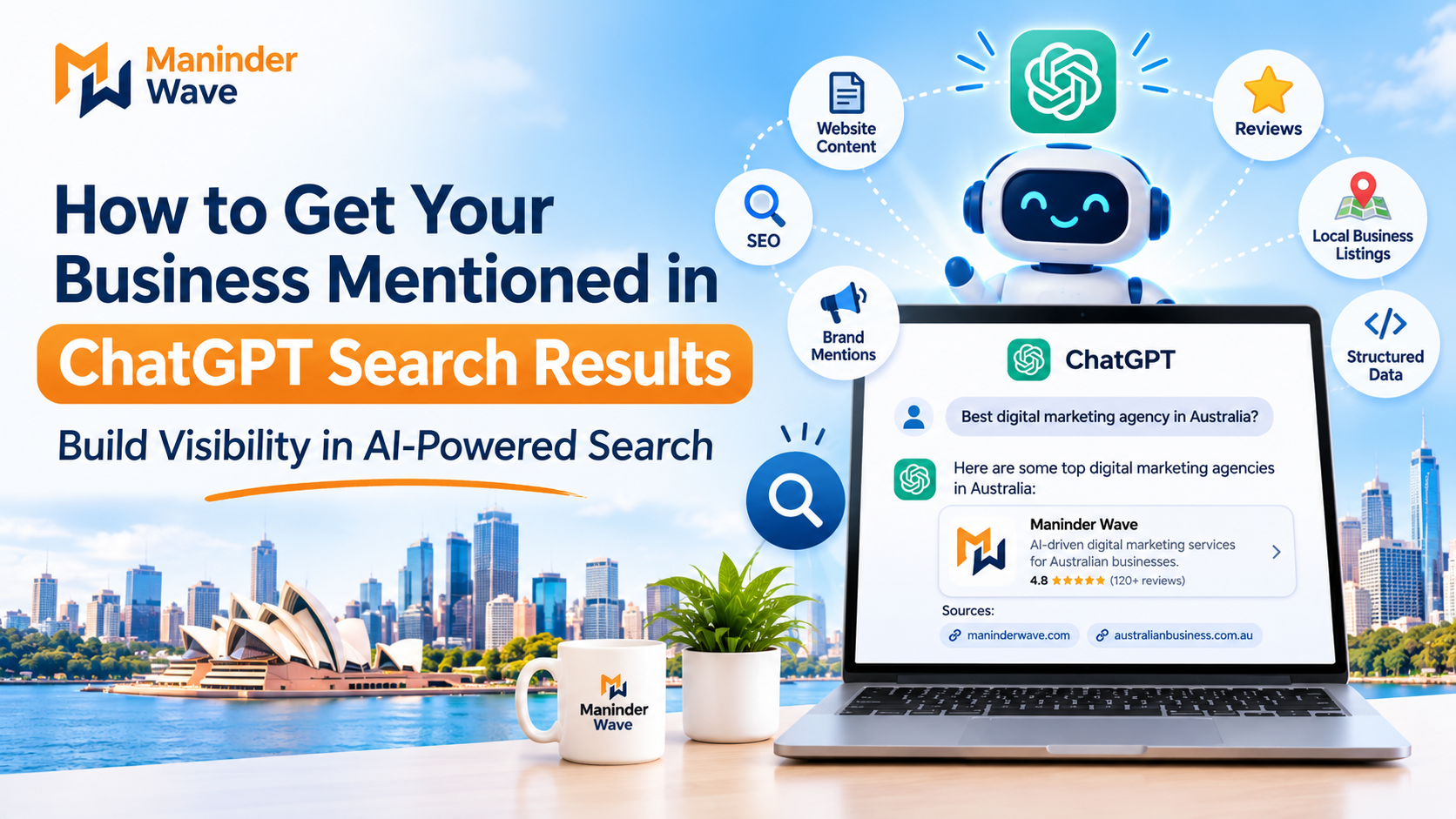
AI assistants do not rely on your site alone. They also form an impression from what others say about you. Aim for consistent, accurate information across:
- Google Business Profile, with correct categories, hours and service areas
- Industry directories and professional associations in Australia
- Review platforms relevant to your sector
- LinkedIn, where a complete company page and active thought leadership build credibility
- News and trade publications that mention your expertise
- Podcasts, webinars and community events where your team contributes
Consistency matters. If your business name, address, phone number and service descriptions differ between platforms, AI systems have a harder time identifying you with confidence. For B2B firms, LinkedIn lead generation in Australia is a practical way to build that visible authority.
Step 7: Use Structured Data and Clear Entities
Structured data (schema markup) is code that labels the details of a page, such as your organisation, products, reviews and FAQs, in a format machines can read. It does not guarantee a mention, but it removes ambiguity.
Pay particular attention to:
- Organisation schema with your name, logo, address and social profiles
- Local business schema if you serve specific Australian suburbs or cities
- FAQ and product schema where the content genuinely supports them
- A consistent brand name used in the same way everywhere
Step 8: Tailor Content for Australian Searchers
Local relevance is a real advantage. When someone asks ChatGPT for a provider “in Melbourne” or “in Queensland”, generic global content often loses to specific local detail.
Include references to Australian states and cities, prices in AUD, local regulations, seasonal factors (for example, the 1 July financial year start) and Australian spelling. Mention the suburbs and regions you actually serve. Our overview of digital marketing in Australia shows how we describe local service areas and timezone support.
Step 9: Measure What You Can
Tracking AI visibility is still imperfect, so combine several methods:
- Test real prompts. Ask ChatGPT, with search switched on, the questions your customers would ask, and note which sources appear. Repeat monthly.
- Check referral traffic. Look in your analytics for visits arriving from chatgpt.com.
- Monitor branded search. A rise in people searching your business name can signal growing awareness.
- Track enquiries. Ask new customers how they found you and include AI assistants as an answer.
Remember that responses vary between users and sessions, so look for patterns over time rather than single results. Pair visibility work with conversion rate optimisation so the visitors you earn actually turn into enquiries.
Common Mistakes to Avoid
- Blocking all AI crawlers without understanding the trade-off
- Publishing thin, repetitive content written only to target phrases
- Ignoring reviews and reputation outside your own website
- Inconsistent business details across platforms
- Chasing guarantees. No agency can promise a ChatGPT mention
Final Thoughts
Getting mentioned in ChatGPT is not about tricks. It comes down to being accessible to crawlers, clear in your answers, consistent across the web and credible in your field. Start with the technical checks, build a content cluster around your most valuable topic, and keep measuring.
If you would like help building a plan that covers both Google and AI search, Maninder Wave can guide you through it. Book a free strategy call, and we will review where your business stands today.
Frequently Asked Questions
There is no way to buy an organic mention in ChatGPT’s answers. Visibility is earned through accessible, trustworthy and helpful content, along with a strong reputation across the web.
If you want your pages to be eligible to appear in ChatGPT search answers, yes. Blocking it removes you from those answers, although you may still appear as a plain link. Review your robots.txt and hosting settings.
They overlap but are not identical. Strong SEO provides the foundation, while AI visibility adds a focus on clear answers, consistent brand information and mentions across other trusted sources.
There is no fixed timeline. Technical fixes can help within weeks, but building authority, reviews and a content cluster usually takes several months. Results also vary by industry and competition.
Yes. AI answers often reward specific, well-explained and locally relevant content. A smaller business with a clear niche, genuine expertise and strong reviews can compete with larger brands.
No. Google remains a major source of traffic, and the same practices support both channels. Think of AI visibility as an extension of good SEO, not a replacement.
