










Blog
Your AI Can Soon Shop at Walmart: Here’s How It Works
22 October 2026
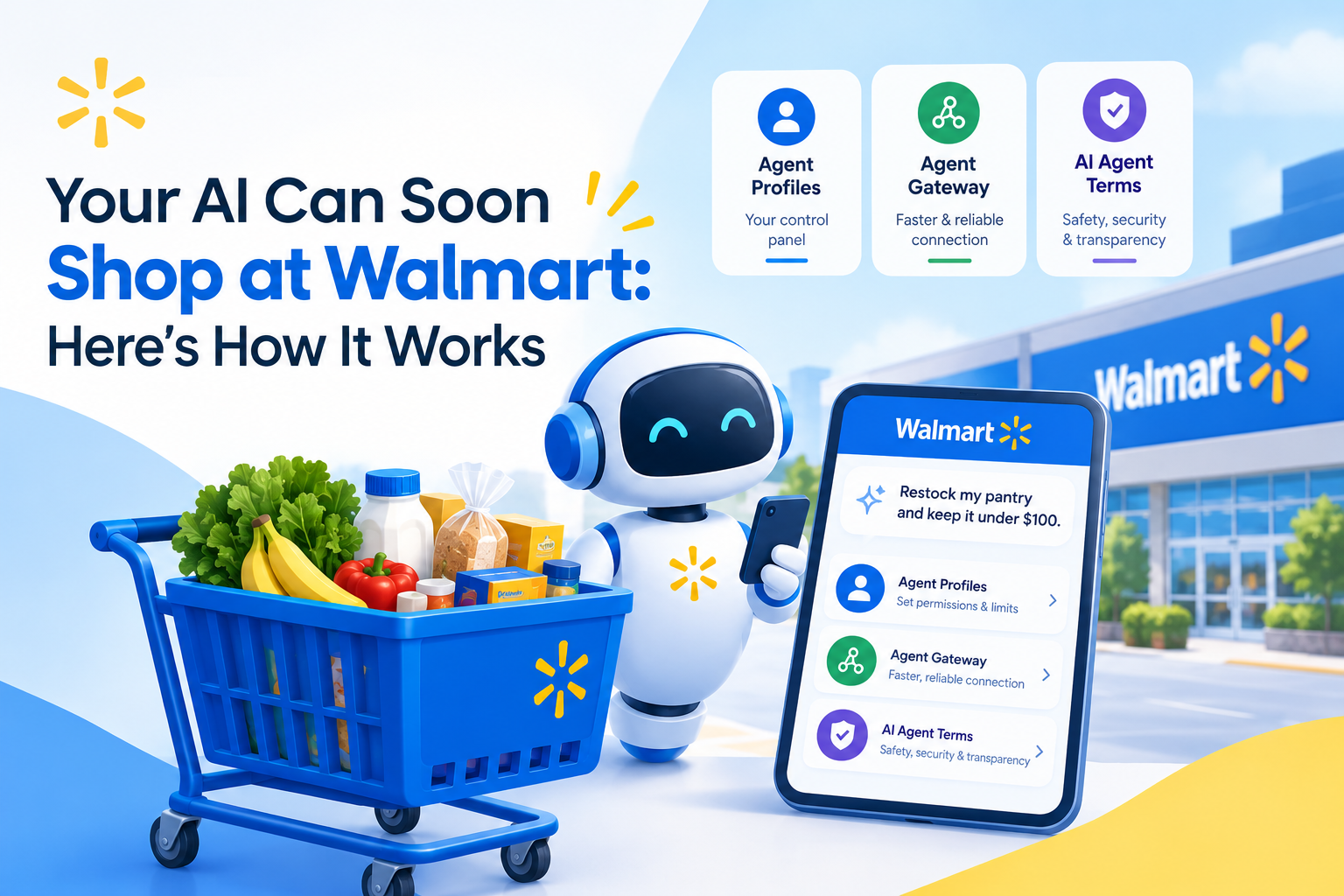
Imagine telling an AI assistant, “Restock my pantry and keep it under $100,” and having the order placed without you opening a single app. Until recently that sounded like a demo video. On October 21, 2026, Walmart took a concrete step toward making it ordinary shopping behaviour.
Walmart introduced new tools that allow AI agents to shop and complete transactions for customers, as the retailer positions itself in the growing use of AI assistants in online commerce. In this post we break down what was announced, how the tools work, why Walmart’s approach differs from Amazon’s, and what it means for everyday shoppers.
What Exactly Did Walmart Announce?
Walmart introduced three things: Agent Profiles, the Walmart Agent Gateway and new terms for AI agents, all meant to help customers shop through AI assistants with more transparency, security and control. Think of them as three layers:
Agent Profiles decide what an agent is allowed to do for you.
- The Agent Gateway gives agents a fast, reliable way to connect to Walmart.
- The terms for AI agents set the rules every agent must follow.
The tools are available to all Walmart account holders and do not require a Walmart+ membership. That matters, because the feature is not locked behind a paid subscription.
Agent Profiles: Your Control Panel for AI Shopping
The biggest worry about AI shopping is simple: what if the agent buys something you never wanted? Agent Profiles are Walmart’s answer.
Walmart said it will roll out Agent Profiles next month, letting shoppers authorize individual AI agents, track their purchases separately, and set a spending limit or require approval for each transaction.
In practice, this means:
- Per-agent permissions. Each agent gets its own profile, so one assistant can have a strict budget while another needs your approval every time.
- Spending limits and approvals. You choose how much freedom the agent gets.
- Separate order tracking. Customers can monitor purchases made by AI agents apart from their own orders and revoke an agent’s access at any time.
- Easy setup. The first time a customer uses an agent to shop through the Walmart Agent Gateway, Walmart automatically creates an Agent Profile for that agent.
The separation of orders is a small detail with a big benefit. If a purchase looks wrong, you can immediately tell whether you or an agent made it.
The Walmart Agent Gateway: A Front Door Built for Machines
Today, most AI agents shop the way a person would: opening a website in a browser and clicking through pages. That is slow and fragile. Walmart said agents currently shop its site through a browser using steps designed for people, which it described as slow and error-prone.
The Agent Gateway fixes this. It is Walmart’s new MCP server, designed to help approved agents connect to Walmart over the Model Context Protocol, which was originally created by Anthropic. MCP is an open standard that lets AI systems talk to external tools and data in a structured way. Instead of “reading” a web page, an agent can ask Walmart’s systems for product details, availability and checkout directly.
The gateway starts as a beta for companies and developers, with safeguards such as category restrictions, rate limits and compliance guardrails. So this is not yet a switch every shopper flips, but the groundwork for the next phase of online retail.
Rules for Agents: Walmart’s AI Terms
Walmart also published terms that spell out how agents may behave. Agents cannot take actions beyond what the shopper intends, cannot access customers’ payment information, and can only access the information they need for the task. Agents that do not comply are blocked from the site.
Walmart added that customers remain in control of purchases and that agents are barred from accessing payment card data. For a technology that handles money, these limits are what could make people comfortable enough to try it.
Walmart vs Amazon: Two Opposite Strategies
The timing is interesting. The announcement came shortly after Amazon began blocking AI agents from making purchases for online shoppers, so Walmart is taking the opposite approach. Reuters noted the move underscores Walmart’s push into AI-enabled shopping and contrasts with Amazon, which has sought to limit third-party AI shopping agents’ access.
Both strategies have logic. Amazon controls a huge shopping destination and may prefer shoppers to stay inside its own app and ads ecosystem. Walmart is betting that being easy to shop from anywhere, including inside other companies’ AI assistants, will win customers who never open Walmart’s app. Which approach pays off will be one of the most watched retail stories of the next few years.
How We Got Here
This did not come from nowhere. In October 2025, Walmart partnered with OpenAI so customers could shop Walmart through ChatGPT using Instant Checkout, planning meals, restocking essentials or discovering products by chatting. Walmart also has its own assistant, Sparky, which recommends products and summarizes reviews inside the app.
The new tools are the safety and infrastructure layer on top of those experiments. First came agents that can shop; now come the controls that make it trustworthy at scale.
What It Means for Shoppers
- Convenience: Routine buying such as groceries, household items and refills can be handed off.
- Control: You set the budget and approval rules, and you can cut off access anytime.
- Transparency: Agent purchases are tracked separately, so mistakes are easier to spot.
- Choice: You can use the AI app you already like instead of being forced into one store app.
An analyst quoted by Reuters said the tools build confidence in what is still an experimental way to shop. Mizuho’s David Bellinger said management buy-in is making it into a real thing.
Open Questions and Risks
It is wise to stay cautious. Spending limits only help if you actually set them sensibly. Agents can misread a request, such as buying the wrong size or brand. Privacy questions remain about what data agents share and how long they keep it. And if a mistake happens, how returns, refunds and responsibility work between the shopper, the agent’s maker and the retailer will need to be clear in practice. Start with low-value, repeat purchases and keep approvals on until you trust the setup.
Final Thoughts
Walmart’s announcement is less about a flashy new gadget and more about plumbing: permissions, rules and a proper connection point for AI agents. That plumbing is exactly what agentic commerce needs to move from experiment to habit. If Agent Profiles roll out as described, shoppers get a practical way to delegate buying without giving up control, and retailers everywhere will have to decide whether to welcome AI agents like Walmart or hold them back like Amazon.
get found in the age of AI.
Frequently Asked Questions
They are dedicated profiles that let you authorize each AI agent separately, set spending limits, require approval per transaction and track the agent’s orders apart from your own.
Walmart said they will roll out next month, which means November 2026, per the October 21 announcement.
No. They are available to all Walmart account holders.
No. Walmart says agents are barred from accessing payment card data.
It is an MCP-based connection that lets approved AI agents interact with Walmart faster and more reliably than by using a browser. It begins as a beta for companies and developers.
Yes. You can revoke an agent’s access at any time and monitor its purchases separately.
Walmart is opening its platform to AI agents with controls, while Amazon has started blocking agents from buying for shoppers.
Not necessarily. Walmart’s listed safeguards for the gateway include category restrictions, rate limits and compliance guardrails. On top of that, you can set your own spending limit or ask for approval on every purchase through Agent Profiles.
