









Blog
AI Search Is Breaking Click-Based Attribution: How to Measure SEO Success in 2026
21 October 2026
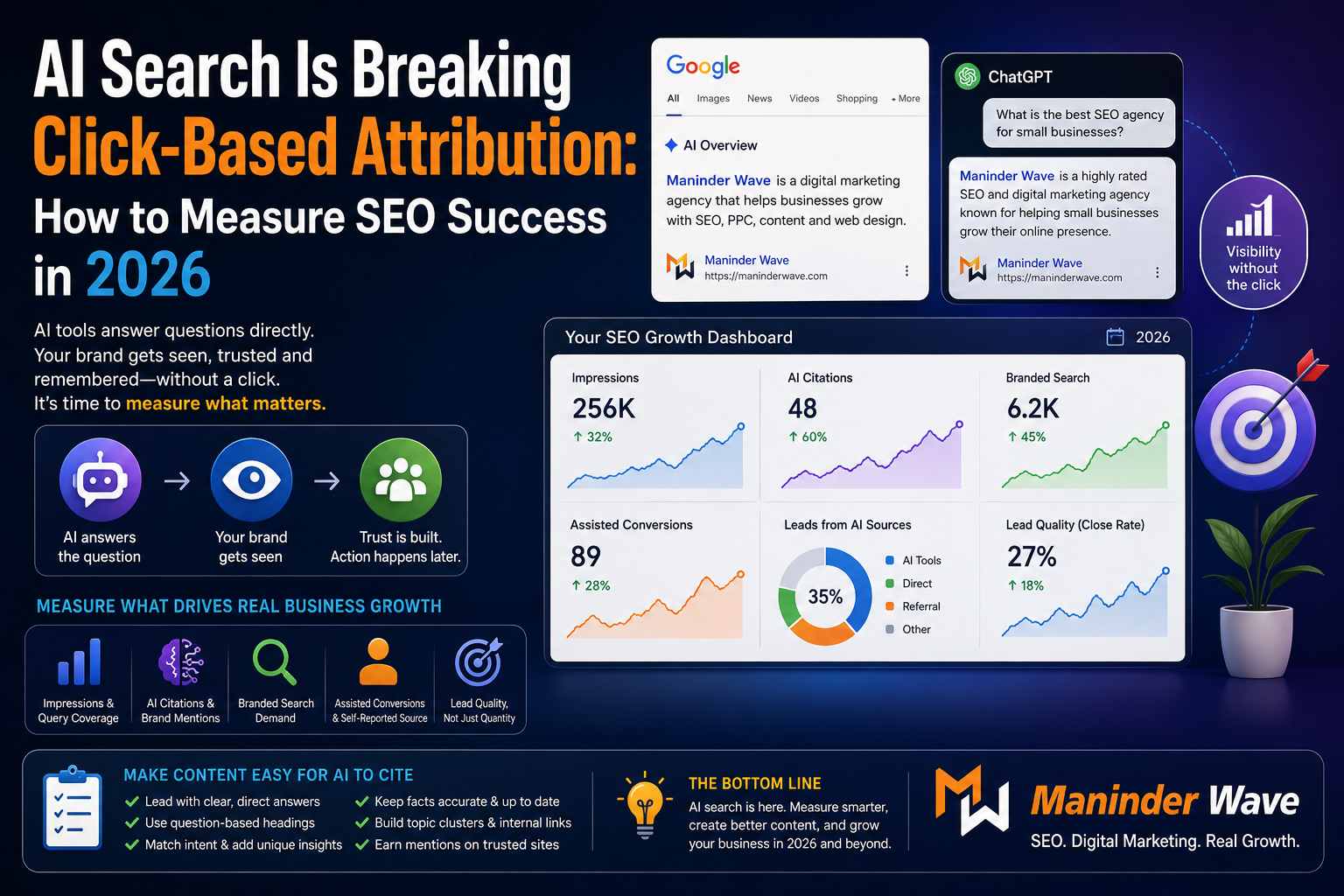
AI search is changing how people find businesses. Tools like Google’s AI answers and ChatGPT often answer a question directly, so someone may see your brand, trust it, and act later without ever clicking a link. That breaks the old habit of judging SEO only by clicks and last-touch conversions. In 2026, the smarter approach is to track visibility, citations, branded demand and lead quality together, and to structure your content so AI systems can easily understand and cite it.
What Has Changed in Search?
For years, the SEO scoreboard was simple: rank higher, get more clicks, get more leads. That model is under pressure. Search Engine Land has recently covered how AI search is breaking click-based attribution, and its analysis of millions of AI answers shows that visibility within the answer itself is becoming a measurable metric.
At the same time, search now spans many surfaces: classic web results, images, video, news, local listings and AI-generated answers. Your customer may meet your brand in three of these places before ever typing your web address. If your reports only count the final click, you will undercount the work SEO is doing.
Three shifts matter most for business owners:
- Zero-click searches are rising. Users get the answer on the results page or inside an AI tool.
- Rich results are changing. Google removed FAQ rich results in 2026, which means you can no longer rely on that format alone to earn extra space in the results.
- Visibility is moving from rankings to citations. Being named or referenced in an AI answer can matter as much as holding position three on a results page.
Why Click-Based Attribution Falls Short
Click-based attribution assumes a straight line: search, click, visit, enquiry. AI search makes the journey messier.
- A prospect asks an AI tool for “the best SEO agency for small businesses”, sees your brand named, and searches for you directly two days later. The sale is credited to “direct” or “branded search”, not to the content that earned the mention.
- Someone reads your answer in a summary, never visits your site, but remembers your name when they are ready to buy.
- Several people on a buying team each use AI tools differently, so no single click captures the decision.
The result is that real SEO value shows up in the wrong column of your report, or does not show up at all. That is not a reason to stop doing SEO. It is a reason to measure it better.
What to Measure Instead (or Alongside) Clicks
Think of measurement as a dashboard, not a single number.
1. Impressions and query coverage
Google Search Console still shows how often you appear and for which queries. Watch the growth in impressions and in the number of distinct queries you appear for. Search Console has also added the ability to filter performance by multiple countries, which helps if you serve more than one market. Rising impressions with flat clicks is a sign of zero-click behaviour, not necessarily of failure.
2. Brand mentions and AI citations
Check regularly whether AI tools mention or cite your business when asked questions in your field. Keep a simple list of 20 to 30 important questions your customers ask, run them across the main AI tools each month, and record whether you are named, linked or absent. This is a manual but very revealing exercise.
3. Branded search demand
If more people search for your business name, your brand is spreading. Track branded queries in Search Console month by month.
4. Assisted conversions and self-reported source
Add a “How did you hear about us?” field to your enquiry form. Answers like “I saw you in ChatGPT” or “Google’s AI summary” give you evidence that analytics tools cannot.
5. Lead quality, not just lead count
AI-influenced visitors often arrive better informed. Track enquiry-to-customer rate and average deal value, not only traffic.
How to Make Your Content Easier for AI to Cite
A BrightEdge audit reported by Search Engine Land found that content built with clear, self-contained answer blocks was about 40% more likely to be cited by AI systems, and that well-organised page layouts saw roughly a 25% uplift in citations. The same coverage stressed that content matching a specific search intent (informational, navigational or transactional) is cited more readily. Authenticity still matters for long-term trust.
Practical ways to apply this:
- Lead with the answer. Put a short, direct answer of two to three sentences right under each heading, then add detail below.
- Use clear headings written as questions. “What is GEO?” is easier for a system to match than a vague, clever title.
- Match intent. Decide whether each page is meant to inform, help someone find you, or help someone buy, and build the page for that single purpose.
- Add information gain. Include original examples, your own data, case notes or expert opinion. Pages that simply repeat what everyone else says give AI no reason to prefer you.
- Keep facts accurate and current. Update dates, prices and statistics. Outdated pages lose trust quickly.
If you want expert help turning your pages into answer-ready, citation-friendly content, our team at Maninder Wave offers SEO and digital marketing support built around exactly this approach.
Build Topic Clusters and Strong Internal Links
Search Engine Land has highlighted topic clusters as a core method for both traditional SEO and AI search. A topic cluster is a main “pillar” page on a broad subject, supported by several detailed pages on related questions, all linked together.
For example, a pillar page on local SEO could link to supporting pages on Google Business Profile optimisation, review management, local citations and service-area pages. Each supporting page links back to the pillar and to its closest siblings.
This helps in two ways:
- Search engines and AI systems can see that your site covers a subject in depth.
- Visitors move naturally from a general question to a detailed answer to an enquiry.
When you add internal links, use descriptive anchor text such as “our SEO and digital marketing services” rather than “click here”. Descriptive anchors tell both people and machines what the destination is about.
Do Not Ignore Technical SEO for AI Agents
AI tools and agents need to reach, read and understand your pages. Search Engine Land has also been covering technical SEO for generative search, and Google has explained how crawling works in 2026. The basics still apply:
- Make sure important pages are crawlable and not blocked by mistake.
- Keep pages fast and mobile-friendly.
- Use clean, logical headings and add structured data where it genuinely fits.
- Fix duplicate pages and messy URL parameters so signals are not split.
- Keep your product or service information consistent everywhere it appears.
Also stay alert to algorithm changes. Google’s September 2026 spam update has finished rolling out, so it is a good moment to review thin pages, low-quality guest posts and risky backlinks.
Do Not Forget Reviews and Third-Party Mentions
AI systems learn about businesses from more than your own site. Reviews, community discussions and mentions on other websites all shape how you are described. Search Engine Land has recently covered Reddit as a way to build visibility in both organic and AI search, and has published guidance on building review engines that stay compliant in regulated industries. Encourage genuine reviews, take part honestly in relevant communities, and never fake either.
A Simple 30-Day Action Plan
Week 1: Baseline. Export Search Console data for the last three months. Note impressions, clicks and top queries. List 20 to 30 customer questions and record whether AI tools mention you.
Week 2: Fix your best pages. Choose your five most important service or blog pages. Add a direct answer under each key heading, tighten the structure and update any old facts.
Week 3: Strengthen linking. Build or improve one topic cluster. Make sure every supporting page links to the pillar and to related pages.
Week 4: Upgrade reporting. Add the “How did you hear about us?” field, set up a monthly dashboard for impressions, branded search, AI mentions and lead quality, and review it with your team.
Final Thoughts
AI search has not killed SEO. It has changed the scoreboard. Businesses that keep judging success by clicks alone will misread their results, while those that track visibility, citations, branded demand and lead quality will make better decisions. Build answer-ready content, connect it with strong topic clusters and internal links, keep your technical foundations healthy, and measure the whole journey.
Ready to adapt your SEO for AI search? Talk to the team at Maninder Wave about SEO, content and digital marketing strategies designed for the way people search in 2026.s? Connect with Maninder Wave for SEO, digital marketing and AI-ready growth strategies.
get found in the age of AI.
Frequently Asked Questions
Yes. Visibility, brand recall and citations still drive enquiries, even when they do not show up as clicks. You simply need to measure more than clicks.
SEO aims to rank pages in traditional search results. GEO (generative engine optimization) aims to have your content used in AI-generated answers. AEO (answer engine optimization) focuses on giving direct, well-structured answers that search and AI tools can lift. In practice the three overlap heavily, and good content helps all of them.
Ask the main AI tools the questions your customers ask and record the results every month. Also add a self-reported source field to your forms.
Usually not. Start by improving your most important pages, adding answer-first sections, tightening internal links and fixing technical issues.
Content and structure improvements can start to show in impressions and AI mentions within weeks to a few months, depending on your competition and how often your pages are crawled.
