








Blog
GPT-6, Gemini 4 Argon and AI Agents: What Marketers and Businesses Need to Know in 2026
21 October 2026
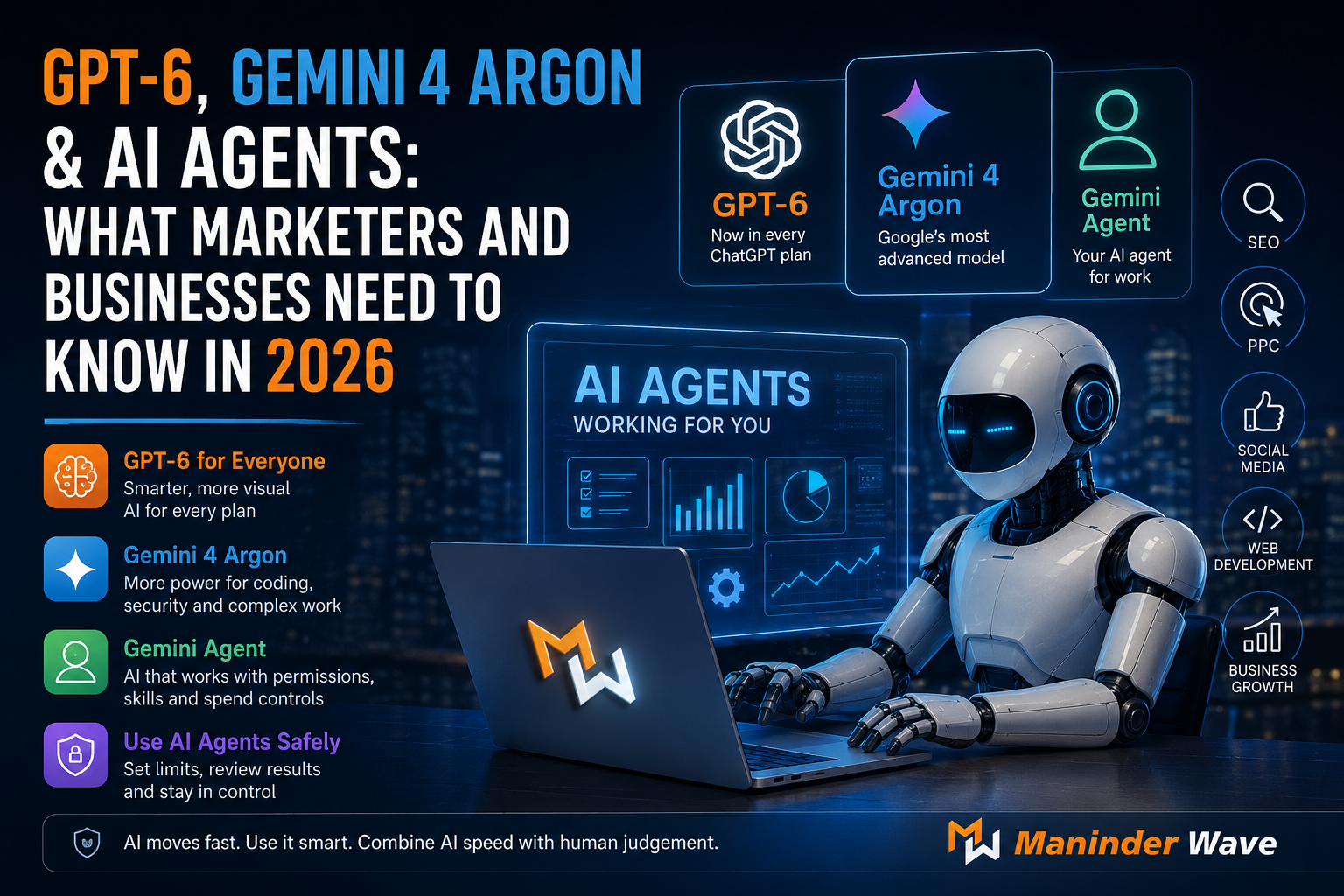
October 2026 has been one of the busiest months in AI this year. OpenAI brought GPT-6 to every ChatGPT plan, Google made Gemini 4 Argon generally available and introduced its Gemini agent for work, and several other labs shipped new models. The big theme across all of them is the same: AI is moving from answering questions to doing tasks. For marketers and business owners, that means faster content, research and reporting, but also new risks around accuracy, permissions and cost.
1. GPT-6 Arrives in Every ChatGPT Plan
On 7 October, OpenAI brought GPT-6 to the ChatGPT chat screen on every plan, including the free tier. It arrived alongside a new interface called Intelligent UI, which places interactive visuals directly inside conversations instead of showing only text.
Why it matters for your business:
- More people will use the same powerful tool. When the free tier gets a top model, your customers, competitors and staff all gain access at once. Your advantage will come from how well you use it, not from simply having it.
- Answers become more visual. Interactive charts and visuals inside a chat make AI tools better at explaining data, comparing options and walking through steps. Content that is clear, structured and factual is more likely to be useful in those answers.
- AI search habits grow. The more capable and accessible ChatGPT becomes, the more people will ask it for recommendations before they ever open a search engine. This makes AI search visibility and GEO (generative engine optimization) more important for every service business.
2. Gemini 4 Argon Reaches General Availability
Google’s Gemini 4 Argon, described as the company’s most advanced model, was announced with stronger coding, cybersecurity and complex professional work abilities. A model-release tracker reports it reached general availability on 13 October with introductory pricing of $2 and $10 (input and output), with the price due to double on 1 December. Treat those figures as a guide and confirm them on Google’s official pricing page before you budget.
Why it matters:
- Pricing is a planning issue. If you build tools or automations on Gemini through the API, an introductory rate that doubles in December can change your costs quickly.
- Coding help is improving. Better software engineering abilities mean web developers can speed up prototyping, debugging and testing, as long as a human reviews the code.
- Security gets attention. The focus on cybersecurity is a reminder that AI-generated code and AI-connected tools need security checks like any other software.
3. The Gemini Agent: AI That Works Instead of Just Answering
On 8 October, Google Cloud introduced the Gemini agent, described as a single, universal agent for work. Reports on the launch say it operates with its own account, its own permissions and a spend cap. Around the same time, Google began moving from “Gems” to “skills” in the Gemini app, and a preview let Gemini Enterprise query business data in systems such as BigQuery using each user’s own credentials.
Google also released AI Edge Foresight, a free, experimental Mac app that records meetings, fills in notes and answers questions from your own documents, with processing done on the device.
Why it matters:
- Permissions and spend caps are the new basics. An agent that can act on your behalf needs clear limits: what it can access, what it can change and how much it can spend.
- Reusable skills save time. Packaged skills let a team repeat a good workflow, such as a weekly SEO report, without rewriting prompts every time.
- Local tools help with privacy. On-device meeting notes can be attractive for teams that handle client information.
4. Other Launches Worth Knowing
GPT-6 and Gemini were not the only stories. These were also reported this month:
- Claude Haiku 5.5 (7 October): Anthropic’s fastest Claude, with a 1 million token context window, lower prices and stronger abilities for knowledge work, computer use and coding.
- Mistral Large 4 (preview, 6 October): Aimed at coding, cybersecurity, finance, manufacturing and product design, with a public release scheduled for 27 October.
- Meta Muse Wonder (12 October): Reported as Meta’s first closed frontier model.
- DeepSeek V4.1 Flash (17 October): An update reported to keep the same price, with open weights under an MIT licence and search and fetch APIs.
- OpenAI “dots” (early October): Always-on agents designed to pursue goals across apps with limited supervision.
The pattern is clear: models are getting cheaper, faster and more capable of working across apps with less supervision.
5. A Warning Sign: Regulators Are Watching AI Agents
The US Federal Trade Commission has opened an industry-wide investigation into AI developers, including Anthropic and OpenAI, to examine possible consumer risks. Separately, news this month has highlighted Microsoft’s new security controls for autonomous agents and its advice that data controls should come before government AI rollouts.
The lesson for businesses is simple: adopt agents, but adopt them carefully. Decide what data they can touch, keep a human approving anything public or financial, and keep records of what the agent did.
What This Means for Your Marketing Team
SEO
Use AI to speed up keyword research, content outlines, internal link suggestions and technical checks. Then add what AI cannot: real experience, original data and expert opinion. Structure pages with direct answers so they can be cited in AI search. Learn more about how we approach this through our SEO services.
PPC and Paid Media
AI agents can help draft ad variations, review search term reports and flag wasted spend. Keep budgets, bid changes and final approvals in human hands, and use spend caps wherever the tool offers them.
Social Media Marketing
Better models make it easier to plan content calendars, repurpose one idea into many formats and summarise audience comments. Always check tone, facts and brand voice before posting.
Web Development
Stronger coding models help with prototypes, bug fixing and test writing. Review all generated code, scan it for security issues and never paste private keys or customer data into a tool you have not vetted.
Business Development and Sales
Agents can prepare meeting briefs, summarise calls and draft follow-ups. Meeting-note tools that run locally can help protect sensitive conversations.
If you want help choosing the right AI tools and building them into a practical plan, explore our digital marketing services or get in touch with the Maninder Wave team.
A Safe Way to Start With AI Agents
- Pick one repeatable task. Weekly reporting, meeting notes or first-draft outlines are good starting points.
- Set limits. Define what the agent can access and whether it can send, publish or spend.
- Keep a human in the loop. A person reviews anything customer-facing or financial.
- Test on low-risk work first. Compare results with your usual process before expanding.
- Review monthly. Check cost, quality and time saved, then decide whether to widen or tighten its role.
Final Thoughts
The AI race in October 2026 is moving toward agents that act, not just chat. GPT-6 in every ChatGPT plan, Gemini 4 Argon and the Gemini agent show how fast capable AI is spreading. Businesses that experiment carefully, set clear limits and combine AI speed with human judgement will benefit most.
Want to turn the latest AI developments into real marketing results? Connect with Maninder Wave for SEO, digital marketing and AI-ready growth strategies.
get found in the age of AI.
Frequently Asked Questions
OpenAI brought GPT-6 to ChatGPT on every plan on 7 October, including the free tier. Usage limits and features can differ by plan, so check the current details in the app.
It is Google’s most advanced Gemini model so far, with improvements in software engineering, cybersecurity and complex professional tasks. It reached general availability in mid-October.
It is a work agent from Google Cloud designed to carry out tasks across business tools, with its own account, permissions and a spend cap.
No. They speed up repetitive work, but strategy, judgement, creativity and accountability still need people. Teams that learn to use agents well will outperform teams that ignore them.
It depends on your tasks, budget and data sensitivity. Test two or three tools on the same real task and compare quality, speed and cost.
