










Blog
Landing Page Design Services: How to Turn Ad Traffic into Qualified Leads
16 October 2026
Businesses invest in Google Ads, social media advertising and other paid campaigns to attract potential customers. However, generating clicks is only one part of digital marketing. The real challenge is turning those visitors into enquiries, bookings, sign-ups or sales.
This is where a well-designed landing page makes a difference. Instead of directing every visitor to a general website homepage, businesses can create dedicated pages that match the visitor’s needs, explain a specific offer and encourage one clear action.
For companies competing in Singapore’s digital marketplace, effective landing page design can help improve campaign efficiency, deliver a better user experience and make marketing investments more valuable.
What Is a Landing Page and Why Does It Matter?
A landing page is a dedicated web page created to support a specific marketing campaign or business objective. Unlike a traditional website page that may contain several navigation options, a landing page focuses on one primary goal.
For example, a business running Google Ads for accounting services could direct visitors to a page explaining its accounting packages, benefits, pricing information and consultation options. This gives potential customers the information they need without requiring them to search through the entire website.
Landing pages are particularly useful for:
- Google Ads and pay-per-click campaigns
- Facebook and Instagram advertising
- Product launches and promotional offers
- Webinar registrations and downloadable resources
- Service enquiries and consultation bookings
- SaaS product demonstrations and free trials
A landing page does not guarantee conversions on its own. Its effectiveness depends on the relevance of the offer, the quality of the traffic, the page experience and how clearly the next step is communicated.
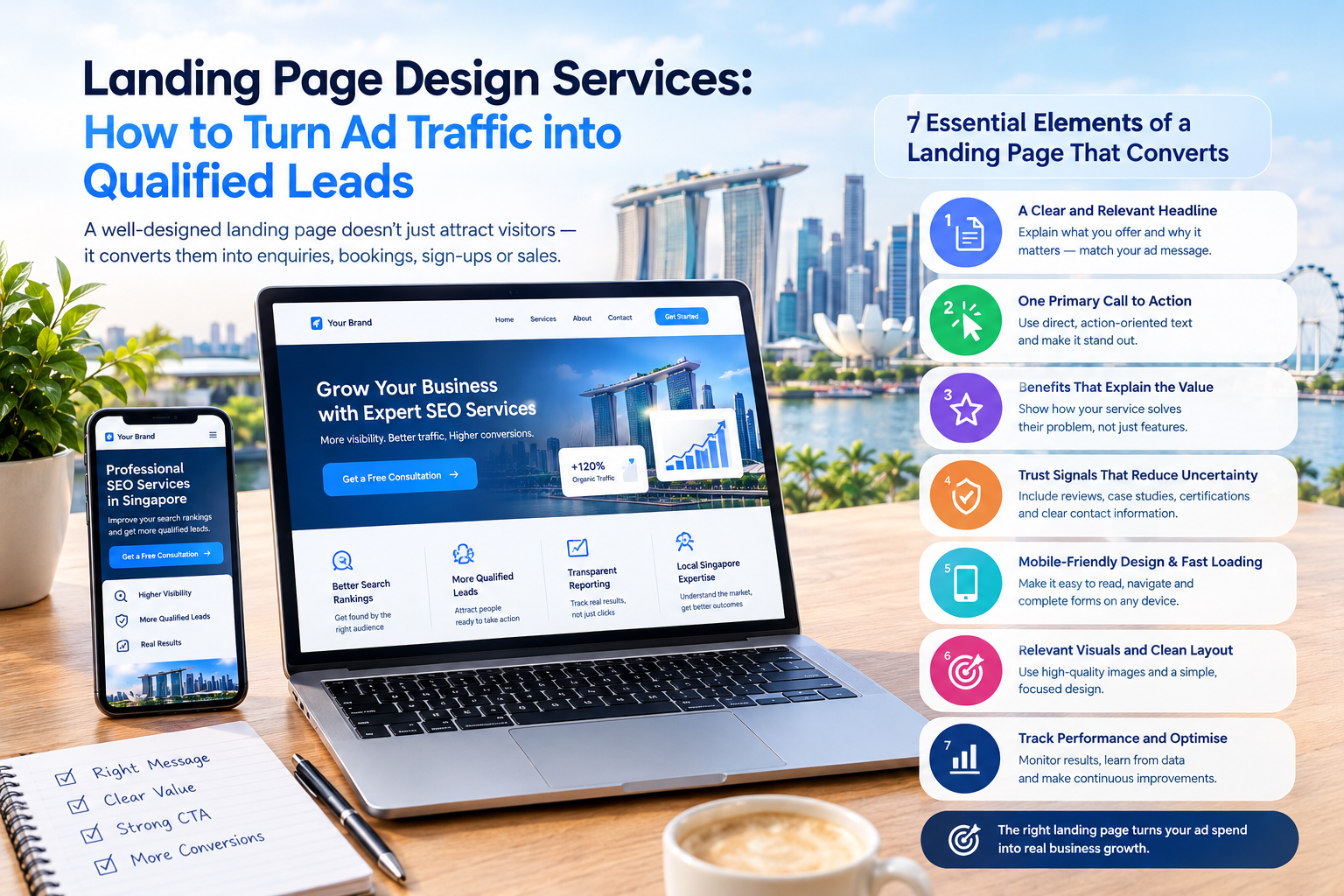
7 Essential Elements of a Landing Page That Converts
1. A Clear and Relevant Headline
The headline is often the first thing visitors notice. It should immediately explain what the business offers and why the visitor should care.
If someone clicks an advertisement promoting SEO services, the landing page should clearly discuss SEO rather than introduce unrelated marketing services.
This connection between the advertisement and the landing page is known as message match. When the headline, offer and supporting content reflect the visitor’s original interest, the page feels more relevant and easier to understand.
Avoid vague headlines that sound attractive but fail to explain the actual benefit.
2. One Primary Call to Action
Every landing page should have a clearly defined objective. Depending on the campaign, this might be requesting a consultation, booking a demonstration, purchasing a product or submitting an enquiry.
Use direct, action-orientated CTA text such as:
- Request a Consultation
- Get a Personalised Quote
- Book a Free Discovery Call
- Start Your Free Trial
The CTA should stand out visually and appear where visitors naturally expect to take action. Repeating the same primary CTA at relevant points can help visitors act when they are ready.
Avoid presenting too many competing options that distract users from the main goal.
3. Benefits That Explain the Value
Visitors want to understand how a product or service can solve their problem. A list of features may provide useful details, but benefits explain why those features matter.
For example, instead of simply stating that a service includes monthly reporting, explain how regular reports help businesses understand campaign performance and make informed marketing decisions.
Use concise headings, short paragraphs and relevant examples. Keep the content focused on the questions your target audience is most likely to ask before making a decision.
4. Trust Signals That Reduce Uncertainty
Potential customers may hesitate if they are unfamiliar with a business. Landing pages can address this concern through genuine trust signals, including:
- Verified customer reviews and testimonials
- Relevant case studies with substantiated results
- Industry certifications where applicable
- Clear business contact information
- Transparent service descriptions and pricing, where appropriate
- Explanations of the process and what happens after an enquiry
Place supporting evidence close to important decisions, such as the main enquiry form or CTA. Only use claims, testimonials and performance figures that can be verified.
5. Mobile-Friendly Design and Fast Loading
Many visitors access advertising campaigns through mobile devices. A landing page that looks impressive on a desktop but is difficult to use on a phone can create unnecessary friction.
Effective mobile landing page design should include readable text, appropriately sized buttons, responsive layouts and forms that are easy to complete. Images should be optimised, and unnecessary scripts should be limited to help the page load efficiently.
Businesses should also monitor relevant Core Web Vitals and real-user performance data. Faster pages support a smoother experience, although page speed alone does not guarantee higher conversion rates.
6. Simple Forms That Respects the Visitor’s Time
Every additional form field can create friction, particularly when visitors are not yet ready to make a major commitment.
Ask only for information needed at that stage of the customer journey. A basic enquiry might require a name, business email and a short description of the requirement. More complex services may need additional qualifying questions.
Make field labels clear, explain why sensitive information is requested when relevant, and provide helpful error messages. After submission, display a confirmation message or thank-you page so visitors know their enquiry was received.
7. Conversion Tracking and Continuous Testing
A landing page should be measured against its intended business outcome, not just its appearance or traffic volume.
Set up appropriate analytics and advertising conversion events to track actions such as form submissions, calls, purchases and booked appointments. Google Analytics 4, Google Tag Manager and advertising platform tracking can help businesses understand how visitors interact with their pages.
Once sufficient data is available, test meaningful changes such as headlines, CTA wording, form length or the placement of trust signals. Change one major element at a time where practical, and evaluate whether the results are statistically reliable before declaring a winner.
How Landing Pages Improve PPC Campaign Performance
Paid advertising and landing page design work best when they are planned together. An advertisement attracts attention and establishes an expectation. The landing page must fulfil that expectation by providing relevant information and a clear next step.
Consider a business spending money to promote a specific service. If every advertisement sends visitors to a homepage containing multiple unrelated services, visitors may struggle to find the information they expected.
A dedicated landing page can provide a more direct journey from advertisement to enquiry.
Businesses investing in PPC services in Singapore should therefore evaluate the entire conversion journey, including targeting, ad messaging, landing page relevance, lead quality and follow-up.
Useful metrics include:
- Conversion rate: The percentage of visitors who complete the desired action.
- Cost per conversion: Advertising spend divided by the number of recorded conversions.
- Qualified lead rate: The proportion of enquiries that meet the business’s requirements.
- Cost per qualified lead: Advertising spend divided by the number of qualified leads.
- Landing page engagement: Relevant interaction and behaviour metrics that help identify potential friction.
These measures help businesses understand whether campaigns are generating meaningful opportunities rather than simply attracting clicks.
Landing Page SEO: Can a Campaign Page Also Support Organic Search?
Although many landing pages are built for paid campaigns, some can also attract organic traffic when they provide useful information and satisfy a clear search intent.
To support organic visibility, use a descriptive page title, a clear heading structure, relevant keywords and genuinely helpful content. Optimise images, ensure the page works on mobile devices and use internal links where they help visitors explore related services.
However, not every advertising landing page needs to rank organically. Pages created for short-term promotions or tightly controlled paid campaigns may serve a different purpose. Indexing and canonical settings should reflect the site’s overall SEO strategy rather than being applied automatically.
A coordinated approach helps connect landing page performance with wider digital marketing services in Singapore, allowing businesses to consider paid acquisition, organic discovery and conversion optimisation together.
How Maninder Wave Can Help Businesses Improve Campaign Performance
Successful digital marketing involves more than bringing visitors to a website. Businesses also need relevant messaging, useful page content, reliable tracking and a clear path towards conversion.
Maninder Wave helps businesses approach digital growth through SEO, PPC and other digital marketing solutions. By reviewing campaign objectives, audience needs and website performance, businesses can identify opportunities to improve the journey from an initial click to a meaningful enquiry.
Whether you are launching a new advertising campaign or improving an existing one, start by identifying where visitors lose interest. Review the advertisement, landing page message, mobile experience, form and follow-up process before deciding what to change.
Want to make more of your advertising traffic? Explore Maninder Wave’s digital marketing services to discuss a strategy aligned with your business goals.
Frequently Asked Questions
A landing page guides visitors towards a specific action, such as submitting an enquiry, booking a consultation, purchasing a product or registering for an event. Its content and layout should support that objective.
Dedicated pages allow businesses to align their advertising message with the information visitors see after clicking. This can make the experience more relevant, reduce unnecessary navigation and help measure campaign conversions more accurately.
An effective landing page combines a relevant headline, a clear offer, persuasive benefits, credible trust signals, mobile-friendly design, a simple conversion process and reliable tracking. Its performance should be evaluated using real campaign data.
Landing page optimisation can help reduce friction and encourage more visitors to complete the intended action. When conversion rates improve, cost per conversion may decrease, provided traffic quality and other campaign factors remain reasonably consistent.
Review a landing page whenever the offer, audience, advertising message or business objectives change. Regular performance reviews can also reveal problems with mobile usability, form completion or conversion tracking. Make updates based on evidence rather than changing elements without a clear reason.
