








Blog
8 Best AI SEO Tools in 2026 for Smarter Digital Marketing
19 October 2026
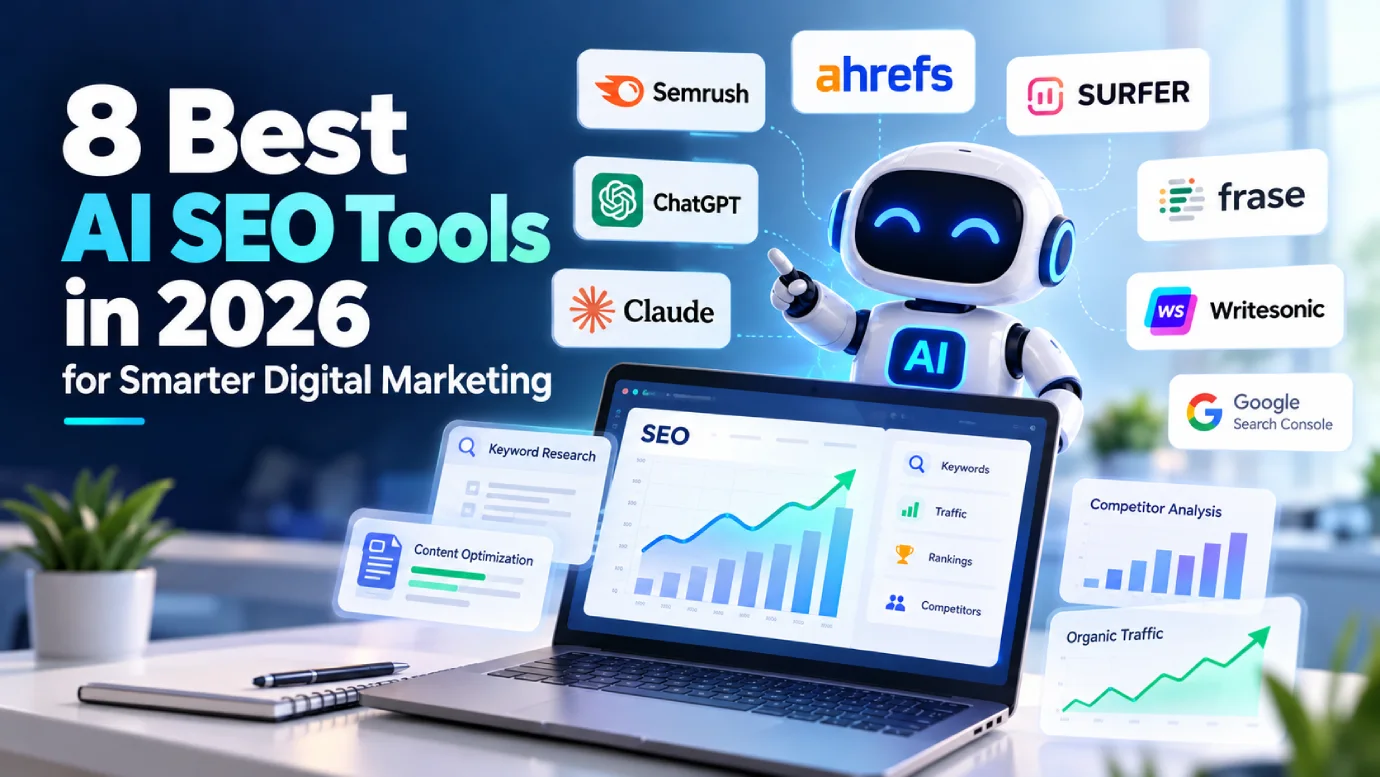
Artificial intelligence is changing how businesses approach search engine optimization, content creation, keyword research, and online marketing. In 2026, businesses can use AI SEO tools to discover valuable keywords, analyse competitors, improve website content, and identify opportunities to increase organic traffic.
For businesses targeting customers in the United States, choosing the right tools can make digital marketing more efficient and data-driven. From small businesses to established brands, AI-powered platforms can help marketing teams understand search intent, improve content quality, and build stronger SEO strategies.
However, AI tools are not a replacement for human expertise. The best results come from combining reliable data, original content, technical SEO, and a clear understanding of customer needs.
In this guide, we explore eight AI SEO tools that can support smarter digital marketing in 2026.
Why AI SEO Tools Matter for Digital Marketing in 2026
Traditional SEO often requires extensive manual research, competitor analysis, and content optimisation. AI can speed up many of these activities by identifying patterns, organising information, and helping marketers make informed decisions.
Businesses can use AI SEO tools to:
- Discover keyword opportunities and related search terms.
- Analyse competitor content and identify content gaps.
- Create SEO briefs and organise blog outlines.
- Improve on-page SEO and content relevance.
- Understand search intent and audience questions.
- Support visibility across traditional search engines and AI-powered search experiences.
For a digital marketing agency in USA, these capabilities can help streamline campaign planning while leaving more time for strategy, creativity, and performance analysis.
8 Best AI SEO Tools in 2026
1. Semrush: Best for All-in-One SEO Research
Semrush is a comprehensive digital marketing platform that helps businesses research keywords, analyse competitors, monitor rankings, and identify SEO opportunities.
Its keyword research and competitive analysis features can help marketers understand which topics attract search traffic and where competitors are gaining visibility. Its content-related features can also support the planning and optimisation process.
Best features:
- Keyword research and search volume analysis.
- Competitor domain and backlink research.
- Site audits and position tracking.
- Content research and optimisation features.
Best for: Businesses and marketing teams that need SEO research, competitor analysis, and campaign tracking in one platform.
2. Ahrefs: Best for Backlink and Competitor Analysis
Ahrefs is widely used for understanding website authority, backlink profiles, organic keyword performance, and competitor strategies.
Its research capabilities help marketers identify pages that attract links and discover topics competitors already rank for. These insights can inform content planning and link-building strategies.
Best features:
- Backlink analysis.
- Organic keyword research.
- Competitor content discovery.
- Website health monitoring.
Best for: SEO specialists and agencies looking to strengthen organic visibility through competitor research and link-building opportunities.
3. Surfer SEO: Best for On-Page Content Optimisation
Surfer SEO helps content teams optimise web pages using search-related data and recommendations. It can assist with analysing competing pages, organising relevant terms, and improving the topical coverage of articles.
Writers can use it while creating new content or refreshing existing pages.
Best features:
- Content editor and optimisation suggestions.
- Relevant keyword and term recommendations.
- Content auditing.
- SEO content planning support.
Best for: Businesses publishing regular blogs, landing pages, and educational resources.
Remember that an optimisation score is a guide, not a guarantee of higher rankings. Content should always remain useful and natural for readers.
4. Frase: Best for SEO Content Briefs
Frase supports the research and planning stages of SEO content creation. It can help marketers examine search results, identify common questions, and structure articles around user intent.
This is particularly useful when creating detailed blog briefs for writers or planning a content calendar.
Best features:
- SERP-based content research.
- SEO outlines and content briefs.
- Question and topic discovery.
- Content optimisation support.
Best for: Content marketers who want to reduce research time and produce better-organised articles.
5. ChatGPT: Best for SEO Brainstorming and Content Planning
ChatGPT can help marketers generate blog ideas, organise headings, develop content briefs, create FAQ drafts, and explain complex topics in accessible language.
It can also help transform keyword research into a practical content plan. For example, a marketer can provide a list of relevant search terms and ask for topic clusters, search-intent categories, or a draft outline.
Best features:
- Blog topic ideation.
- Content outlines and FAQ brainstorming.
- Keyword clustering assistance.
- Content editing and repurposing.
- SEO strategy documentation.
Best for: Marketing teams that need flexible support for research, planning, writing, and editing.
Always verify facts, statistics, and product details. ChatGPT can make mistakes, and AI-generated drafts should be reviewed before publication.
6. Claude: Best for Long-Form Content Development
Claude can assist with developing detailed articles, refining existing drafts, summarising research, and maintaining a consistent writing style across longer documents.
It can be useful when marketers need to turn a detailed brief into a structured article while preserving a clear argument and logical flow.
Best features:
- Long-form drafting and editing.
- Research-note summarisation.
- Content restructuring.
- Tone and readability improvements.
Best for: Content teams producing comprehensive guides, thought leadership articles, and in-depth educational resources.
Like other AI writing assistants, Claude should be used alongside fact-checking, editorial review, and original expertise.
7. Writesonic: Best for AI-Assisted Marketing Content
Writesonic offers AI-powered content creation and marketing workflows, with features that can vary by plan. It supports marketers who need help developing website copy, blog drafts, and other marketing assets.
Depending on the available features, it may also help teams explore content visibility in AI-powered search experiences.
Best features:
- AI-assisted article creation.
- Marketing copy generation.
- Content rewriting and expansion.
- SEO-related content workflows.
Best for: Businesses looking to speed up the production of multiple marketing content formats.
Before subscribing, compare the current feature set with your requirements and check whether its SEO or AI visibility features suit your workflow.
8. Google Search Console: Best for Measuring Organic Search Performance
Google Search Console is not primarily an AI writing tool, but it is an essential companion to AI-assisted SEO. It provides first-party information about how a website performs in Google Search.
Marketers can use the platform to identify queries that generate impressions and clicks, review page performance, and detect certain indexing or technical issues.
Best features:
- Search queries, clicks, and impressions.
- Page-level performance reports.
- Indexing and technical issue information.
- Search performance monitoring.
Best for: Website owners, SEO specialists, and digital marketing teams that need to measure real organic search results.
Combining Search Console data with AI analysis can help identify pages that need updates, but you should always check recommendations against actual performance and search intent.
How to Choose the Right AI SEO Tools for Your Business
The best tool depends on your marketing goals, budget, and existing workflow. Buying several overlapping subscriptions may increase costs without delivering meaningful improvements.
Consider these factors before choosing a platform:
Define Your SEO Goals
If your priority is keyword research, start with Semrush or Ahrefs. For content optimisation, consider Surfer SEO. For article briefs, Frase may be useful. ChatGPT and Claude can support ideation, drafting, and editing.
Evaluate Your Budget
Compare subscription prices, usage limits, team access, and the features included in each plan. Start with one or two tools that solve your biggest challenges before expanding your technology stack.
Check Data Quality
AI-generated suggestions are only useful when supported by reliable information. Verify keyword metrics, competitor findings, and search performance data using appropriate SEO platforms and Google Search Console.
Keep Content Helpful and Original
Avoid publishing large volumes of generic AI-generated articles. Every page should answer a genuine user question, demonstrate relevant knowledge, and provide information that adds value beyond competing pages.
How AI SEO Tools Support Smarter Digital Marketing
AI SEO tools can support a wider digital marketing strategy by connecting keyword research, content planning, website optimisation, and performance measurement.
For example, a business can use SEO research tools to identify customer questions, AI writing assistants to develop a content outline, and Google Search Console to evaluate results after publication.
A digital marketing company in the USA can use this process to organise campaigns more efficiently and help clients identify areas for improvement. AI can also support broader activities such as local SEO, paid search planning, social media content development, and lead generation when the selected tools are appropriate for those tasks.
At Maninder Wave, an effective digital marketing strategy should combine technology with human judgement, clear business goals, and consistent performance analysis. The objective is not simply to publish more content, but to create useful resources that attract relevant visitors and support business growth.
For businesses exploring AI-driven digital marketing, the most valuable investment is a workflow that connects research, execution, and measurable outcomes.
Common Mistakes to Avoid When Using AI SEO Tools
Even advanced tools can produce disappointing results when used without a clear strategy. Avoid these common mistakes:
- Targeting every suggested keyword: Choose terms that match your audience, services, and search intent.
- Publishing unverified information: Check facts, claims, statistics, and references before publishing.
- Ignoring technical SEO: AI content cannot fix crawlability, indexing, site speed, or website structure problems on its own.
- Over-optimising content: Write naturally instead of repeating keywords to reach an arbitrary score.
- Expecting guaranteed rankings: Search performance depends on many factors, including competition, content quality, technical health, and links.
- Ignoring results after publication: Monitor performance and update content when data reveals a genuine opportunity.
A balanced approach helps businesses use automation without sacrificing credibility or content quality.
Conclusion
The best AI SEO tools in 2026 help businesses reduce repetitive work, understand search opportunities, and create more organised digital marketing strategies. Semrush and Ahrefs support research, Surfer SEO and Frase help with content optimisation, ChatGPT and Claude assist with writing, Writesonic supports marketing content, and Google Search Console measures organic performance.
Choose tools according to your goals rather than popularity alone. With reliable data, original content, technical SEO, and ongoing measurement, businesses can build a more effective approach to search visibility and sustainable digital growth.
Frequently Asked Questions
Semrush, Ahrefs, Surfer SEO, Frase, ChatGPT, Claude, Writesonic, and Google Search Console are useful options for different SEO tasks. The best choice depends on whether you need research, writing support, content optimisation, or performance tracking.
AI SEO tools can help identify opportunities and improve content workflows, but they cannot guarantee rankings. Results depend on relevance, content quality, technical SEO, competition, and other ranking factors.
ChatGPT and Claude can help with topic ideation, outlining, drafting, and editing. Frase and Surfer SEO can support research and optimisation. Human review remains important for accuracy and originality.
Yes. Google Search Console is free, and some AI and SEO platforms offer free access or limited trials. Check current plan details because features, usage limits, and pricing can change.
Small businesses can use AI to research keywords, plan blogs, draft marketing content, identify customer questions, and organise campaigns. Combining these tools with local SEO, useful website content, and performance tracking can support more informed marketing decisions.
