








Blog
AI Answering Services for HVAC Companies in the USA: Book More Jobs 24/7
19 October 2026
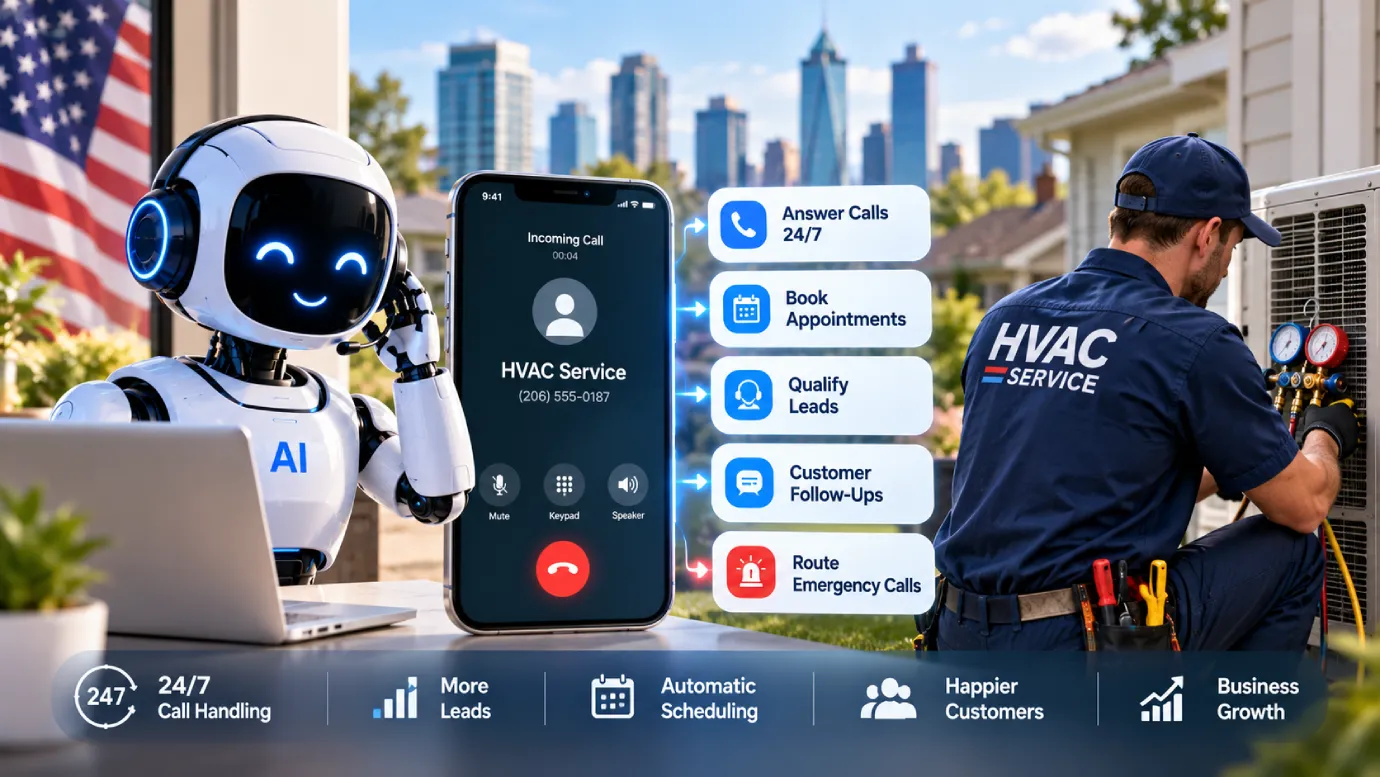
For HVAC contractors across the United States, every incoming call can represent a potential service appointment, an emergency repair, or a long-term customer relationship. However, when technicians are in the field and office staff juggle multiple responsibilities, answering every call becomes challenging. Customers who cannot reach a business may contact another contractor instead.
AI answering services offer a practical way to manage customer calls, capture service enquiries, and schedule appointments beyond regular office hours. By combining conversational AI with business software, HVAC companies can improve communication, organise incoming leads, and reduce their teams’ administrative burden.
For American HVAC businesses looking to improve customer acquisition and operational efficiency, understanding how AI phone answering works can help them choose a solution that fits their needs.
What Is an AI Answering Service for HVAC Companies?
An AI answering service for HVAC companies uses voice technology and artificial intelligence to answer incoming calls, understand customer requests, collect relevant information, and perform approved actions.
Unlike traditional voicemail, an AI phone answering system can guide callers through a conversation. Depending on its configuration, it may answer common questions, check service-area eligibility, schedule appointments, or transfer urgent calls to an on-call technician.
For example, a homeowner in Texas might call about an air conditioner that has stopped cooling. The AI answering system’s contact information, asks about the issue, confirms whether the address falls within the company’s service area, and helps arrange an available appointment.
When connected to a compatible scheduling platform, the system may also create a service request and send a confirmation message.
The exact capabilities depend on the software, integrations, and rules established by the HVAC business.
Why HVAC Businesses in the USA Miss Valuable Customer Calls
HVAC companies may ies experience changing call volumes throughout the year. Summer heat waves can increase demand for air conditioning repairs, while winter cold brings a surge in heating emergencies.
During these busy periods, technicians may be travelling between jobs, dispatchers may be coordinating schedules, and office employees may be assisting existing customers.
Common challenges include:
- Missed calls: Staff cannot always answer while managing other responsibilities.
- After-hours enquiries: Customers may need service when the office is closed.
- Delayed responses: Potential customers may contact competing contractors while waiting for a callback.
- Repetitive questions: Employees repeatedly explain service areas, operating hours, maintenance plans, and diagnostic fees.
- Manual scheduling: Staff must transfer information between phone calls, calendars, and field service software.
A reliable answering workflow helps reduce these communication gaps. Businesses should review their own call logs to understand how frequently missed calls occur and which enquiries are most likely to become booked jobs.
5 Ways AI Answering Services Help HVAC Companies Generate More Leads
1. Answer Customer Calls Around the Clock
An AI answering agent can provide call coverage during configured hours, including evenings, weekends, and holidays. This allows customers to receive an initial response even when the regular office team is unavailable.
The system can collect contact details, identify the type of service required, and record the enquiry for follow-up. Where supported, it can also help schedule an appointment directly.
For contractors serving multiple cities or counties, consistent call handling can help manage enquiries from different service areas without requiring an employee to answer every routine question.
2. Help Capture Emergency Service Requests
Heating and cooling problems sometimes require urgent attention. An AI answering system can follow predefined escalation rules to identify potentially urgent situations and notify the appropriate employee.
For instance, a caller reporting a furnace outage during freezing weather may need a faster response than someone requesting routine maintenance.
HVAC businesses should establish clear emergency criteria, backup contacts, and escalation procedures before activating the system. The AI should not diagnose dangerous conditions or replace professional safety guidance. Calls involving suspected gas leaks or carbon monoxide exposure should follow approved emergency instructions and direct callers to emergency services when appropriate.
3. Automate Appointment Scheduling
Scheduling appointments manually can create unnecessary delays, particularly when several customers call simultaneously.
An AI answering service connected to compatible scheduling software may check available appointment windows, collect booking details, and send confirmations. It can also support reminders and rescheduling workflows where those features are available.
Before selecting a platform, confirm whether it can access live technician availability and create actual jobs in your field service system. A tool that only records messages may not deliver the same operational benefits as one that completes the booking process.
4. Connect Marketing Campaigns With Lead Follow-Up
Generating traffic through SEO, Google Ads, or social media advertising is only part of customer acquisition. Businesses also need a process for responding to enquiries and turning suitable prospects into appointments.
AI answering services can complement these marketing activities by collecting information from callers, recording lead sources when available, and transferring details into a customer relationship management (CRM) system.
A lead generation agency or internal marketing team can use this information to understand which campaigns produce relevant service enquiries and booked jobs.
This creates a more connected process between advertising, customer communication, and sales performance. HVAC companies should measure results using qualified enquiries, appointment rates, and cost per booked job rather than relying only on call volume.
5. Reduce Repetitive Administrative Work
AI answering systems can manage routine questions about service availability, operating hours, maintenance plans, and approved pricing information.
When connected to business software, they may also create customer records, attach call summaries, and trigger follow-up messages.
This can give office staff more time to coordinate technicians, assist customers with complicated issues, and manage daily operations.
The objective is to support employees rather than eliminate the need for human judgement. Complaints, unusual requests, complex commercial enquiries, and sensitive situations should be transferred to a person when appropriate.
How to Choose the Right AI Phone Answering Service
Not every AI answering platform is suitable for every HVAC company. A small contractor with one technician may have different requirements from a multi-location business handling hundreds of calls.
Consider these factors before choosing a provider:
Scheduling and CRM integration: Check whether the platform connects with your existing calendar, customer records, and field service software.
Call accuracy: Test the system with different accents, background noise, equipment terminology, and common customer questions.
Emergency escalation: Confirm that urgent calls reach the correct employee and that backup contacts are available.
Human handoff: Make sure callers can speak with a team member when the AI cannot handle a request.
Pricing transparency: Review setup charges, monthly subscriptions, usage fees, integration costs, and support expenses.
Data protection: Understand how call recordings, transcripts, and customer information are stored and accessed. Review applicable federal and state privacy, recording, and communications requirements.
A practical starting point is to test the service on after-hours calls before expanding it to every incoming enquiry.
How to Measure the Results of AI Answering Automation
Before implementation, establish a baseline using your existing phone system and booking records. After launch, compare performance against the same measures.
Useful metrics include:
- Call answer rate: The percentage of incoming calls answered successfully.
- Booking conversion rate: The share of eligible enquiries that result in appointments.
- Missed-call recovery: The number of previously missed enquiries that become meaningful conversations or bookings.
- Response time: How quickly customers receive assistance.
- Cost per booked job: The total answering service cost divided by the number of jobs booked through the system.
- Customer satisfaction: Feedback about the quality and convenience of phone interactions.
These measurements help HVAC companies determine whether automation is improving customer communication and supporting business performance. Results will vary according to call volume, implementation quality, local demand, and service capacity.
At Maninder Wave, the focus is on helping businesses connect digital marketing activities with practical growth objectives. For HVAC contractors, combining lead generation with efficient enquiry management can make it easier to understand how marketing efforts contribute to real business opportunities.
Common Mistakes to Avoid When Implementing AI Answering
Even capable AI systems can create problems when their setup is incomplete. Outdated service information, incorrect appointment availability, and unclear escalation rules can frustrate customers.
To avoid these issues, maintain an accurate knowledge base, review call transcripts, test emergency scenarios, and ensure the system does not promise unconfirmed arrival times or unauthorised repair prices.
Start with a limited workflow, gather feedback from employees, and expand only when the system consistently handles routine calls correctly.
Conclusion
AI answering services can help HVAC companies across the USA manage customer calls, capture service enquiries, coordinate appointments, and improve follow-up processes. Their value depends on selecting the right technology, maintaining accurate business information, and establishing reliable procedures for urgent or complex situations.
Starting with after-hours calls or overflow enquiries allows contractors to test the system before expanding its responsibilities. By tracking bookings, response times, and operating costs, businesses can make informed decisions about whether automation supports their goals.
Maninder Wave supports a strategic approach to digital growth in which marketing, customer engagement, and measurable outcomes work together. With the right combination of technology and human oversight, HVAC businesses can build a more consistent customer experience and create a stronger foundation for sustainable growth.
Frequently Asked Questions
Yes. A compatible system can check available appointment windows and create bookings when integrated with the company’s scheduling or field service software.
Many platforms can be configured to answer calls outside regular office hours, collect service details, provide approved information, and route urgent enquiries according to established rules.
They can identify potential emergencies and follow predefined escalation procedures. Safety-critical situations require approved instructions and prompt referral to emergency services or qualified personnel when appropriate.
AI answering can capture enquiries, collect customer information, schedule appointments, and connect call records with CRM systems. These capabilities help businesses track which enquiries progress into booked jobs.
Businesses should evaluate call accuracy, scheduling integration, emergency handling, human handoff, data protection, pricing, and reporting capabilities before committing to a provider.
