










Blog
AI in Digital Marketing Canada: How Artificial Intelligence Is Transforming Business Growth in 2026
23 October 2026
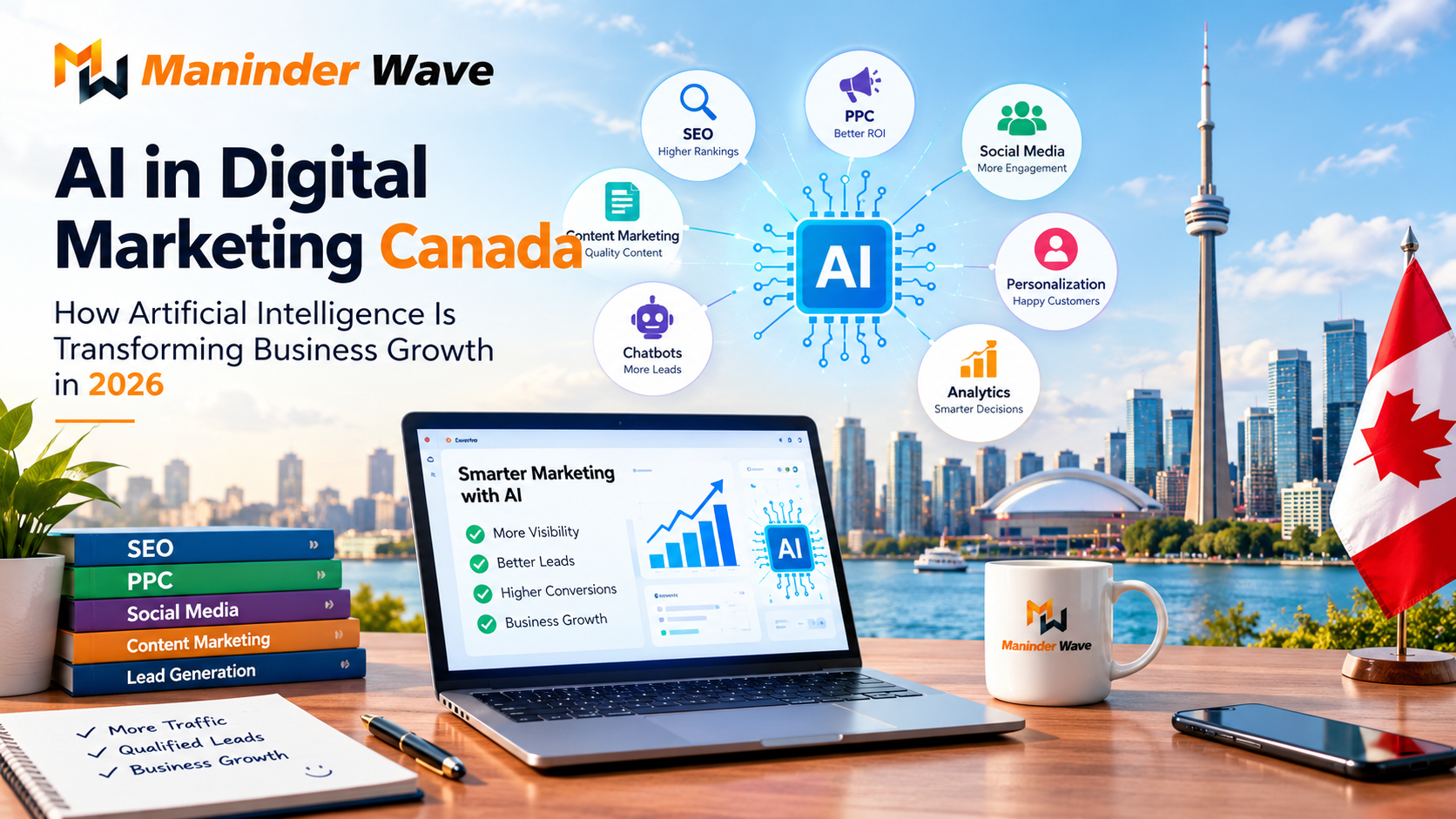
Artificial intelligence is changing how businesses across Canada attract customers, improve online visibility, and generate leads. From Toronto and Vancouver to Calgary, Ottawa, and Montreal, businesses are exploring AI-powered marketing tools to improve campaign performance, understand customer behaviour, and make smarter marketing decisions.
In 2026, digital marketing involves more than traditional SEO, social media posts, and paid advertising. Businesses are increasingly using artificial intelligence to automate repetitive tasks, personalize customer experiences, analyse campaign data, and adapt to changing search behaviour.
For Canadian businesses, adopting AI in digital marketing can create opportunities to improve marketing efficiency and compete in an increasingly digital marketplace. However, successful results still depend on a clear strategy, relevant content, reliable data, and a strong understanding of local customers.
This guide explains how artificial intelligence is transforming digital marketing in Canada, the strategies businesses can use, and how AI can support sustainable business growth.
What Is AI in Digital Marketing?
AI in digital marketing refers to the use of artificial intelligence technologies to support marketing activities such as SEO, content creation, audience targeting, advertising optimization, customer engagement, and performance analysis.
For example, a Canadian service business can use AI-assisted tools to identify customer questions, analyse website performance, create content outlines, or improve lead follow-up workflows.
Common applications include:
- AI-powered search engine optimization
- AI content marketing and research
- Automated Google Ads and Meta Ads workflows
- Social media marketing and engagement analysis
- Customer segmentation and personalization
- AI chatbots and lead qualification
- Marketing automation and predictive analytics
AI is most effective when it supports a well-defined business objective. Simply adopting more tools does not guarantee better marketing performance.
1. AI Is Transforming SEO Marketing in Canada
Search engine optimization remains important for Canadian businesses that want to attract customers through organic search. However, people increasingly discover information through traditional search results, AI-powered search experiences, and conversational tools.
Businesses need content that answers customer questions clearly while maintaining strong technical SEO foundations.
AI can help Canadian marketing teams:
- Research relevant keywords and search intent
- Identify content gaps on service pages
- Analyse competitors and search trends
- Improve website content structure
- Discover internal linking opportunities
- Support technical SEO audits
- Analyse organic traffic and conversions
For example, a Toronto-based accounting firm could create helpful content about its services, common customer questions, and the needs of local businesses. AI-assisted research may help identify relevant topics, while subject-matter experts ensure the information is accurate.
Businesses should also make their websites accessible to search engines, maintain accurate business information, and publish original content that demonstrates experience and expertise.
AI-generated content alone does not guarantee higher rankings. Helpful information, technical quality, relevance, and trust remain essential.
2. AI Content Marketing Helps Canadian Businesses Create Better Content
Content marketing allows businesses to educate potential customers, demonstrate expertise, and build trust before a purchase decision.
AI tools can help with blog outlines, keyword research, social media captions, email drafts, content repurposing, and editorial planning.
For example, a digital marketing agency serving Canadian businesses could transform one detailed article into a LinkedIn post, an email newsletter, and a short video script. Each version can be tailored to its audience and platform.
However, publishing large volumes of generic AI-generated content can weaken a brand’s credibility. Content should be fact-checked, edited, and enriched with original examples and useful insights.
Canadian businesses should also consider regional differences when creating content. Customer expectations, terminology, language preferences, and local search intent can vary between provinces and communities.
The goal is not simply to publish more content. It is to create information that helps potential customers solve problems and make informed decisions.
3. AI-Powered PPC Advertising in Canada
Pay-per-click advertising helps businesses reach potential customers through paid search and social advertising. AI-powered campaign features can support bidding, targeting, creative testing, and performance analysis.
Canadian businesses can use AI-assisted PPC strategies to:
- Test different advertising messages
- Optimize campaigns around conversion goals
- Analyse cost per lead and conversion rates
- Identify better-performing audience segments
- Improve campaign reporting
- Review advertising budget allocation
For instance, a Canadian home renovation company could run Google Ads targeting relevant services in its operating area. Rather than measuring success only through clicks, it could track qualified enquiries, consultation bookings, and customer acquisition costs.
Campaign performance can vary by industry, province, competition, and season. Businesses should review their own results instead of relying on generic performance benchmarks.
AI does not make every campaign profitable automatically. Effective PPC advertising still requires accurate conversion tracking, relevant landing pages, suitable targeting, and regular campaign oversight.
4. Personalized Marketing for Canadian Customers
Personalization helps businesses deliver more relevant messages to different customer groups. AI can analyse permitted customer data to support segmentation, recommendations, and behaviour-based communication.
Applications include:
- Personalized email campaigns
- Relevant product or service recommendations
- Customer segmentation
- Targeted advertising creative
- Automated follow-up messages
- Tailored website experiences
For example, a Canadian B2B company might share different educational resources with visitors researching SEO services and those comparing PPC advertising solutions.
Personalization must respect customer privacy and applicable Canadian requirements. Businesses should understand their obligations under relevant privacy laws, including PIPEDA where applicable and provincial privacy legislation where relevant.
The objective is to make communication more useful without collecting unnecessary data or creating intrusive customer experiences.
5. AI Chatbots and Lead Generation
AI chatbots can help Canadian businesses answer common questions, guide website visitors, and collect enquiries outside normal business hours.
A service-based business could use a chatbot to ask visitors about their objectives, required services, business location, and preferred contact method before directing them to a consultation form.
AI chatbots can support:
- Frequently asked questions
- Initial lead qualification
- Service information
- Consultation requests
- Customer support
- Routing enquiries to the appropriate team
Businesses should ensure that chatbots provide accurate information and clearly explain when a customer should speak to a human representative.
They should also avoid promising guaranteed rankings, sales, or advertising results.
When properly implemented, conversational AI can improve the customer journey and help marketing teams prioritize relevant enquiries.
6. AI Is Changing Social Media Marketing in Canada
Social media marketing remains a useful way for businesses to build awareness, communicate with customers, and promote their services.
AI can help marketing teams develop content ideas, prepare publishing calendars, analyse engagement, and adapt content for different platforms.
For example, a Canadian professional services company could publish an educational LinkedIn article, repurpose its main points into short social posts, and create an email newsletter around the same subject.
However, each platform requires an appropriate communication style. Copying identical content everywhere may not deliver the best experience.
Businesses should monitor meaningful indicators such as website visits, qualified enquiries, conversions, and customer interactions rather than relying exclusively on likes and impressions.
Human creativity and authentic communication remain important for building long-term relationships with Canadian audiences.
7. Predictive Analytics for Smarter Marketing Decisions
Predictive analytics uses historical data and statistical or machine-learning methods to estimate potential future outcomes.
Canadian businesses can use these insights to support campaign planning, audience segmentation, budget decisions, and demand forecasting.
For example, a business could analyse historical enquiry data to understand which services attract the most qualified leads. The team could then test different campaign budgets and messaging to see whether performance improves.
AI predictions are not guarantees. Data quality, competition, economic conditions, and changing customer behaviour can affect outcomes.
Businesses should validate predictions against actual performance and use them as decision-support tools rather than unquestionable answers.
8. Marketing Automation and Customer Journeys
Marketing automation connects activities across the customer journey, from initial discovery to enquiry and follow-up.
A typical journey for a Canadian business could include:
- A potential customer discovers the business through Google Search or an advertisement.
- The visitor reads a relevant service page.
- The visitor submits an enquiry or requests a consultation.
- The CRM records the lead and assigns it to the appropriate team.
- A relevant follow-up message is sent where appropriate.
- The business tracks whether the enquiry becomes a customer.
AI can help categorize enquiries, summarize interactions, and suggest relevant follow-up actions.
Automation should be tested regularly to prevent inaccurate messages, duplicate records, and irrelevant follow-ups. Businesses should also ensure that marketing communications comply with applicable Canadian anti-spam requirements, including CASL where relevant.
9. How to Measure AI Digital Marketing ROI in Canada
Investing in AI tools is worthwhile only when the investment supports meaningful business outcomes.
Canadian businesses should track metrics relevant to their objectives.
| Marketing objective | Key performance indicators |
| SEO marketing | Organic traffic, qualified visits, conversions |
| PPC campaigns | Cost per lead, conversion rate, acquisition cost |
| Content marketing | Engaged visits, enquiries, assisted conversions |
| Social media | Qualified traffic, engagement, conversions |
| Lead generation | Qualified leads, lead-to-customer rate |
| Marketing automation | Time saved, workflow accuracy |
| Business growth | Revenue contribution and customer lifetime value |
Businesses should establish a baseline before implementing an AI solution and compare performance over an appropriate period.
For example, if an AI-assisted workflow reduces reporting time, the business can measure the hours saved. If AI supports paid advertising, the business should also examine lead quality and customer acquisition costs.
Measuring both efficiency and business outcomes helps companies make more informed investment decisions.
10. Challenges of AI Digital Marketing in Canada
Although AI offers significant opportunities, Canadian businesses should consider several challenges before adopting new tools.
Accuracy: AI-generated information may contain errors and requires review.
Privacy: Customer data must be handled responsibly and in accordance with applicable laws.
Implementation costs: Software, training, integration, and ongoing maintenance can increase expenses.
Brand consistency: Excessive automation may make content sound generic.
Measurement: Businesses need clear benchmarks to determine whether AI improves performance.
Human oversight: Important decisions involving customers, budgets, and brand reputation require appropriate review.
An effective AI strategy balances automation with expertise, accountability, and regular performance evaluation.
11. How to Build an AI Digital Marketing Strategy for Canadian Businesses
Businesses can introduce AI gradually instead of changing their entire marketing operation at once.
Step 1: Identify Your Business Goals
Decide whether you want to increase organic visibility, generate qualified leads, improve campaign efficiency, or save time on repetitive tasks.
Step 2: Understand Your Canadian Audience
Research customer needs, relevant search terms, service areas, and regional differences. Use genuine customer insights rather than relying entirely on automated assumptions.
Step 3: Choose Relevant AI Tools
Select tools that address specific problems, such as content research, reporting, campaign optimization, or customer support.
Step 4: Integrate AI Into Existing Workflows
Ensure the tools work with your website, analytics, CRM, and marketing processes without creating unnecessary complexity.
Step 5: Establish Human Review
Check content accuracy, customer communications, privacy practices, and important campaign decisions.
Step 6: Measure and Improve
Compare results against your baseline. Expand successful workflows and adjust those that do not deliver measurable value.
This gradual approach can help businesses build an AI marketing system that supports sustainable growth.
Conclusion: AI Is Shaping the Future of Digital Marketing in Canada
Artificial intelligence is transforming digital marketing by helping Canadian businesses improve SEO, content development, PPC advertising, customer engagement, and marketing automation. These capabilities can support more efficient workflows and better-informed decisions when they are connected to clear business objectives.
However, long-term growth requires more than technology. Businesses need useful content, accurate information, strong customer relationships, responsible data practices, and consistent performance measurement.
At Maninder Wave, businesses can explore integrated digital marketing services, including search engine optimization, social media marketing, Google and Meta Ads, content marketing, email marketing, and lead generation. By combining data-informed marketing strategies with suitable AI-powered tools and human expertise, businesses can work towards stronger online visibility and more qualified enquiries in Canada.
The key is to choose AI applications that solve real problems, measure their impact, and continue improving your marketing strategy as customer expectations and digital platforms evolve.
Frequently Asked Questions
AI in digital marketing in Canada involves using artificial intelligence to support SEO, content creation, paid advertising, customer engagement, marketing automation, and performance analysis for businesses operating in the Canadian market.
AI can help Canadian businesses identify customer needs, improve marketing workflows, analyse campaign performance, personalize communication, and support lead generation. Results depend on implementation, data quality, and the business strategy.
Common applications include keyword research, content planning, advertising optimization, customer segmentation, chatbots, predictive analytics, and marketing automation. Businesses should prioritize applications that solve a measurable problem.
AI can support keyword research, content analysis, technical audits, and search-intent research. It cannot guarantee higher rankings. Strong technical SEO, relevant content, and a positive user experience remain important.
AI-powered advertising features can assist with bidding, audience targeting, creative testing, and performance analysis. Businesses should measure qualified leads, conversions, and acquisition costs rather than clicks alone.
AEO focuses on making content useful for answer-oriented search experiences, while GEO focuses on visibility in generative AI experiences. Both complement foundational SEO practices, but neither guarantees inclusion in AI-generated answers.
Yes. Small businesses can begin with affordable, focused applications such as content planning, email drafting, reporting, and customer support. They should evaluate costs, privacy, and measurable benefits before expanding.
Businesses can compare tool and implementation costs with outcomes such as time saved, qualified enquiries, conversion rates, customer acquisition costs, and revenue contribution.
AI can automate selected tasks, but agencies continue to provide strategy, creative judgement, technical expertise, campaign management, and human accountability. Combining AI tools with professional expertise can support more effective marketing.
Start with one business objective, review existing marketing data, select an appropriate tool, establish human oversight, and measure results. Expand the strategy gradually as evidence of value becomes available.
