







Blog
How AI Chatbots Support Digital Marketing for Homebuilders
12 October 2026
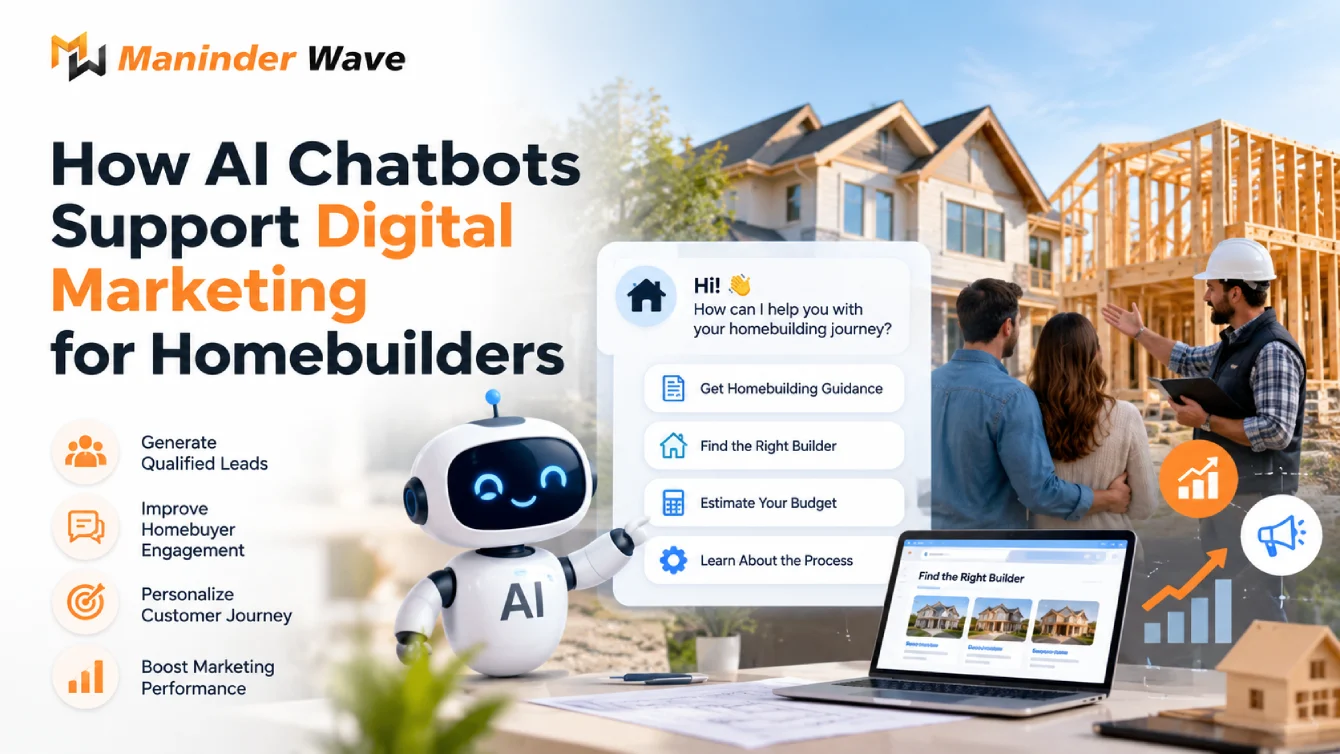
The homebuilding industry is becoming more competitive as buyers research properties, compare builders, and explore construction options online. Homebuilders need effective digital marketing strategies to attract potential customers, answer questions quickly, and turn website visitors into qualified leads.
AI chatbots can help businesses achieve these goals by providing instant responses, collecting project requirements, and guiding homebuyers toward relevant services. When integrated with a broader digital marketing strategy, chatbots can improve customer engagement and make lead management more efficient.
For homebuilders looking to strengthen their online presence, Maninder Wave understands the importance of combining digital marketing with technology to support business growth. This article explores how AI chatbots can improve marketing performance and create a smoother experience for prospective homebuyers.
1. How AI Chatbots Help Homebuilders Generate Qualified Leads
Generating qualified leads is a major challenge for homebuilders. Many website visitors are simply researching their options, while others are ready to discuss budgets, locations, and construction plans.
An AI chatbot can ask visitors relevant questions to understand their needs. For example, it might ask about their preferred location, property type, estimated budget, number of bedrooms, and expected construction timeline.
Based on these responses, the chatbot can organize visitor information into a structured lead profile. The sales team can then prioritize enquiries that match its services and follow up with more relevant information.
Chatbots can also collect contact details when visitors agree to share them. This helps homebuilders identify potential customers without relying entirely on manual enquiry forms.
2. Using AI Chatbots to Improve Homebuyer Engagement
Homebuyers often have questions about construction costs, design options, permits, timelines, and the building process. If they cannot find answers quickly, they may leave a website and continue researching elsewhere.
An AI chatbot can provide immediate responses to common questions and guide visitors toward relevant website pages. It can explain basic construction terminology, describe the stages of homebuilding, and help users understand what information they should prepare before contacting a builder.
For example, a visitor researching a custom home might ask what affects construction costs. The chatbot could explain how location, materials, home size, site conditions, and design choices influence the overall budget.
However, construction costs and regulatory requirements vary by location. Chatbots should communicate these limitations clearly and direct users to qualified professionals for accurate estimates or technical advice.
3. How AI Chatbots Support Digital Marketing Campaigns for Homebuilders
Digital marketing campaigns often attract visitors through search engines, paid advertising, social media, and email. An AI chatbot can help businesses make better use of this traffic by giving visitors a direct way to ask questions and express interest.
For example, a homebuilder running a Google Ads campaign for custom homes could connect the landing page to a chatbot. Instead of asking every visitor to complete a lengthy form, the chatbot could guide interested users through a short conversation about their project.
This approach can help marketers understand which enquiries are relevant and where visitors need additional information before contacting the sales team.
Chatbot interactions can also reveal recurring customer questions. Marketing teams can use these insights to improve landing pages, develop blog topics, and clarify service information.
To measure performance, homebuilders should track meaningful metrics such as qualified enquiries, appointment bookings, conversion rates, and cost per lead. A high number of chatbot conversations alone does not necessarily indicate better marketing results.
4. Personalizing the Homebuyer Journey With AI Chatbots
Every homebuyer has different priorities. Some want an affordable family home, while others are interested in luxury properties, energy-efficient designs, or custom construction.
AI chatbots can use the information visitors voluntarily provide to offer more relevant responses. Someone interested in a single-storey home might receive guidance about accessibility and layout options, while a visitor planning a larger property could explore design requirements and construction stages.
This personalization can make the website experience more useful without requiring every visitor to speak with a sales representative immediately.
Homebuilders should also respect visitor privacy. Chatbots should request only the information needed to assist with an enquiry, explain how submitted details will be used, and avoid collecting sensitive personal or financial information unnecessarily.
5. How AI Chatbots Help Match Homebuyers With the Right Builders
Finding a suitable builder involves more than choosing the first company that appears in search results. Homebuyers need to consider location, experience, project type, budget, previous work, and professional credentials.
An AI chatbot can collect these requirements and organize them into a clear project profile. If connected to an accurate builder directory or customer management system, it may help identify businesses whose services appear relevant to the project.
For example, a homeowner planning a custom two-storey property could be directed toward builders who work in the required area and have experience with similar residential projects.
These recommendations should be treated as a starting point, not a guarantee of quality or availability. Homebuyers should independently verify licensing, insurance, references, portfolios, contracts, and warranty terms before choosing a builder.
6. Integrating AI Chatbots With CRM and Lead Generation Tools
A chatbot becomes more useful when it connects with the systems a homebuilding business already uses. Customer relationship management (CRM) software can store enquiry details, organize follow-ups, and help sales teams manage their pipelines.
With an appropriate integration, chatbot responses can be used to create lead records, assign enquiries to team members, schedule consultations, or trigger follow-up communications.
For example, a visitor planning to begin construction within six months could be categorized differently from someone who is only exploring design ideas. This helps the sales team tailor its follow-up according to the visitor’s needs and readiness.
Before implementing these connections, businesses should confirm that their chatbot and CRM support the required integrations. They should also establish clear processes for data accuracy, consent, access permissions, and human review.
7. Best Practices for Using AI Chatbots in Homebuilder Marketing
To get useful results from chatbot technology, homebuilders should focus on customer needs rather than automation alone.
Consider these practical recommendations:
- Define clear goals: Decide whether the chatbot should answer questions, qualify leads, book consultations, or support builder discovery.
- Use reliable information: Keep service details, project examples, contact information, and other business information up to date.
- Make conversations simple: Ask only relevant questions and avoid overwhelming visitors with long forms.
- Provide human support: Give visitors a clear way to contact a real team member when their questions require specialist knowledge.
- Track conversions: Measure qualified leads, booked consultations, and sales opportunities rather than counting conversations alone.
- Review chatbot responses: Check for inaccurate information, confusing answers, and gaps in the customer journey.
- Protect customer data: Follow applicable privacy requirements and communicate data collection practices clearly.
Maninder Wave recognizes that effective digital marketing depends on understanding customer intent and creating useful online experiences. Chatbots can support this process when they are integrated thoughtfully into a wider marketing plan.
Conclusion
AI chatbots offer homebuilders a practical way to improve customer engagement, streamline enquiries, and support digital marketing campaigns. From qualifying leads to organizing project requirements and assisting with builder discovery, they can make the early stages of the homebuilding journey more efficient.
However, chatbots work best when combined with accurate information, reliable marketing campaigns, human expertise, and clear follow-up processes. Homebuilders should focus on helping prospective customers make informed decisions rather than automating every interaction.
Maninder Wave supports the principle that technology and digital marketing should work together to create better customer experiences and sustainable business growth.
Frequently Asked Questions
AI chatbots can answer common questions, qualify enquiries, collect project requirements, and guide visitors toward relevant services. These functions can support lead generation and improve the website experience.
Yes. Chatbots can ask relevant questions about location, budget, property type, and timeline to help identify promising enquiries. Lead quality still depends on the questions asked and the accuracy of the information collected.
They can organize project requirements and suggest builders based on available information about location, specialization, and experience. Homebuyers should independently verify every recommendation before making a decision.
Many chatbot platforms support CRM integrations or connections through APIs and automation tools. The available features depend on the specific chatbot and CRM system.
Homebuilders can monitor qualified leads, appointment bookings, conversion rates, response quality, and cost per lead. These metrics help determine whether the chatbot is contributing to meaningful business outcomes.
