









Blog
Claude Code Now Refuses to Recreate Existing Video Games: What Changed and Why It Matters
2 November 2026
Quick answer
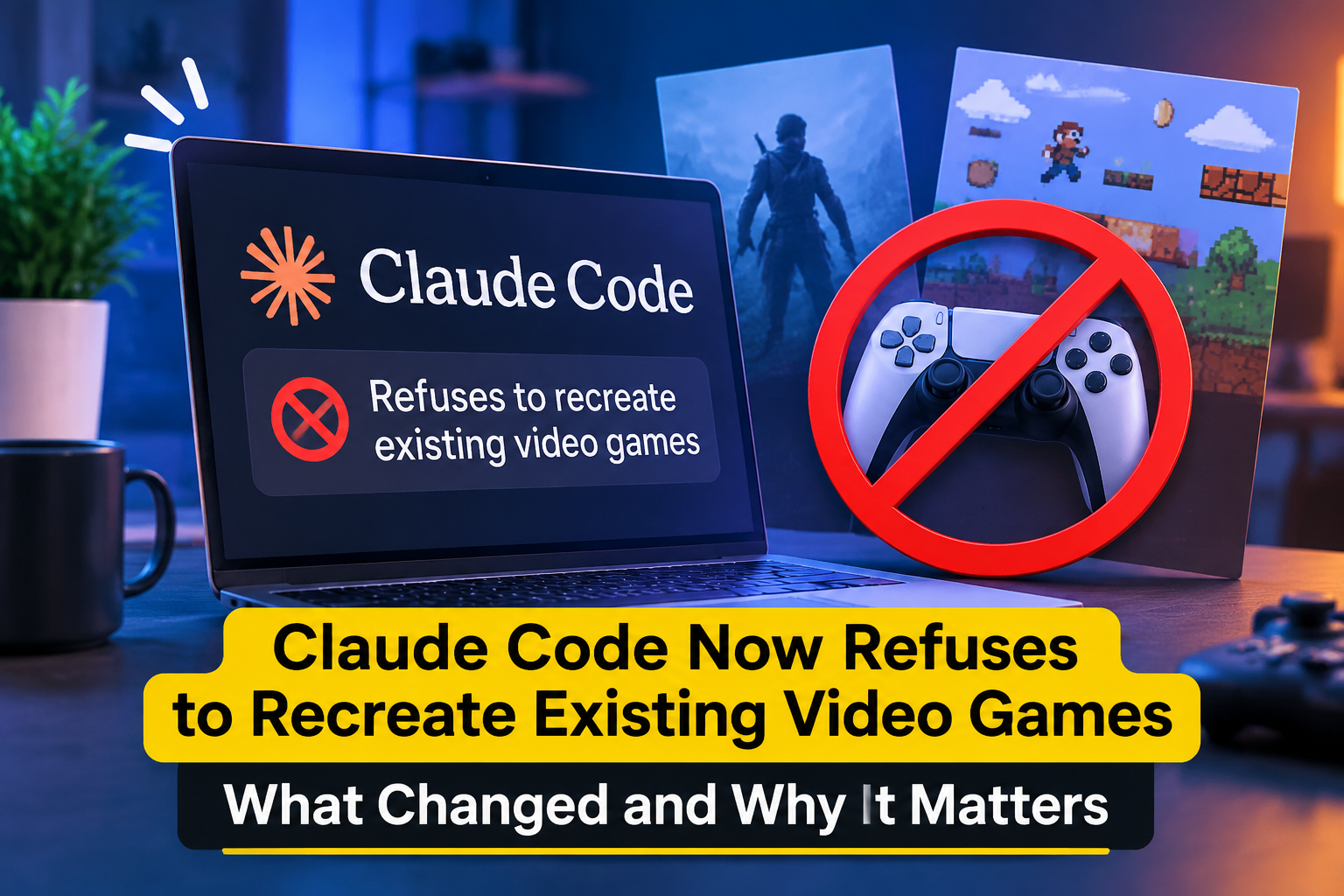
In late October 2026, Anthropic added a short instruction to Claude Code, running on Opus 5.5, that steers the tool away from rebuilding someone else’s specific game. Original games, genre-based games, and projects built from a user’s own designs and assets are meant to keep working. Anthropic says the change exists because using Claude to infringe intellectual property violates its usage policy.
Key Takeaways
- The rule reportedly went live around October 27, 2026, and was first noticed by a user on X.
- Anthropic confirmed the update and described it as two added sentences in Claude Code’s prompt.
- The target is recreation of a specific existing game, even if it is renamed or presented as original.
- Making your own game, or a game in a familiar genre, is still supported.
- Critics note the rule may only stop the laziest copycats and that open-weight models remain an alternative.
What Exactly Did Anthropic Change?
Claude Code is Anthropic’s coding assistant, used by developers and hobbyists to build software from natural-language instructions. Around October 27, a user on X reported that a new rule had appeared in the tool’s internal instructions. It tells the assistant to support original games, games in a recognizable genre, and games based on the user’s own designs and assets. It also tells the assistant not to build a copy of a particular existing title, even when the copy has been given a new name or is described as original.
The user who spotted it also claimed the rule cannot be switched off. That detail comes from the user’s report rather than from Anthropic.
Anthropic later confirmed the change through a statement from a member of its technical staff. In short, two sentences were added to Claude Code’s prompt on Opus 5.5 to nudge it away from recreating another studio’s specific game. The stated reason was that infringing intellectual property with Claude is against Anthropic’s usage policy. The company added that original games, genre games, and games made from your own designs and assets should continue to work, and that it will keep adjusting the approach to find the right balance.
Why Are Game Remakes Such a Big Issue Right Now?
AI coding tools have made it far cheaper to build a playable game. A person with a clear description, or a set of screenshots and gameplay footage, can now produce a working prototype in a fraction of the time a studio would need. Some people use that power for fun, such as recreating a childhood favorite for personal enjoyment. Others use it for profit, rushing a lookalike to a storefront.
That second use is what has rattled independent developers. For a small team, a public demo or playtest is a marketing tool, but it can also become raw material for a copycat. If a clone ships first, the original may struggle to stand out.
How Developers Have Reacted to AI Cloning
The fear is no longer theoretical. According to the report, several studios have changed their plans:
- Digital Sun Games cancelled a planned public playtest for its upcoming game ReVamp, worried that someone might feed the demo into an AI tool and release a rival version.
- Other studios have reportedly pulled back from public demos around showcase events such as Steam Next Fest for similar reasons.
- Developers have also pressed Valve to explain how Steam will stop low-effort clones from displacing the games they copy. Valve responded with a rare public explanation to developers in South Korea earlier in the same week.
These responses show how seriously the community treats the problem. When studios stop showing their work to players, the whole ecosystem loses early feedback and word of mouth.
What Is Still Allowed With Claude Code?
This is the question most readers search for first, so here is a clear breakdown.
| Request | Likely outcome |
| A brand-new game with your own concept | Supported |
| A game in a broad genre (roguelike, platformer, farming sim) | Supported |
| A game built from your own art, music, and design documents | Supported |
| A 1:1 rebuild of a named commercial game | Steered away |
| A renamed copy of an existing game presented as original | Steered away |
The line is drawn at specific existing games. Genres, mechanics, and styles are generally not owned by anyone, which is why genre-inspired development remains a normal and healthy part of the industry. Whether a given project crosses the line in a legal sense is a question for courts and lawyers, not for a coding assistant, so treat the table above as a practical guide rather than legal advice.
Will This Rule Actually Stop Game Cloning?
Honestly, probably only in part. The original report raised several fair doubts.
1. Safety rules can be worked around. Researchers and journalists have repeatedly shown that guardrails on generative AI tools can sometimes be sidestepped through clever phrasing or persuasion. A determined person may find a way to describe a clone without triggering the rule.
2. Ownership is hard to judge. The software cannot easily verify whether a user truly owns a game idea or its assets. A developer who is rebuilding their own old project could, in theory, be turned away by mistake. Anthropic’s invitation for affected users to report wrongly blocked requests suggests it expects some false positives.
3. Other tools exist. If one assistant becomes inconvenient, cloners can move to open-weight models that run without comparable restrictions. That means the rule may reduce casual misuse more than organized copying.
So the update is best understood as a policy signal and a first line of defense, not a complete solution.
What This Means for Indie Developers
If you make games, the news is mixed but useful. Here are practical steps worth considering:
- Think before releasing playable builds. Weigh the marketing benefit of a public demo against the cloning risk, especially for small projects with a distinctive hook.
- Document your creative process. Dated design notes, concept art, and version history can help you demonstrate that an idea originated with you.
- Register and protect your assets. Trademarks, copyright registration, and clear licensing terms give you stronger footing if you ever need to act.
- Report clones quickly. Storefronts generally have takedown channels, and prompt, well-documented reports tend to work better than vague complaints.
- Build community early. A loyal audience is harder to copy than a mechanic. Players who follow your journey are more likely to choose the original.
What This Means for People Who Use AI to Build Games
If you use AI coding tools for game development, the practical lesson is simple: lean into originality. Describe your own concept, your own characters, and your own rules. Use the genre as a starting point instead of a template to duplicate. Work from assets you created or have the right to use. If a legitimate request gets declined, Anthropic has said it wants to hear about it, which gives you a way to flag mistakes.
Beyond avoiding a blocked request, original work simply has a better chance of finding an audience. Players can already find the famous titles. They come to new games for something they have not seen before.
The Bigger Picture: AI Companies and Intellectual Property
This update fits a wider pattern. As AI systems gain the ability to produce complete software, images, music, and text, their makers are being pushed to decide where assistance ends and infringement begins. Usage policies that once seemed abstract are now being translated into concrete behavior inside products.
Expect more of this. Other AI providers face the same pressure from creators, publishers, and platform holders. How consistently these rules are applied, how transparent companies are about them, and how easily honest users can appeal mistakes will shape trust in the technology.
For the game industry in particular, the debate is only beginning. Studios want protection from copycats, tool makers want to avoid facilitating infringement, and creators want freedom to experiment. Balancing those three goals will take ongoing adjustment rather than a single rule.
Conclusion
Anthropic’s update to Claude Code is a small change with large symbolic weight. By steering the assistant away from rebuilding specific existing games, the company is acknowledging that AI-powered cloning is a real concern for developers, while still protecting the freedom to create original and genre-based work.
The rule will not end game cloning on its own. Workarounds, ownership questions, and unrestricted alternative models all limit its reach. Still, it shows that major AI companies are starting to turn intellectual property policies into real product behavior, and that developers’ worries are being heard.
For creators, the takeaway is the same as it has always been: make something that is unmistakably yours. AI can speed up the work, but originality is still what makes a game worth playing.
Frequently Asked Questions
Yes. Anthropic says original games, genre games, and games built from your own designs and assets are meant to keep working. Only recreations of a specific existing game are discouraged.
The rule was reportedly added around October 27, 2026, and Anthropic confirmed the update a few days later.
Anthropic says using Claude to infringe intellectual property is against its usage policy, and the added instruction is meant to steer the model away from recreating someone else’s specific game.
According to the reported wording, no. The rule is aimed at recreations of a specific game even when they are renamed or described as original.
A user who spotted the update claimed there is no way to disable it. Anthropic has not described any opt-out in its public statement.
Anthropic described the change as an addition to Claude Code’s prompt on Opus 5.5.
Anthropic has indicated it wants to hear about wrongly declined requests from users working on their own projects. Providing context such as your own designs and assets can also help clarify the request.
Unlikely. Guardrails can sometimes be bypassed, ownership is difficult for software to verify, and open-weight models without similar limits are available.
