











Blog
Oracle’s AI-Powered Analytics Applications for Banks and Insurers: What Financial Institutions Need to Know
12 November 2026
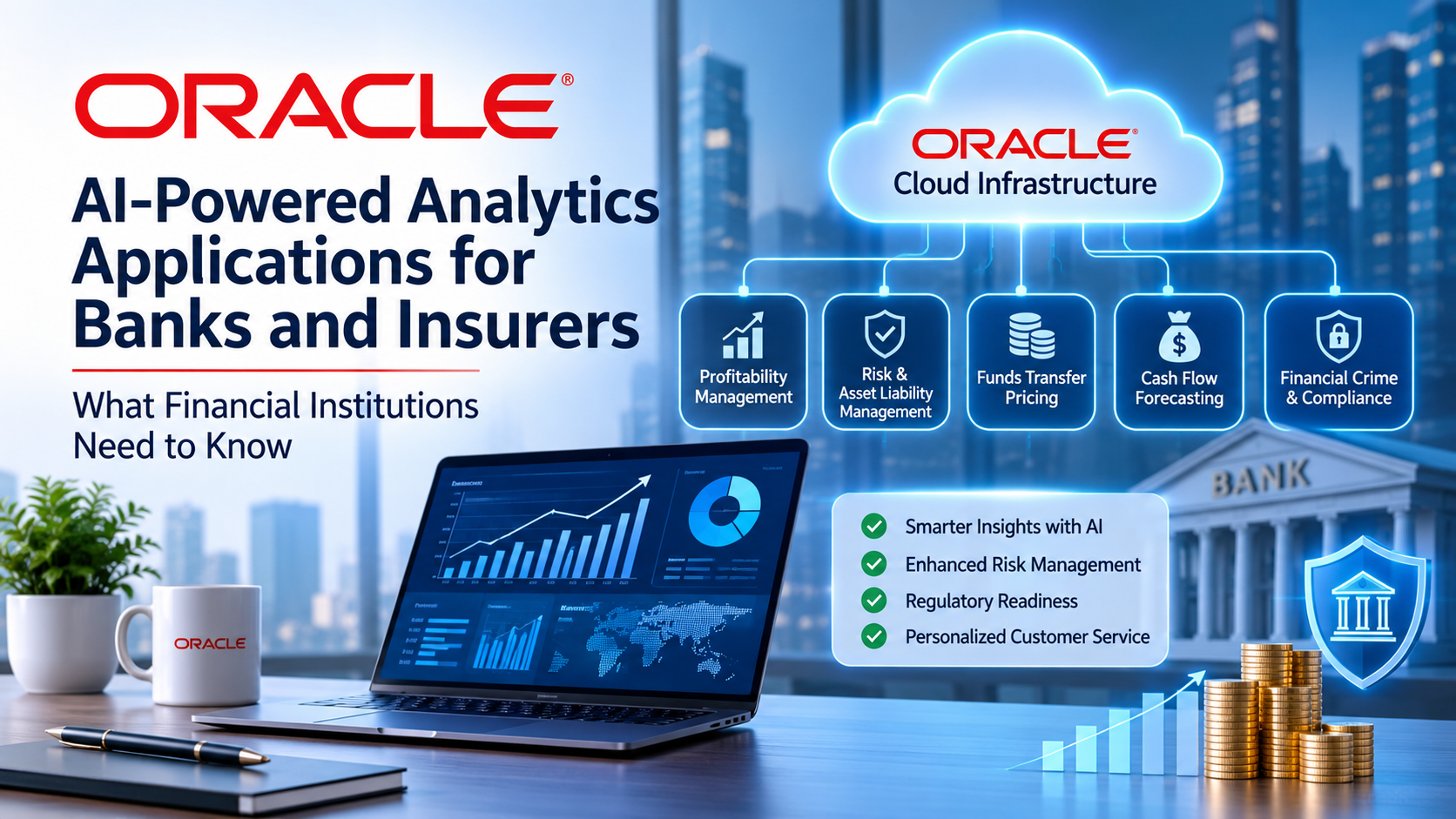
Oracle’s AI-powered analytics applications for banks and insurers are cloud-based tools that combine financial data, machine learning and generative AI. They help institutions understand profitability, manage risk and investigate suspicious activity faster. They run on Oracle Cloud Infrastructure, can be adopted one module at a time, and receive regular updates so firms avoid heavy upgrade projects.
Banks and insurers have never had more data, and many have never felt less certain about what it says. Margins are under pressure, regulators want faster and more detailed reporting, and customers expect instant, personal service. In that setting, Oracle’s push into AI-powered analytics for financial institutions is worth a close look, whether you work in a bank, an insurance company or a fintech.
This guide explains what these applications do, why they matter, where the risks sit and how to prepare.
What Oracle Has Launched
Oracle has expanded its financial services portfolio with analytics applications that put AI directly into finance, risk, treasury and compliance work. These are not stand-alone dashboards. Oracle describes them as part of a wider suite of composable cloud applications built on a microservices architecture, so each service can run alone, work with the others or sit next to a firm’s existing systems.
The applications draw on the Oracle Cloud Infrastructure stack, including Oracle Autonomous Database and Oracle Analytics. They cover areas such as:
- Profitability management: seeing which products, segments and customers create or drain value.
- Asset liability management: tracking interest rate risk and balance sheet movements.
- Funds transfer pricing: assigning an accurate internal cost of funds to every product.
- Cash flow forecasting: projecting future positions with more precision.
- Financial crime and compliance: supporting anti-money laundering investigations and case management.
Together they aim to give leaders a single, consistent view of performance and risk instead of a patchwork of spreadsheets and disconnected reports.
Why Banks and Insurers Need AI Analytics Now
Three forces are pushing financial institutions toward AI-driven analytics.
1. Margin pressure. Interest rate swings and competition from digital-first rivals squeeze profitability. Institutions need to know precisely where they earn money and where they lose it, product by product.
2. Regulatory scrutiny. Recent bank failures made supervisors and boards more focused on liquidity, interest rate exposure and stress testing. Firms must show that they can model scenarios quickly and explain the results.
3. Customer expectations. Customers compare their bank or insurer with the best apps they use every day. Delivering personal service requires clean, connected data and fast analysis.
AI analytics addresses all three by shortening the time between a question and a trustworthy answer.
How Generative AI Changes Financial Reporting
A report full of numbers still needs a person to interpret it. Oracle’s newer analytics services use generative AI and natural language generation to turn data into written insights. Instead of only showing that a segment’s margin fell, the system can describe what moved, which drivers mattered and where to look next.
For a finance team, this means:
- Less time assembling commentary for management packs.
- Faster answers during planning cycles and board preparation.
- A shared explanation that business and risk teams can both read.
The key point is that AI drafts and highlights, while people review and decide. Treating the output as a first draft, not a verdict, keeps accountability where regulators expect it.
AI in Financial Crime and Compliance
Compliance teams drown in alerts, and most turn out to be false positives. Oracle’s financial crime and compliance portfolio uses AI and machine learning to prioritise cases, connect related activity and help investigators see networks rather than isolated transactions.
The practical gain is focus. Analysts spend more time on genuinely suspicious behaviour and less on clearing noise. Oracle has also been adding AI agent capabilities to support investigations, which points to a future where software handles evidence gathering and summarising while humans make the final judgement.
A Composable, Cloud-Native Approach
Large institutions rarely rip out core systems in one move, and Oracle’s design reflects that. Its services use APIs and a single data layer, so a bank can start with one problem, such as funds transfer pricing, and add other modules later.
Oracle also states that its cloud services receive regular quarterly updates. For institutions used to expensive, multi-year upgrade cycles, continuous delivery can lower total cost of ownership and keep models and regulatory content current.
What This Means for Banks
For banks, the main value lies in connecting profitability, risk and liquidity in one place. A treasury team can see how a change in interest rates affects margins. A finance team can trace the cost of funds to individual products. A risk team can run scenarios against the same data finance uses, which cuts down on arguments about whose numbers are right.
What This Means for Insurers
Insurers face their own version of the problem. They hold long-term liabilities, depend heavily on investment returns and must report in detail. AI-powered analytics can improve forecasting, support pricing decisions and speed up reporting. Oracle’s wider insurance offering also emphasises real-time analytics and the flexibility to adapt to changing business needs, which suits an industry where products and regulations shift often.
Risks and Questions to Ask Before Adopting
AI analytics is powerful, but it is not automatic success. Before committing, financial institutions should look at:
- Data quality: AI amplifies whatever it is fed. Fragmented or inconsistent data produces confident but wrong answers.
- Explainability: Supervisors expect firms to explain how a model reached a result. Ask how outputs can be traced and audited.
- Governance: Decide who approves AI-generated insights and how changes to models are documented.
- Integration effort: Even composable tools need careful mapping to existing ledgers and risk systems.
- Vendor concentration: Relying heavily on one cloud provider carries resilience and exit-planning implications.
- Skills: Teams need training to question AI output rather than accept it blindly.
How to Prepare: A Practical Roadmap
- Pick one high-value use case. Profitability analysis, cash flow forecasting or alert reduction in AML are common starting points.
- Clean and connect your data. A unified data foundation matters more than any single tool.
- Set AI governance rules early. Define review steps, audit trails and escalation paths.
- Run a pilot with clear metrics. Measure time saved, accuracy gained and false positives reduced.
- Involve risk and compliance from day one. Early involvement avoids late-stage objections.
- Scale module by module. Expand once the first use case proves its value.
The Bigger Picture: Toward Agentic AI in Finance
Oracle’s direction does not stop at analytics. The company has also extended AI agents into areas like corporate banking, covering treasury, trade finance, credit and lending, with an emphasis on governance. The trend is clear: financial software is moving from showing information to recommending and, with human oversight, carrying out routine tasks.
Analytics is the foundation for that shift. An agent can only act sensibly if the underlying data and models are sound, which is why institutions investing in analytics today are preparing for what follows.
Conclusion
Oracle’s AI-powered analytics applications reflect a wider change in financial services: AI is moving from experiments into the core of finance, risk and compliance. For banks, the promise is clearer profitability and stronger risk control. For insurers, it is faster forecasting and reporting. For both, success depends on clean data, careful governance and people who stay in charge of decisions.
Institutions that start with a focused use case, measure results and build trust in the outputs will be best placed to benefit.
Frequently Asked Questions
They are cloud-based applications that use machine learning and generative AI to support finance, risk, treasury and compliance work. They help institutions analyse profitability, manage risk and investigate financial crime.
Banks, insurers and other financial institutions. Because the services are modular, both large groups and smaller firms can adopt the parts that suit them.
It turns raw numbers into written explanations, highlighting what changed and why. This saves time in reporting and helps non-specialists understand results.
No. It speeds up analysis and reduces manual work, but people remain responsible for decisions, oversight and regulatory accountability.
Oracle describes the services as composable, using APIs and a shared data layer, so they can run on their own, work together or coexist with existing applications.
Poor data quality, weak explainability, unclear governance, integration complexity and dependence on a single vendor. Each can be managed with planning.
Choose one measurable use case, prepare the data, set governance rules, run a pilot and expand step by step.
