







Blog
Google AI Mode Ads Earn Less Than Traditional Search Ads: What Advertisers Need to Know
19 November 2026
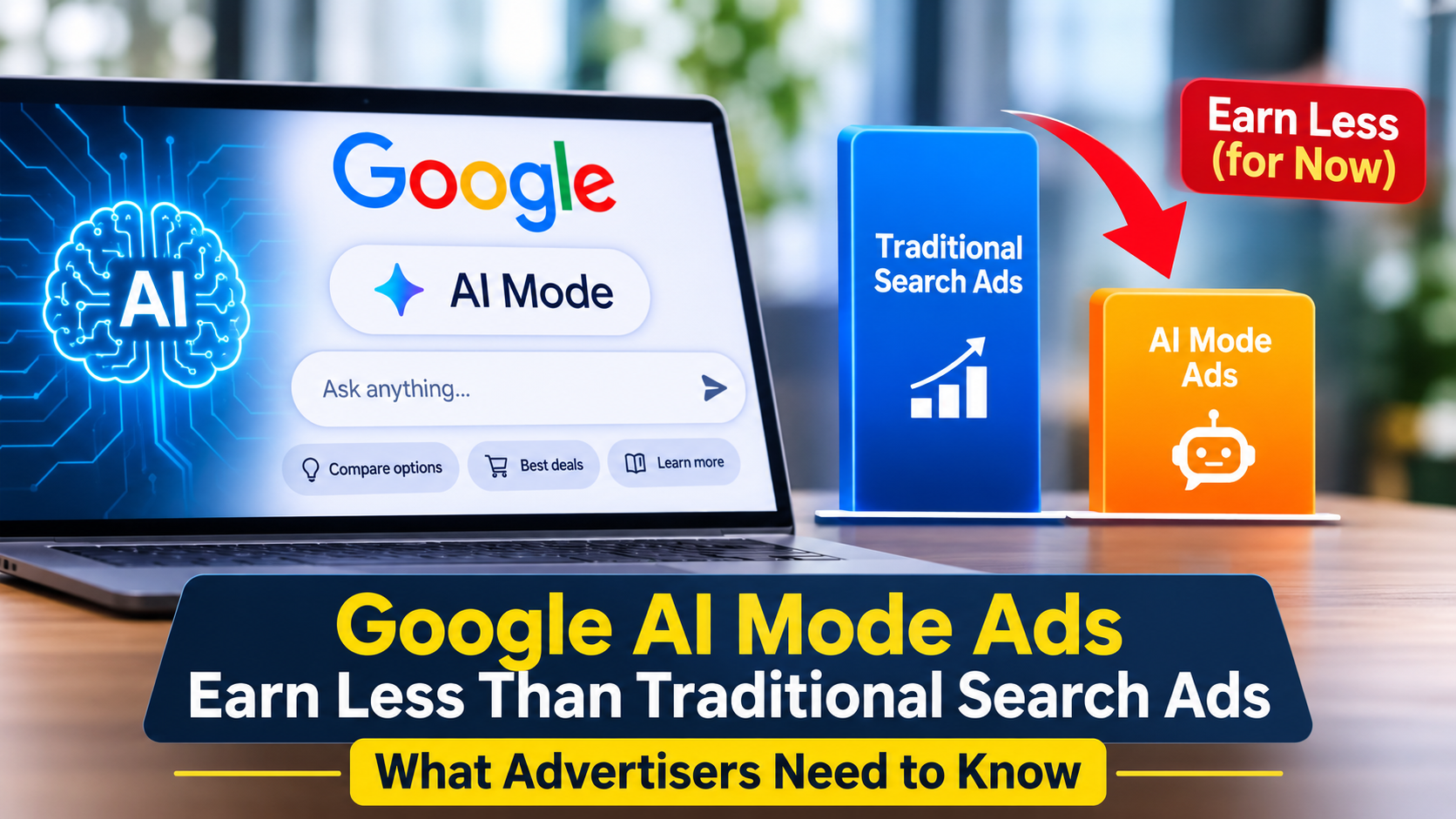
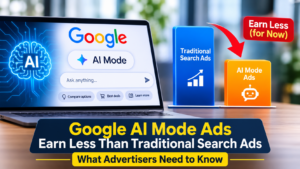
During Google’s Q3 2026 earnings call, executive Philipp Schindler confirmed that ads shown in AI Mode currently make less money per query than ads in traditional Google Search. Google expects this gap to narrow as it expands ad formats, adds multi-turn ads, and rolls out AI Mode ads to more markets.
Google’s search business is changing faster than at any point in its history. Chatbot-style answers now sit beside blue links, and advertisers are asking a very practical question: do ads inside AI-powered search perform as well as the ads we have relied on for two decades? On October 29, 2026, Google gave a partial answer, and it was not the one many marketers hoped for.
What Google Actually Said About AI Mode Ads
On the earnings call following Google’s third-quarter results, Philipp Schindler, Google’s senior vice president and chief business officer, explained that fast growth in AI Mode usage had a visible side effect on revenue. Each AI Mode query currently earns less than a standard search query. In Google’s own terminology, this is “lower monetization.”
This detail matters because Google had told the market something different about a related product. Earlier, the company said that ads appearing with AI Overviews earn roughly the same as ads on results pages without them. That statement applied only to AI Overviews, the short summaries on top of normal results. AI Mode is a separate, conversational experience, and it behaves differently from a revenue standpoint.
Schindler did not frame the news as a problem. He said Google feels positive about its trajectory, that early ad experiments have delivered promising results, and that the company is now scaling ads inside both AI Overviews and AI Mode to more users and more queries.
AI Mode vs. AI Overviews vs. Traditional Search
To understand the revenue gap, it helps to separate the three surfaces.
Traditional search is the classic results page: a query, a list of links, and paid placements above or beside them. Intent is often clear, and many searches are commercial, so clicks on ads convert well.
AI Overviews are generated summaries displayed above regular results. Users still see the usual page structure, so advertiser performance has stayed close to normal, according to Google’s earlier comments.
AI Mode is a dedicated conversational search experience. Users ask longer questions, follow up, refine, and keep going. Instead of scanning a page of options, they move through a dialogue. That changes where ads fit and how often people click them.
Why Would AI Mode Ads Earn Less?
Google pointed to a few forces, and some can be reasonably inferred from how the product works.
1. Research-heavy, upper-funnel behavior. Schindler suggested that many AI Mode queries are early-stage. People compare ideas, learn about a topic, or explore options long before they are ready to buy. Ads earn more when someone is close to a purchase decision, so exploratory conversations naturally monetize at a lower rate.
2. Users get answers without needing to click. When an AI response solves most of the question, fewer people feel the need to visit a landing page. Fewer clicks mean less advertiser spend.
3. Ad formats are still maturing. Search ads were refined over many years. Placements in AI answers are new, and Google is still testing layouts, labeling, and relevance rules. Early formats rarely perform at their eventual potential.
4. Rapid growth outpacing ad supply. AI Mode usage is climbing quickly, while the ad inventory and advertiser demand for those placements are still catching up. Fast usage growth with partial monetization drags down average earnings per query.
The Multi-Turn Opportunity
One feature of AI Mode actually favors Google: people search more often inside it. A single conversation can include five, eight, or ten follow-up questions where a normal session might include one or two searches. More turns create more chances to show an ad.
That is the logic behind Google’s push into multi-turn ads in the United States. Rather than treating each prompt as an isolated event, the system can show a relevant sponsored message at a stage where the user’s interest has become clearer. Google is also expanding AI Mode ads into international markets, which widens the pool of advertisers and shoppers.
Other Reasons Search Growth Slowed in Q3
The call also covered why search revenue growth cooled compared with the previous quarter. Schindler said AI Mode was only one piece of the story, and he listed several drivers:
- Currency effects: Exchange rates were the biggest single factor behind the slowdown from Q2 to Q3.
- Retail in Asia-Pacific: Some advertisers in that region were affected after the European Union removed its de minimis exemption, a rule that had made low-value cross-border shipments easier.
- Media and entertainment: Spending settled back down after an unusually strong second quarter, when the FIFA World Cup pulled many advertising budgets into June instead of July.
So the AI Mode revenue gap is real, but it is not the sole explanation for the growth change. Anyone reading the headline as “AI is breaking Google Ads” is oversimplifying.
What This Means for Advertisers
If you run paid search campaigns, here is how to think about this news.
Do not panic or pull budgets. Google’s comment concerns its own revenue per query, not necessarily your return on ad spend. Your results depend on your targeting, creative, and landing page quality.
Track AI-surface performance separately. As Google expands ads into AI Overviews and AI Mode, ask whether your reporting shows where impressions and clicks come from. Compare conversion rates and cost per acquisition across surfaces and decide where to invest.
Match your ads to upper-funnel intent. If AI Mode users are researching, a hard sales pitch may fall flat. Educational messaging, comparison content, and clear value propositions are better suited to people still deciding.
Strengthen landing pages. When someone does click after a long AI conversation, they are often better informed. Pages need to answer deeper questions quickly, with proof, pricing clarity, and an easy next step.
Test conversational keywords. AI Mode queries read like full sentences. Broader match types, flexible audiences, and creative assets that adapt to context may give Google’s systems more room to find relevant placements.
What This Means for SEO and Content Teams
Paid search is only half the picture. Organic visibility is also changing as AI-generated answers become a primary way to discover brands.
- Write content that answers questions directly in the first lines of a section, then adds depth.
- Use clear headings, short definitions, and FAQ sections so AI systems can extract accurate snippets.
- Build topical authority with connected articles rather than isolated posts.
- Keep information current, since AI answers favor fresh and reliable sources.
- Strengthen brand mentions and trust signals across the web, not only on your own site.
This is the practical meaning of Answer Engine Optimization (AEO) and Generative Engine Optimization (GEO): structuring content so it is easy for both people and machines to understand, cite, and recommend.
Will AI Mode Ad Revenue Improve?
Google clearly believes so. The company says monetization should rise over time, and history supports patience. Mobile search ads also earned less at first, then caught up as formats and user habits matured. Several things could close the gap:
- Better ad formats designed for conversations instead of list-style results
- Smarter matching between a user’s evolving question and the advertiser’s offer
- Wider advertiser adoption as measurement tools improve
- Multi-turn ad delivery that follows the user’s journey toward a decision
Still, nobody outside Google can say how quickly this will happen. Advertisers should plan for a period of uneven results rather than assuming an instant fix.
Final Thoughts
Google’s admission that AI Mode ads earn less than traditional search ads is notable, but it is not a crisis. It reflects a young product with growing usage, early ad formats, and a different type of user intent. Google is investing in multi-turn ads and wider market rollout precisely because it expects revenue to catch up.
For marketers, the lesson is balance. Keep your core search campaigns healthy, learn how AI surfaces behave, and build content that serves both searchers and answer engines. The brands that adapt early to this blend of paid and AI-driven discovery will be better placed when AI Mode becomes a bigger share of search.
Frequently Asked Questions
Yes, at least for now. Google’s Philipp Schindler said on the Q3 2026 earnings call that AI Mode has lower monetization than traditional search, and that the company expects it to improve over time.
Not according to Google’s earlier statements. The company said ads alongside AI Overviews earn about the same as ads on results pages without them. The lower monetization comment relates to AI Mode specifically.
Multi-turn ads are sponsored placements that can appear across a back-and-forth conversation rather than after a single query. Google is introducing them in the United States to take advantage of the extra searches AI Mode encourages.
Google announced an expansion of ads in AI Mode into international markets, so availability is growing beyond the United States.
No. The statement is about Google’s revenue per query, not your campaign returns. Check your own conversion data before changing strategy.
Currency fluctuations were the biggest driver. Retail advertisers in Asia-Pacific were affected by changes to EU import rules, and media and entertainment spending cooled after a very strong World Cup-driven quarter.
Keep running proven campaigns, monitor performance by surface when reporting allows, create helpful research-stage content, and improve landing pages for visitors who arrive already informed.
AEO focuses on being the direct answer in featured snippets, voice results, and AI summaries. GEO focuses on being cited or recommended inside generative AI responses. Both reward clear, trustworthy, well-structured content.
