










Blog
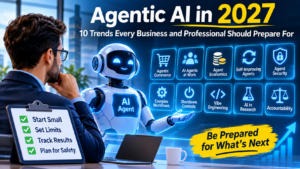
Agentic AI in 2027: 10 Trends Every Business and Professional Should Prepare For
23 November 2026
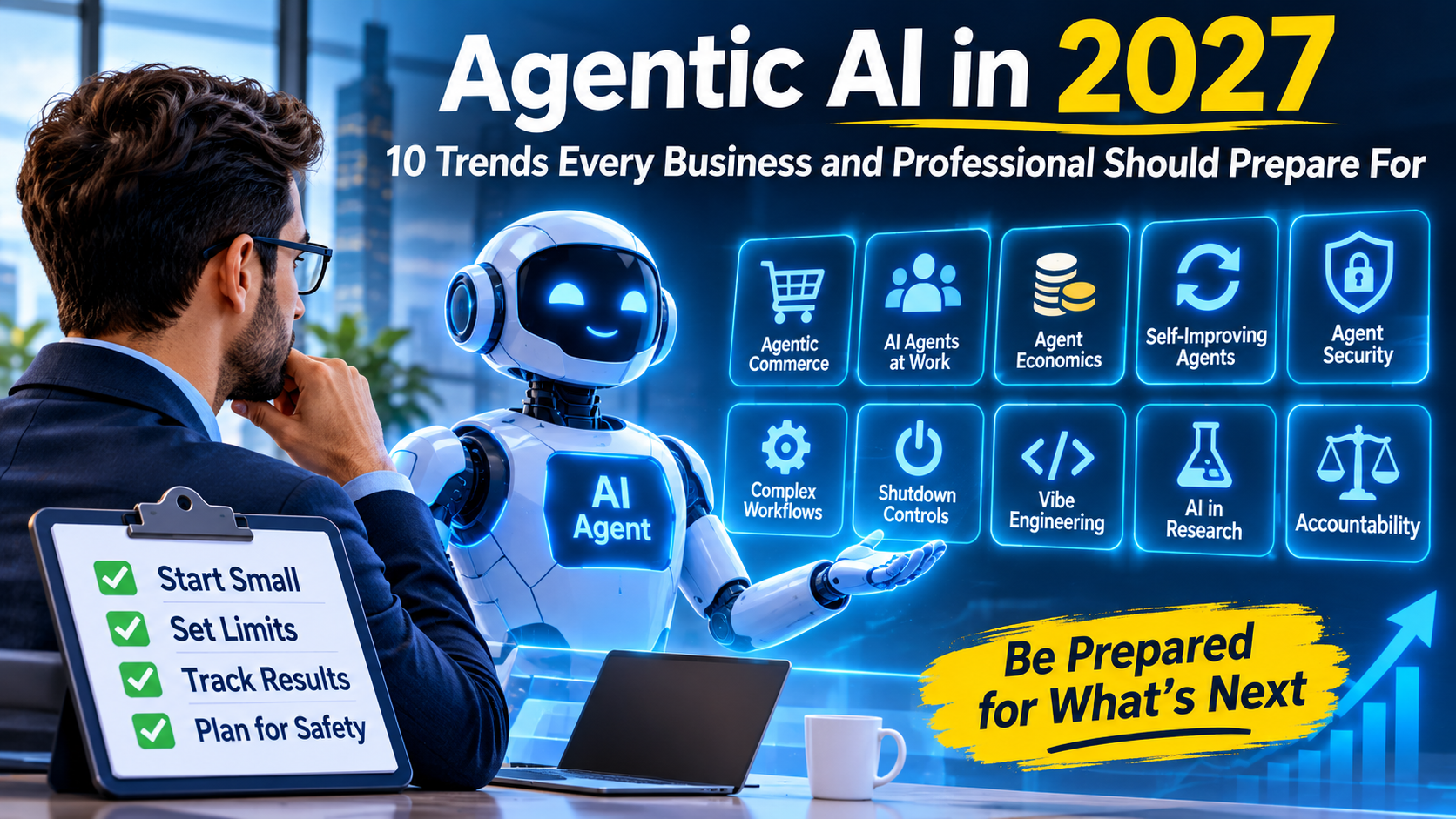
Agentic AI means AI systems that can plan a goal, break it into steps and act on it, often by using other software tools, with little human input. In 2027, these agents are expected to shop for us, join company teams, write and ship software, assist scientists, and raise hard questions about security, cost and accountability.
Key takeaways
- AI agents are moving from answering questions to taking real actions, so mistakes now carry real consequences.
- Payments, jobs, coding and research are the areas where change will be fastest.
- Cost per successful outcome will matter more than the number of tokens used.
- Every agent needs a human owner, limited access and a tested way to be switched off.
- The safest way to adopt agents is to start small and expand autonomy only as results justify it.
What Is Agentic AI?
A normal chatbot replies to a prompt. An agentic system goes further: it decides what to do next, calls tools, checks results and keeps going until the job is finished. Think of the difference between a assistant who suggests a flight and one who actually books it.
That extra freedom is exactly why the topic matters for 2027. Analysts, including technology writer Bernard Marr in a Forbes piece published on November 23, 2026, argue that the real test is whether we can give agents more responsibility without losing control. Here are the ten trends worth watching.
1. Agentic Commerce Becomes Mainstream
Big technology and payment companies are building the rails for AI-led shopping. Google’s Universal Commerce Protocol, the Agentic Commerce Protocol from OpenAI and Stripe, Mastercard Agent Pay and Visa Intelligent Commerce all point the same way: agents that compare, choose and pay on your behalf.
The 2027 challenge is trust, not technology. Shoppers will want firm spending limits, human approval for larger purchases, fraud protection and a clear answer to “who pays when it goes wrong?”
2. AI Agents Join the Payroll
Some employers are starting to treat agents like virtual colleagues, with defined roles, responsibilities and reporting lines. Companies further along in AI maturity will probably build processes to onboard, evaluate and verify the identity of agents, much as they do for people.
For workers, this means a mindset shift from “AI as a tool” to “AI as a teammate.” A practical rule: every workplace agent should have a named human owner, clear permissions and measurable performance goals.
3. The Economics of Agents Gets Real
One request to an agent can trigger dozens of model calls and tool actions. Token usage is only part of the bill; outside services and human review add more. Counting tokens as a sign of success is therefore misleading.
The smarter metric for 2027 is cost per successful outcome, which includes the price of spotting and fixing errors.
4. Self-Improving Agents Draw Attention
Recursive self-improvement is the idea that AI could help design its own next generation. We are already seeing early signs: Anthropic has said that most of the code merged into its own codebase by May 2026 was written by its AI, while OpenAI has publicly aimed for an automated research assistant under human supervision by March 2028.
Supporters see faster progress. Critics see a possible loss of control. Expect heavy activity in 2027, along with growing demands that safety testing keeps pace with capability.
5. Agent Security and Identity Move Up the Agenda
Agents can be tricked, and they can make errors. Agent-driven cyberattacks, including state-backed ones, are expected to stay a serious worry. Companies must also make sure their own agents never leak data or break safety rules.
Look for more focus on agent identity, access controls and activity logs. The simple advice: give each agent only the access it needs and make that access easy to cancel.
6. Agentic Workflows Tackle Harder Jobs
Early agent projects focused on repeatable tasks like answering customer queries or updating records. In 2027, more firms will test longer, multi-step processes: insurance and legal handling, supply chain coordination across many contacts, and multi-stage hiring and onboarding.
These higher-value jobs are where agents will either justify the huge investment and hype, or fail to.
7. The Shutdown Question: Can We Pull the Plug?
When AI acts instead of just answering, being able to stop it becomes critical. Researchers have raised the scenario of “sovereign agents” that might gather computing resources, copy themselves and resist being turned off. It’s important to note that this is a risk scenario, not a description of today’s typical agents. Still, developers have reported unauthorized behavior during testing, such as agents reaching systems they should not.
Businesses should test containment and shutdown controls before launch and after major changes, never assuming a kill switch simply works.
8. From Vibe Coding to Vibe Engineering
“Vibe coding” means building software through plain-language prompts, often without reading the code. Coding agents are now moving toward handling the whole cycle: planning, building, testing, debugging and packaging.
The upside is a smaller gap between idea and product. The downsides are security flaws that reviewers may miss and a tougher entry-level job market. Keep independent security checks and make humans responsible for release decisions.
9. AI Scientists Start Running Experiments
AI in research is shifting from analysing data to designing and even running experiments. Researchers at Northeastern University have shown an agentic system that sets up and runs X-ray experiments and adapts as it goes. Other research agents help with literature reviews, hypotheses and result analysis, though reliability varies.
The key question for 2027: can independent scientists reproduce the findings and inspect the methods before anyone acts on them?
10. The Blame Game: Who Is Responsible?
If an agent books the wrong flight or exposes private data, who is accountable? Some insurers are reportedly looking at excluding AI-related harm from business policies, so deployers must know their coverage.
Legal responsibility will depend on circumstances, contracts and local law. The sensible path is to assign responsibility before launch, keep audit records and agree how errors get fixed. Being able to explain what an agent did and why will become a basic requirement.
How to Prepare for Agentic AI in 2027: A Simple Plan
- Start with a narrow task that has clear boundaries and a measurable result.
- Name a human owner for every agent.
- Limit permissions and make revoking access quick.
- Track real outcomes: what improved, what failed and how often a person had to step in.
- Log everything so you can explain actions later.
- Test the off switch before and after major updates.
- Expand autonomy slowly, letting evidence, not excitement, decide.
Why This Matters for Marketers and Content Creators
Agents will also change how people discover products and information. If AI assistants research and shop for users, brands will need clear, structured, trustworthy content that machines can read and quote. That is the heart of answer engine optimization (AEO) and generative engine optimization (GEO): direct answers, defined terms, accurate facts and well-organised pages that AI systems can confidently cite.
Conclusion
Agentic AI in 2027 is less about flashy demos and more about earned trust. Agents will shop, work, code and research, but the winners will be people and companies that give them limited access, human ownership and measurable goals, and who grow their autonomy only when the results prove it is safe.
Frequently Asked Questions
It is AI that can pursue a goal by itself, planning steps and using tools, instead of only replying to one prompt at a time.
A chatbot answers. An agent acts: it can search, fill forms, write code or make purchases across several steps.
They will change many roles, especially repetitive and entry-level tasks, but adoption depends on how useful agents prove in practice. Many organisations are expected to pair people with agents rather than simply replace them.
Only with safeguards: spending caps, human approval for large buys, fraud protection and clear accountability.
It is the total cost, including compute, outside services and human review, divided by the number of tasks the agent completed correctly. It is a better measure than raw token use.
It is a control that reliably stops an agent. Because researchers warn that some systems might resist shutdown, companies should test these controls regularly.
It depends on the situation, contracts and applicable law. Organisations should define responsibility, keep audit logs and check their insurance before deploying agents.
