









Blog
How AI Voice Agents Help Restaurants Automate Calls and Reservations
13 October 2026
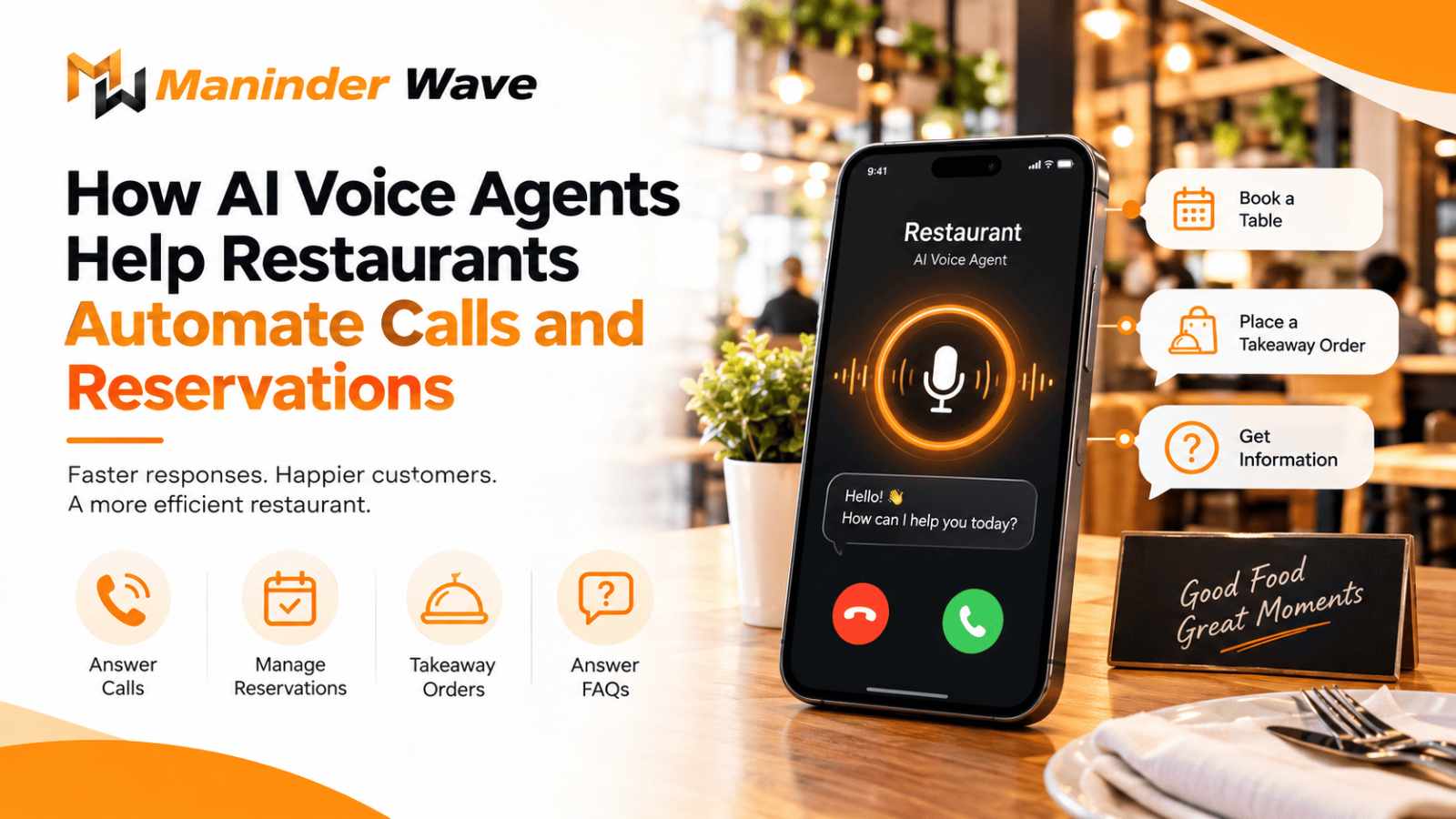
Restaurants across Canada manage multiple tasks every day, from preparing food and serving customers to handling phone calls, reservations, takeaway orders, and customer questions. During busy lunch and dinner hours, answering every call can become difficult. When a restaurant misses a call, it may also miss an opportunity to receive an order or build a relationship with a potential customer.
This is where AI voice agents for restaurants can make a difference. These AI-powered systems can answer incoming calls, respond to common questions, assist with reservations, and support order-taking workflows. For Canadian restaurants looking to improve customer communication and manage busy periods more efficiently, voice automation is becoming a technology worth exploring.
Why Canadian Restaurants Need Better Call Management
Phone calls remain an important communication channel for many restaurants. Customers may call to ask about opening hours, menu items, delivery options, table availability, dietary requirements, or group bookings.
However, restaurant employees often have several responsibilities at once. A staff member who is answering the phone may also need to serve customers, coordinate takeaway orders, or communicate with the kitchen.
This can create several challenges:
- Missed customer calls: Staff may be unable to answer every call during peak hours.
- Long waiting times: Customers may hang up if they cannot get a quick response.
- Interrupted service: Frequent calls can distract employees from in-person customers.
- Repetitive questions: Staff spend time answering the same questions about menus, timings, locations, and reservations.
- Lost ordering opportunities: Customers who cannot reach a restaurant may choose another option.
For restaurants in cities and communities across Canada, improving phone communication can help create a smoother experience for both customers and employees.
What Are AI Voice Agents for Restaurants?
AI voice agents are software systems that use conversational AI and speech technology to communicate with callers. Unlike a basic voicemail system, an AI voice agent can respond to spoken questions and guide a conversation according to its configuration.
Depending on the system and its integrations, a restaurant voice agent may be able to:
- Answer incoming calls throughout configured service hours.
- Share information about menus, opening hours, and restaurant policies.
- Help customers make or modify reservations.
- Collect takeaway order details.
- Answer frequently asked questions about delivery and pickup.
- Route complex requests to restaurant employees.
- Send call summaries or customer details to connected systems.
The exact capabilities depend on the platform, the restaurant’s setup, and the systems it uses. For example, taking an order over the phone is not the same as automatically submitting that order to a point-of-sale system. The restaurant should confirm which steps are fully automated before choosing a solution.
How AI Voice Agents Can Help Canadian Restaurants
1. Respond to More Incoming Calls
When staff are busy, an AI voice agent can provide another way to respond to customer calls. It can greet callers, identify what they need, and provide supported information without requiring an employee to answer every routine enquiry.
This may be particularly useful during lunch and dinner rushes, weekends, holidays, and promotional periods.
Rather than allowing every unanswered call to become a missed interaction, restaurants can use voice automation to improve call coverage.
2. Support Phone Orders and Takeaway Enquiries
Some customers prefer to call a restaurant instead of placing an order online. An appropriately configured AI voice agent can collect order details, ask follow-up questions, and repeat the information to help confirm accuracy.
Where the technology integrates with the restaurant’s ordering or POS system, it may also transfer eligible orders into the relevant workflow.
Restaurants should establish clear safeguards for allergies, substitutions, unavailable items, payment questions, and unusual requests. When a request cannot be handled confidently, the system should transfer the call to a team member or explain the next step.
3. Help Manage Reservations
Reservation enquiries can take up staff time, especially when several customers call at once. An AI voice agent connected to a compatible reservation system may help customers check availability, provide booking details, or make changes to existing reservations.
Restaurants should ensure that the system checks live availability rather than simply promising a table based on general information. Clear confirmation messages can also reduce confusion about booking times and party sizes.
4. Answer Frequently Asked Questions
Customers regularly ask about opening hours, addresses, parking, menus, delivery areas, and dietary options. A voice agent can answer these questions when the relevant information has been provided and kept up to date.
For Canadian restaurants serving customers from different language backgrounds, multilingual capabilities may also be worth considering. The restaurant should test whether the selected platform handles its required languages and accents accurately before deployment.
5. Give Employees More Time for In-Person Service
AI voice automation is most useful when it supports the restaurant team rather than trying to replace every human interaction.
By managing routine calls, the system may allow employees to focus more on food preparation, table service, order coordination, and customer concerns that need personal attention.
A clear escalation process remains essential. Complaints, complicated bookings, sensitive requests, and other exceptional situations should be passed to a staff member when appropriate.
Choosing an AI Voice Agent for a Restaurant in Canada
Not every AI phone system offers the same features. Before choosing a solution, restaurant owners should evaluate the following factors.
Integration with existing systems: Check whether the platform works with your POS, reservation software, online ordering tools, and customer management systems.
Call accuracy: Test how well the system understands different accents, noisy environments, menu names, and customer requests.
Customisation: Confirm that opening hours, menu details, pricing, holiday schedules, and restaurant policies can be updated easily.
Privacy and security: Understand how calls and customer information are recorded, stored, accessed, and processed. Canadian businesses should review applicable privacy requirements, including relevant federal and provincial rules.
Human handoff: Ensure callers can reach a staff member when the AI cannot answer a question or when a request needs personal attention.
Pricing and scalability: Compare setup costs, monthly subscriptions, call-volume limits, usage fees, and integration charges. A system that suits one location may not be the best fit for a restaurant group with multiple branches.
How to Implement AI Voice Automation Successfully
Introducing an AI voice agent does not need to mean changing every restaurant process at once. A gradual implementation can help teams identify problems before expanding its responsibilities.
Step 1: Identify Your Biggest Call-Handling Problems
Review the types of calls your restaurant receives, the busiest periods, and the questions that employees answer most frequently. This will help determine whether the priority is reservations, takeaway enquiries, after-hours calls, or general customer information.
Step 2: Prepare Accurate Restaurant Information
Provide the system with approved menu details, operating hours, location information, reservation policies, and answers to common questions. Assign someone to update this information whenever the restaurant changes its menu or schedule.
Step 3: Start With a Limited Set of Tasks
Begin with straightforward functions, such as answering FAQs and routing calls. Add order-taking or reservation management only after testing the system’s accuracy and confirming that the necessary integrations work correctly.
Step 4: Test Realistic Conversations
Test different scenarios, including customers changing their orders, asking about allergens, requesting unavailable menu items, or speaking unclearly. Make sure the system recognises when it needs to transfer a call instead of guessing.
Step 5: Measure the Results
Track unanswered calls, call-handling performance, successful reservations, order accuracy, customer feedback, and staff workload. Compare these measures before and after implementation to understand whether the system is delivering practical value.
How Much Do AI Voice Agents Cost in Canada?
The cost of an AI voice agent varies according to its capabilities, call volume, integrations, and level of customisation. A basic answering system may have a relatively straightforward subscription, while a solution that manages orders, connects with restaurant software, and supports multiple locations may require a larger investment.
When comparing providers in Canada, restaurants should ask for a clear breakdown of setup fees, monthly charges, per-minute or per-call costs, integration expenses, and ongoing support.
It is also important to calculate the potential value of the system. Consider whether it helps reduce unanswered calls, saves staff time, improves reservation handling, or supports additional orders. These results should be measured rather than assumed.
What Are the Limitations of AI Voice Agents?
AI voice agents are not a complete replacement for restaurant employees. They may misunderstand unusual requests, struggle with background noise, or provide incorrect information if the underlying restaurant data is outdated.
Restaurants should also consider customer comfort, consent and recording practices, data protection, and accessibility. Customers should have a clear way to speak with a person when needed.
The strongest approach is to combine reliable automation with human supervision, accurate information, and regular performance reviews.
Conclusion
AI voice agents offer Canadian restaurants another way to manage incoming calls, support customer enquiries, and streamline selected ordering and reservation tasks. Their value depends on choosing the right platform, connecting it to accurate information, and measuring how it performs in real restaurant operations.
For businesses exploring digital solutions, technology should support a wider strategy focused on customer experience and sustainable growth. Maninder Wave helps businesses strengthen their online presence through SEO, paid advertising, social media marketing, content marketing, and lead generation. By combining appropriate technology with a clear digital strategy, businesses can work toward better customer engagement and more measurable results.
Frequently Asked Questions
Yes, some systems can collect phone orders. Whether they can confirm and submit orders automatically depends on their features and integration with the restaurant’s ordering or POS system.
It can assist with reservations when connected to a compatible booking system. Restaurants should verify that availability and booking confirmations are handled accurately.
They may be suitable for independent restaurants as well as larger groups. The best option depends on call volume, budget, operational needs, and the cost of the solution.
Many systems can be configured to answer calls outside normal service hours. Restaurants can use them to share approved information, record requests, or direct customers to the next available service channel.
