










Blog
Claude Ship Explained: How Anthropic’s AI Agents Now Review, Fix and Approve Code
25 November 2026
What Is Claude Ship?
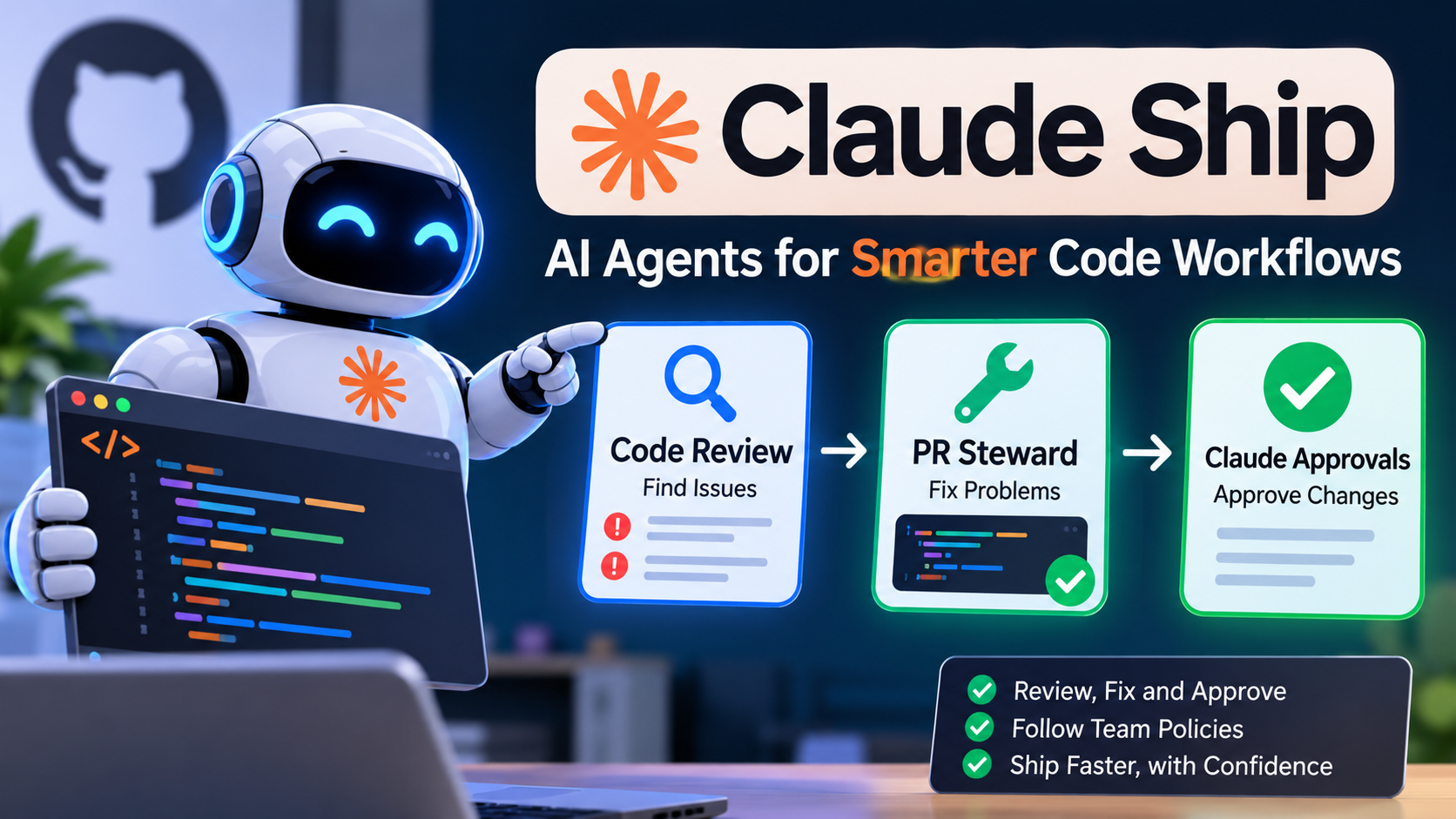
Claude Ship is a new beta service from Anthropic that lets AI agents handle the steps that come after code is written: reviewing a pull request, fixing the problems found, and approving low-risk changes when a team’s own rules allow it. It bundles the existing Code Review feature with two new beta agents, PR Steward and Claude Approvals, and is currently offered on Claude Team and Enterprise plans for GitHub repositories.
Key Takeaways
- Claude Ship covers the whole journey after a pull request is opened: review, repair and approval.
- Teams write a policy file inside their repository that decides what Claude may approve alone and what needs a human.
- Anthropic advises starting in observe-only mode before making Claude’s approval a requirement.
- Anthropic openly says the system can miss bugs and security flaws, so it should be one layer of review, not the only one.
- Anthropic’s Claude Code team reports that merged pull requests more than doubled between June and September, while the share of reverted changes fell by over 40 percent.
Why AI-Written Code Created a New Bottleneck
AI coding assistants have changed how quickly software gets written. A developer can now produce in an afternoon what once took several days. The catch is that every change still has to be understood, checked and merged by a person, and human attention has not grown at the same pace as code output.
Industry reporting has suggested that roughly half of developers do not thoroughly check AI-generated code, largely because verifying it can feel slower than reviewing a colleague’s work. This gap is often described as verification debt: code piles up faster than anyone can confidently vouch for it. When reviews get skipped, bugs and security weaknesses can slip into production.
Anthropic’s answer is to bring AI into the checking stage too, so the steps after a pull request can move at roughly the same speed as the writing stage.
How Claude Ship Works
Claude Ship is not a single tool. It is a pipeline of three parts that hand work to each other.
1. Code Review: Finding the Problems
Code Review studies a pull request against the wider codebase from several different angles. It gathers its findings, challenges them to weed out false alarms, sorts them into categories and posts them on the pull request. Think of it as a small panel of reviewers who each hunt for something different and then compare notes.
2. PR Steward: Fixing and Tidying Up
PR Steward steps in once feedback exists, whether that feedback came from Code Review or from teammates. It works through merge conflicts and flagged issues, pushes fixes, and then waits for the next round of comments. It does not approve or merge anything itself. After every push it leaves a note explaining what it changed and how to undo it, and people can tell it to stop or give it fresh instructions at any time.
3. Claude Approvals: Making the Decision
Claude Approvals makes the final call, but only inside limits set by humans. It reads a policy file stored in the repository. If a change is routine and the policy allows it, Claude can approve it. If a change is riskier, the policy can require a person to look at it first.
Together, the loop runs like this: look for issues, fix them, look again, fix again, and then pass the change toward approval.
Humans Stay in Charge Through Policy
The most important design choice is that the rules belong to the team. Because the approval policy lives as a file inside the repository, it can be versioned, reviewed and updated like any other piece of code. A team might allow automatic approval for small documentation edits or minor test changes, while insisting that anything touching payments, login systems or infrastructure goes to a senior engineer.
Anthropic recommends a gradual rollout. For most customers, the suggested first step is observe-only mode, where the team watches what Claude would have approved and compares it with human judgment. Only after confidence grows should a team set up branch protection so that Claude’s green light becomes a required step.
What Early Results Show
Anthropic says these capabilities have already been supporting its own teams. On the Claude Code team, where Claude writes most of the code, merged pull requests more than doubled from June to September, and the share of merged changes that later had to be reverted dropped by more than 40 percent. The company stresses that Claude’s review is one layer within a broader process there, not the entire safety net.
These figures come from Anthropic’s own environment and have not been independently verified. Other teams may see different results depending on their codebase, test coverage and review habits.
Risks and Limits to Understand
Anthropic itself warns that Claude Ship may miss bugs, security vulnerabilities and other issues. A few general concerns follow from that:
- Over-trust: A green approval can create false comfort, especially for busy teams.
- Shared blind spots: When AI both writes and checks code, similar weaknesses may go unnoticed on both sides.
- Policy mistakes: A policy that is too loose lets risky changes through. One that is too strict removes the time savings.
- Sensitive code: Authentication, encryption and data handling deserve human eyes no matter what an AI approves.
- Beta status: Features, behavior and availability can change as the product matures.
Who Should Consider Claude Ship
The best fit is a team on GitHub using Claude Team or Enterprise, with a high volume of pull requests, a solid automated test suite and clear internal rules about risk. Smaller teams, or those in regulated industries, may want to stay in observe-only mode for longer.
A practical way to adopt it:
- Write down which kinds of changes your team considers low risk.
- Turn on observe-only mode and compare Claude’s decisions with your reviewers.
- Track review time, revert rates and bugs that reach production.
- Expand Claude’s permissions slowly, one change type at a time.
- Keep humans on every high-risk area of the codebase.
What This Means for Software Development
Claude Ship points to a shift in the developer’s role. Instead of reading every line, engineers increasingly design the rules, watch the results and step in where judgment matters most. The valuable skill becomes deciding what is safe to automate and what is not. Expect other AI coding vendors to move toward similar review-to-approval pipelines as AI-generated code keeps growing.
Conclusion
Claude Ship is Anthropic’s attempt to make the stages after coding keep pace with AI-assisted writing. By combining in-depth review, automatic fixes and policy-based approval, it promises faster delivery without removing people from the loop. The company’s own caution is the right takeaway: start in observe-only mode, keep humans on risky changes, and treat the AI as one strong layer of defense rather than the whole wall.
Frequently Asked Questions
Claude Ship is a beta service from Anthropic that uses AI agents to review pull requests, fix issues and approve routine changes based on rules a team defines.
Code Review only finds and reports problems. Claude Ship includes Code Review and adds PR Steward, which fixes issues, and Claude Approvals, which decides whether a change can be approved under team policy.
Yes, but only within limits. Claude Approvals can approve routine changes on its own if the team’s policy file allows it. The policy can also require a person to sign off on riskier changes.
It is available in beta on Claude Team and Enterprise plans for repositories hosted on GitHub.
Anthropic warns that it may miss bugs and security vulnerabilities. For sensitive areas such as authentication or encryption, keep human review in place and treat Claude as an extra layer.
Begin in observe-only mode, compare Claude’s decisions with your human reviewers, and only then configure branch protection to require Claude’s approval.
Nothing in the announcement suggests that. Humans still write the approval policy, handle risky changes and supervise the agents. The role shifts from checking every line to managing rules and results.
