










Blog
Shirudo Explained: How OpenAI and Cisco Want AI Agents to Shield Linux Systems Before Patches Arrive
25 November 2026
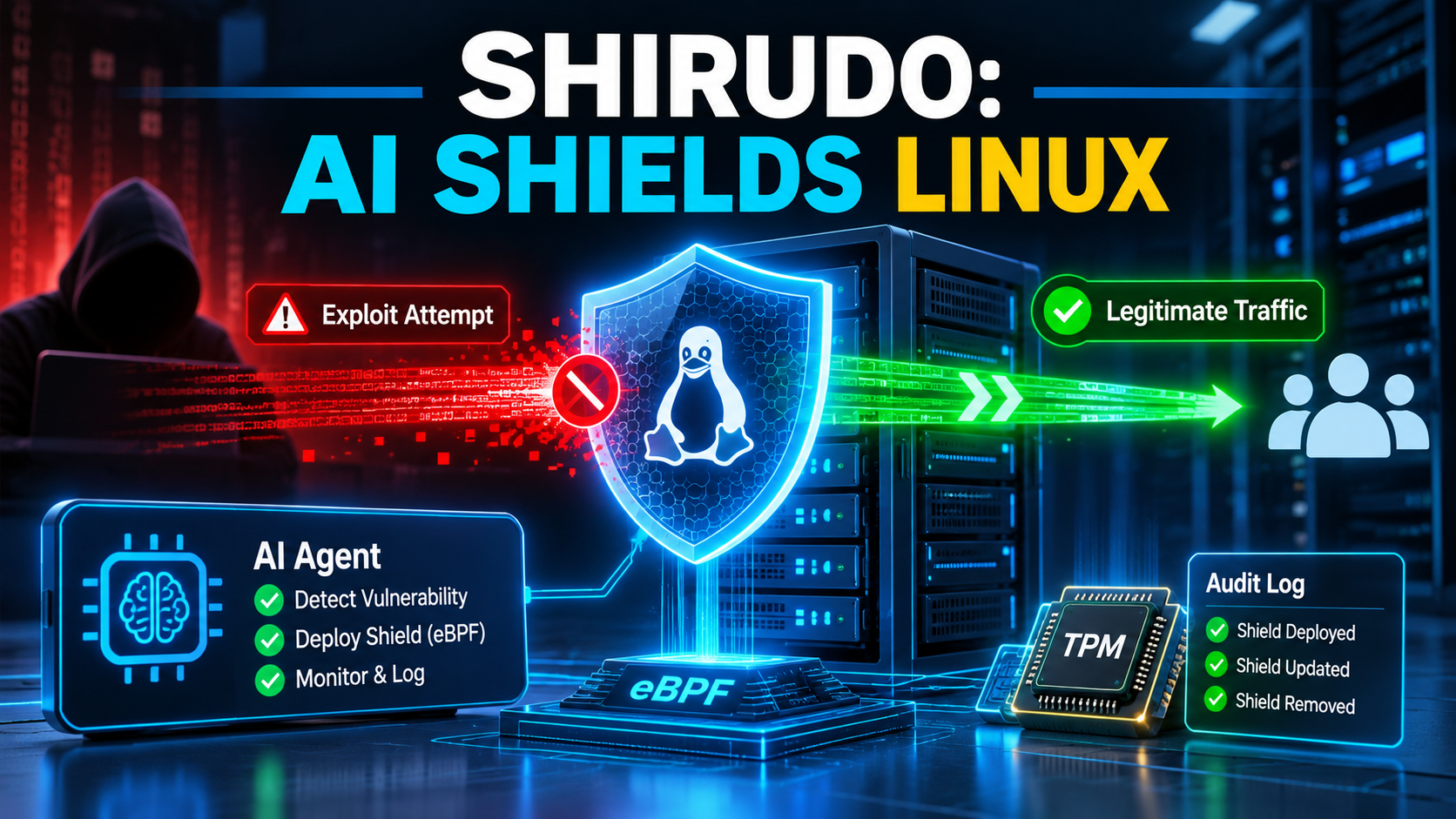
Shirudo is an open-source Linux runtime built by OpenAI and Cisco. It lets AI agents create small, temporary protections, called “shields”, that stop an exploit from reaching a vulnerable service while normal users keep working. The aim is to cover the risky gap between a vulnerability being disclosed and a patch being safely deployed. It was announced on November 23, 2026, and uses eBPF technology plus a hardware-backed record for later investigation.
The Problem: The Dangerous Gap Before a Patch Goes Live
Every security team knows this scenario. A serious vulnerability is announced, and attackers start probing for it within hours. Your vendor releases a fix, but you can’t push it to production immediately. Patches have to be tested, because a rushed update can break an application, crash a service or knock a business-critical system offline.
That testing period can last days. During that time your systems are known to be weak, and everyone, including the attackers, knows it.
Admins usually have two bad options. They can leave the service exposed and hope nothing happens. Or they can switch the risky feature off, which protects the network but may also stop customers and employees from using the service.
Shirudo is designed to offer a third option: protect the service in the meantime, without taking it down.
What Is Shirudo?
Shirudo is a new open-source Linux runtime, released jointly by OpenAI and Cisco, that allows AI software to block suspicious requests to a service while still permitting legitimate ones. The name is the Japanese word for “shield”, and that idea runs through the whole design. The temporary protections an AI agent deploys through the framework are called shields.
OpenAI describes the underlying difficulty clearly. An attack and a normal request can depend on the very same Linux operation. If you block that operation completely, you stop the attacker, but you may also stop the service from functioning. Shirudo tries to be more precise, separating malicious use of an operation from harmless use, so the application can stay online.
How Shirudo Works, Step by Step
1. An AI agent identifies the exposure. The agent works out which systems are affected by a newly disclosed weakness.
2. The agent writes a shield. Rather than clicking through dashboards, the agent produces a targeted protection in code.
3. The shield runs inside the kernel using eBPF. eBPF lets approved programs run safely inside specific parts of the operating system kernel. Because of that, a shield can watch and filter activity at a very low level, without rebuilding the application or rebooting the machine.
4. Legitimate traffic continues. The shield is written to block the exploit pattern only, so regular users and workloads aren’t interrupted.
5. Every action is recorded. Shirudo uses the computer’s Trusted Platform Module (TPM) hardware to keep a lasting record of which shields were added or removed. If something goes wrong later, investigators have a trustworthy trail.
6. The shield is retired. Once the real patch has been tested and deployed, the temporary shield has done its job.
The Real-World Test: Java4Shell
OpenAI and Cisco tried Shirudo on a Linux system that was vulnerable to the Java4Shell exploit. According to Cisco, an AI agent working inside the Shirudo architecture automatically built a shield that stopped Java4Shell exploitation, and the affected Java-based applications kept running.
This matters because it shows the central promise in practice: automated protection that doesn’t trade availability for security. It was a controlled test rather than a large production rollout, so teams should treat it as an encouraging proof point, not a guarantee for every environment.
Where Shirudo Comes From: A Tetragon Rewrite for AI Agents
Shirudo isn’t built from scratch. It’s based on Tetragon, an eBPF-based platform created by Isovalent in 2022. Cisco acquired Isovalent two years later, which is how the technology ended up in this collaboration.
Isovalent’s leaders describe Shirudo as a rewrite of Tetragon designed specifically for agents. Their key lesson is that AI agents work best when they can use code, their natural language, instead of tools designed for human readability. Earlier attempts at automated defence often connected AI workflows to systems built for people to read and click through. Agents don’t gain much from that extra layer, since they can process huge amounts of code easily.
In plain terms: older security tooling was built for humans to operate, while Shirudo is built for machines to operate and for humans to supervise.
Why This Matters for Security Teams
Shorter windows of exposure
Attackers move fast, and patch testing moves at human speed. Letting an AI agent deploy a shield within minutes narrows the period when systems are exposed.
Less downtime
Blocking an entire Linux operation can break a service. Narrow, targeted shields protect the workload without switching it off.
Better forensics
The TPM-backed record means defenders can later answer important questions: what was protected, when, and what was changed or removed.
More breathing room for patching
Teams no longer have to choose between a rushed update and an open door. They can test patches properly while the shield provides cover.
Open-source transparency
Because Shirudo is open source, security researchers can inspect, challenge and improve it. For a tool that will act automatically on production systems, that scrutiny is valuable.
The Bigger Vision
OpenAI’s stated long-term goal is for defenders and AI agents to quickly find affected systems, validate protections, and deploy eBPF shields that block exploits without disrupting workloads. It also envisions applications running with only the permissions they need, governed by policies that are generated and maintained automatically.
That points to a future where “least privilege”, a principle many organisations struggle to maintain by hand, becomes something software keeps up to date on its own.
Things to Keep in Mind
A balanced view helps, especially for a brand-new project.
- It’s a stopgap, not a cure. Shields buy time. They don’t replace patching, and the underlying flaw still needs a proper fix.
- Human oversight still matters. Letting an AI agent change kernel-level behaviour on live systems calls for clear approval rules, testing and rollback plans.
- Early days. The public demonstration centred on one known exploit. Real networks are messier, so pilot it carefully before relying on it.
- Skills required. Teams using eBPF and Linux runtimes will need people who understand them.
What You Can Do Now
- Inventory your Linux workloads. You can’t shield what you haven’t mapped.
- Review your patch process. Measure how long testing takes from disclosure to deployment. That’s your exposure window.
- Follow Shirudo’s open-source progress. Watch the OpenAI and Cisco documentation and the community around it.
- Define approval rules for AI agents. Decide which actions an agent may take automatically and which need a human sign-off.
- Keep audit trails. Whatever tools you adopt, make sure protective changes are logged and reviewable.
Final Thoughts
Shirudo reflects a broader shift in cybersecurity: as attackers gain access to faster, more automated tools, defenders need machine-speed responses too. OpenAI and Cisco’s approach is practical rather than flashy. It doesn’t claim to eliminate vulnerabilities. It tries to make the awkward waiting period between disclosure and patching safer, using eBPF for precision and TPM hardware for accountability.
If it performs well beyond the initial test, Shirudo could become a useful safety net for any organisation running Linux services at scale. For now, it’s a promising open-source project worth watching and trying in a controlled environment.
Frequently Asked Questions
Shirudo is an open-source Linux runtime developed by OpenAI and Cisco. It allows AI agents to deploy temporary protections, called shields, that block exploit attempts while still allowing legitimate access to a service.
It’s the Japanese word for “shield”, which reflects how the framework protects systems during the time before a permanent patch is applied.
OpenAI and Cisco built it together. It’s based on Tetragon, an eBPF platform created by Isovalent in 2022 and later brought into Cisco through its acquisition of the company.
An AI agent writes a shield that runs inside the Linux kernel using eBPF. The shield blocks malicious requests that match an exploit pattern but lets normal requests through, so the application keeps running.
eBPF is a Linux technology that allows approved programs to run safely in specific parts of the operating system kernel. It makes low-level monitoring and filtering possible without rewriting the application.
The Trusted Platform Module keeps a persistent record of the shields that agents added or removed. That record supports later forensic analysis if investigators need to review what happened.
No. Shields are temporary protection while organisations test patches. The permanent fix is still the patch itself.
