









Blog
Agentic Commerce in 2026: What Shopify Store Owners Need to Know
15 October 2026
Not long ago, an online purchase followed a predictable path. A shopper searched on Google, clicked a few results, compared tabs and eventually bought from a store. In 2026 that path is changing. More shoppers now ask an AI assistant to find, compare and even buy products for them, often without opening a single product page.
This shift is called agentic commerce, and it matters a great deal if you run a Shopify store. This guide explains what it means in plain language, how it works, where the opportunities and risks sit, and what you can do right now to prepare.
What Is Agentic Commerce?
Agentic commerce is a model where an AI agent acts on a shopper’s behalf. The agent does more than answer questions. It researches products, compares options against stated preferences, checks availability and, in many cases, helps complete the purchase.
The word “agentic” comes from “agent”, meaning software that can take actions towards a goal. That is the key difference from older chatbots. A chatbot replies to questions. An agent can carry out a multi-step task, such as “find a waterproof hiking jacket under $150 that ships to my city by Friday.”
Here is how it compares with other types of online shopping:
|
Model |
Who does the work |
Example |
|
Traditional ecommerce |
The shopper browses and compares |
Visiting a store and filtering products |
|
Conversational commerce |
A bot answers questions |
A support chat on a product page |
|
Agentic commerce |
An AI agent researches and transacts |
Asking an assistant to find and buy the best option |
For store owners, the important point is that your customer may increasingly be an AI system acting for a person. That agent reads your data, not your homepage banner.
Why 2026 Is the Turning Point for Shopify Stores
Several developments arrived together this year. Shopify’s Agentic Storefronts became live for all US merchants on March 24, 2026, and the channel gives merchants a way to reach shoppers inside ChatGPT, Microsoft Copilot, AI Mode in Google Search and the Gemini app, managed from the Shopify Admin. ecommercefastlaneshopify
Shopify has also described this setup as requiring no separate integrations, no apps and no transaction fees beyond standard processing rates. Orders flow into the admin with referral attribution, so you can see where sales came from. shopify
Behind the scenes, open standards are doing the heavy lifting. The Agentic Commerce Protocol (ACP) and the Universal Commerce Protocol (UCP) give AI platforms a common way to read catalogs and complete checkouts with merchants. Shopify co-developed UCP with Google. You do not need to understand the code, but it helps to know that these standards exist so you are not locked into building a separate integration for every AI tool. shopify
A caution is worth adding here. This space is moving fast. Eligibility, checkout experiences and supported regions differ by platform and change often. Always confirm current details inside your Shopify admin and in Shopify’s official documentation before making decisions.
How AI Shopping Agents Decide What to Recommend
Understanding the agent’s decision process helps you shape your store for it. Agents generally weigh four things:
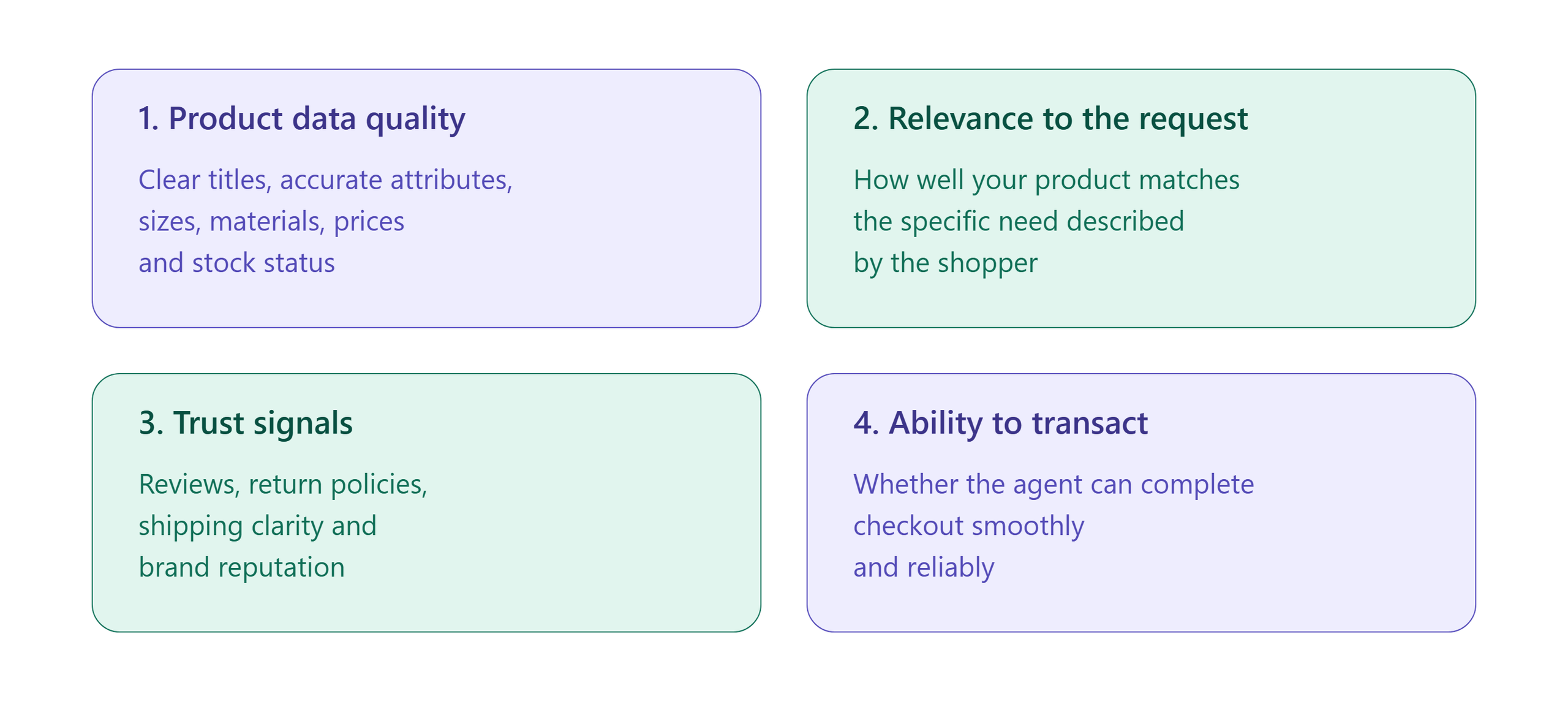
Notice how closely this overlaps with good search engine optimization. If your content is vague, your data is thin or your policies are hidden, both Google and AI agents will struggle to recommend you. Strong SEO has always been about clarity, relevance and trust, and agentic commerce simply raises the stakes.
The Shift From Keywords to Structured Product Data
For years, ecommerce SEO centred on keywords placed in titles, descriptions and headings. Those still matter, but agents depend even more on structured data, which is information organised in a consistent, machine-readable format.
Think of it like this. A human can skim a messy product description and guess that “lightweight, great for rain” means the jacket is waterproof. An agent filtering for “waterproof” needs that attribute stated explicitly. If it is missing, your jacket may never appear in the results.
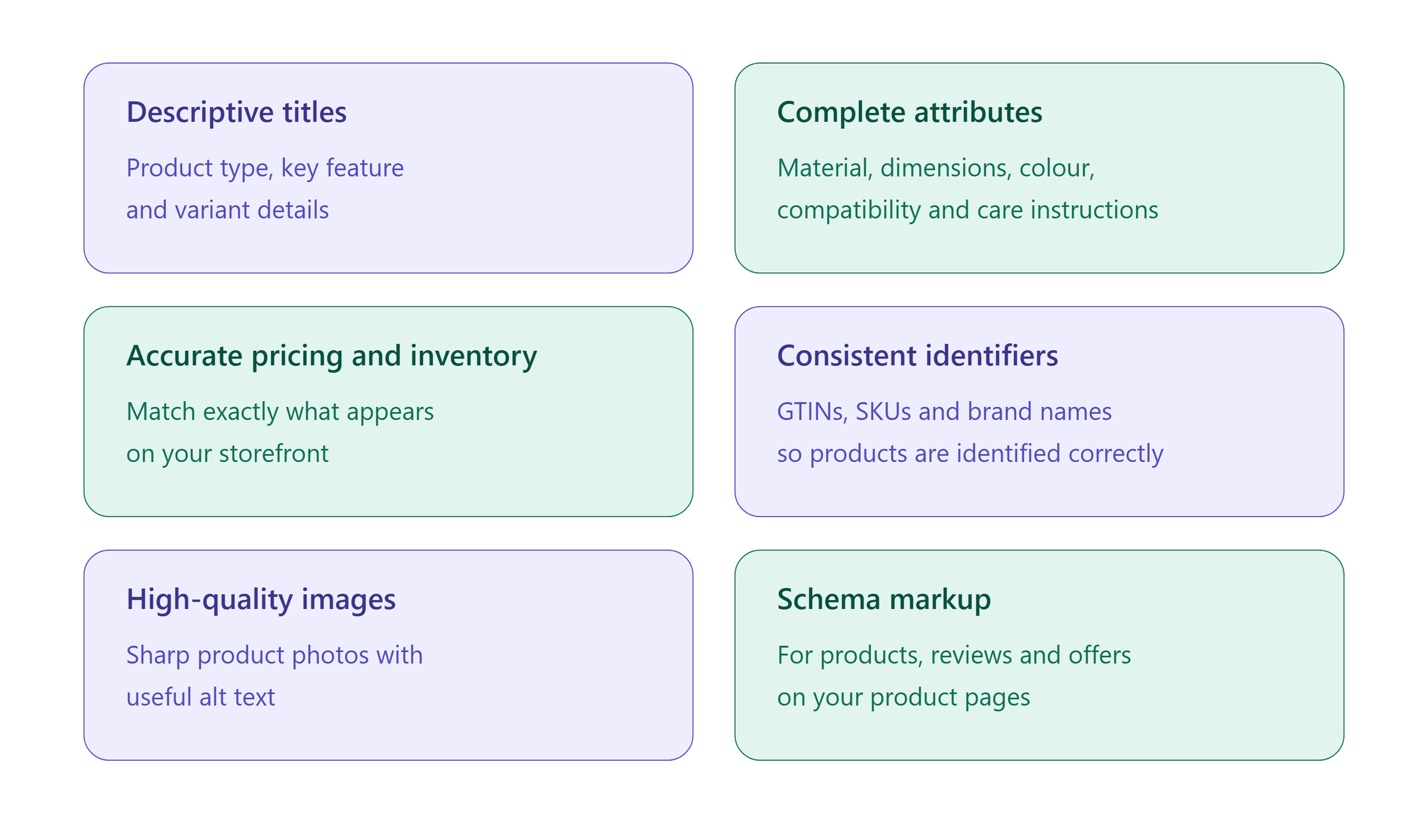
Focus on these data fundamentals:
A Practical Readiness Checklist for Shopify Owners
You do not need a massive project to begin. Work through this list in order.
1. Clean up your catalog. Audit your top 50 products first. Fill in missing attributes, fix inconsistent naming and remove duplicates. Treat product data as a core asset, not an afterthought.
2. Write for questions, not only keywords. Agents handle natural language requests. Add short sections to product pages that answer real questions, such as “Is this suitable for sensitive skin?” or “Does it fit a 15-inch laptop?”
3. Make policies easy to find and easy to understand. Shipping times, returns, warranties and sizing help should be clear and consistent. Agents and shoppers both reward transparency.
4. Review your payments setup. Some AI checkout experiences depend on specific payment providers being enabled. Check which requirements apply to the channels you want to join.
5. Turn on the relevant sales channel and monitor it. Review the Agentic Storefronts settings in your admin, confirm which products are eligible and watch the attribution reports.
6. Protect your site’s performance. Slow, unstable pages hurt conversion whether the visitor arrives from an AI assistant, from Google or directly. In some AI experiences, the shopper still finishes checkout on your own store, so the on-site experience remains critical.
7. Track and test. Treat AI assistants as a distinct traffic and order source alongside Google, Meta and email. Compare conversion rate, average order value and return rates by source.
Where Web Development Services Fit In
Many of the tasks above are technical. Cleaning up product metafields, adding schema markup, fixing theme performance and ensuring a clean checkout flow all fall under web development services. A store with a well-structured theme, fast load times and clean code is easier for both people and machines to understand.
If your Shopify theme is outdated, heavy with apps or hard to customise, agentic commerce is a good reason to modernise it. A rebuilt store that is fast and clearly structured also supports stronger search performance overall. If you are considering that step, read our guide on how to redesign a website without losing Google rankings before you start.
Agentic Commerce, Content and Topic Clusters
AI systems favour sources that demonstrate real expertise. This is where Google’s E-E-A-T standard (Experience, Expertise, Authoritativeness and Trustworthiness) becomes practical for store owners.
Build topic clusters around your product categories. A cluster has one main pillar page that covers a broad subject, supported by detailed guides that link back to it. For example, a skincare store might create a pillar on “How to Build a Skincare Routine”, supported by guides on ingredients, skin types and product comparisons.
Support the cluster with:
- Original expertise. Real testing, photos, customer stories and specific advice.
- Author credentials. Show who wrote the content and why they are qualified.
- Proof. Reviews, case studies and measurable results.
Our content marketing approach follows this principle, and you can see how related topics connect on the Maninder Wave blog. Content that answers questions fully and credibly is more likely to be surfaced by AI systems, because those systems prefer reliable sources.
Risks and Limits You Should Understand
Agentic commerce offers real opportunity, but a balanced view is important.
- Less direct customer contact. If a sale happens inside an AI interface, you may see less browsing behaviour and have fewer chances to upsell or capture an email address.
- Attribution gaps. A shopper may discover your product in one assistant and buy elsewhere, which makes reporting harder.
- Fraud and verification. Orders placed through agents can carry different risk signals than normal orders, so review your fraud settings.
- Margin pressure. When an agent compares you directly with competitors on price and shipping, weak differentiation shows quickly.
- Evolving rules. Platform policies and fees may change, so avoid building your strategy on assumptions.
The right response is not to panic or ignore the trend. Start small, measure carefully and keep your own storefront, brand and customer relationships strong.
Strengthening Conversion Beyond the Agent
Even in an agent-led world, your own website remains your most valuable asset. It is where you build loyalty, run promotions and collect first-party data. Improving it through conversion rate optimization means more of your visitors, from any source, become buyers. If you also run paid campaigns, make sure your PPC advertising points to fast, well-structured landing pages so you do not waste spend.
Agencies such as Maninder Wave, an AI-enabled digital marketing agency, help growing businesses connect search, content, paid media and site performance into one plan, which is exactly what this new shopping behaviour demands.
Final Thoughts
Agentic commerce does not change the fundamentals of good ecommerce. It rewards stores that are clear, accurate, fast and trustworthy. The merchants who act early will be the ones with clean data, strong content and the measurement in place to learn what works.
If you would like help preparing your store, from technical clean-up to search visibility, book a free strategy call with our team.
Frequently Asked Questions
Agentic commerce is shopping where an AI agent researches, compares and sometimes buys products on behalf of a person. Instead of browsing many websites yourself, you describe what you need, and the agent does much of the work.
No. Agentic Storefronts has been described as available to standard Shopify plans, not only Plus. However, eligibility rules can change, so check your admin for the latest requirements.
Unlikely. Your website remains the home of your brand, your policies and your customer relationships. Agentic channels add another way for people to find and buy from you, and in some cases the shopper still completes checkout on your own store.
They overlap heavily. Clear content, accurate structured data, strong reviews and fast pages help you rank in search and help AI agents trust and recommend your products. Good SEO is one of the best forms of preparation.
Audit and improve your product data, starting with your best sellers. Then review your Agentic Storefronts settings in Shopify, confirm your payment setup and begin tracking AI-driven orders as a separate source.
Yes. Agents match products to specific needs, so a smaller store with detailed, accurate data, honest reviews and a clear niche can win recommendations over bigger competitors with generic listings.
