










Blog
CyberStrikeAI: How 44 AI Agents Are Automating Cyberattacks on Japanese Organizations
28 October 2026
What Is CyberStrikeAI?
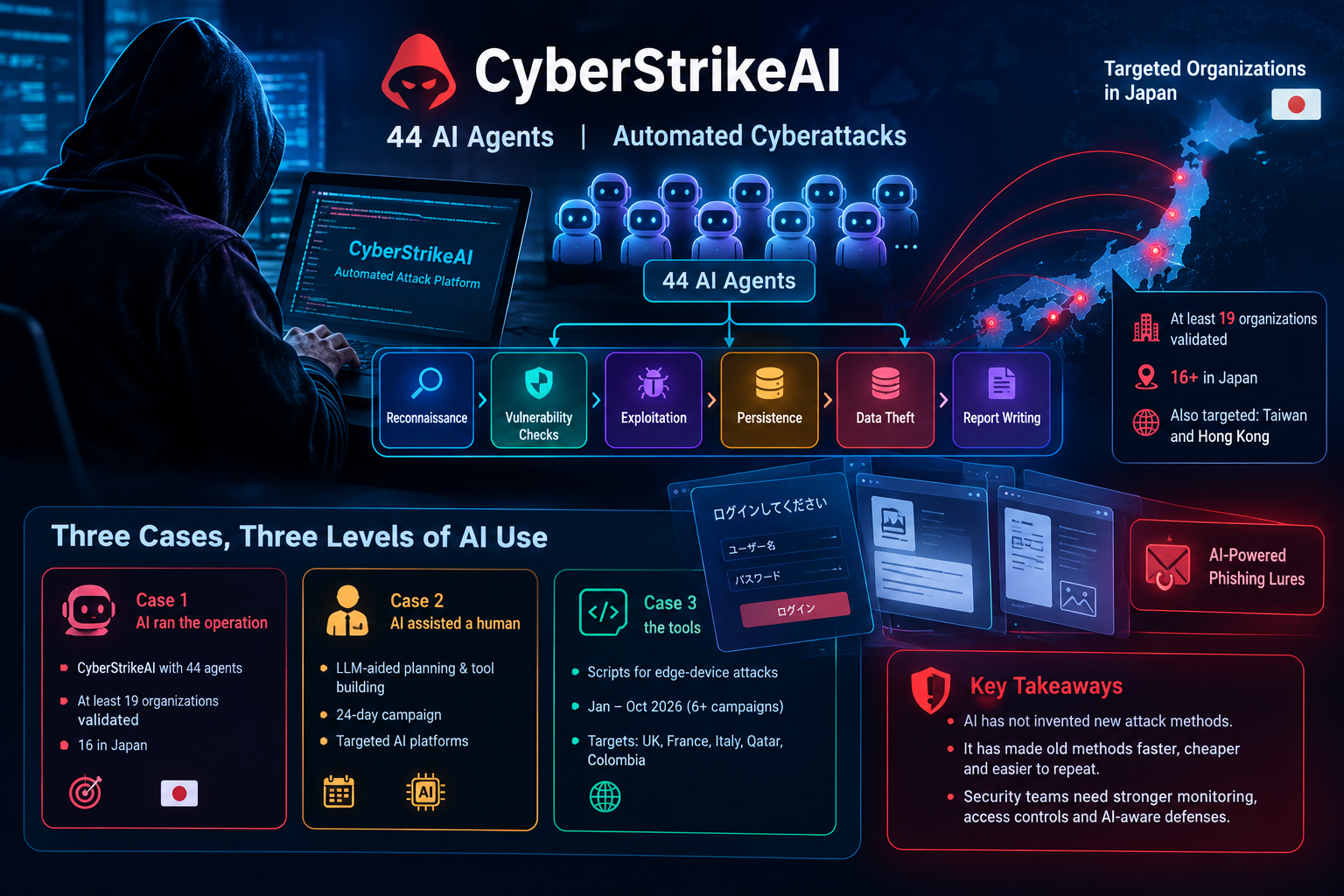
CyberStrikeAI is an open-source penetration testing tool that attackers have turned into an automated hacking platform. In an October 2026 campaign analyzed by TrendAI, it split an entire attack workflow across 44 AI agents. Those agents handled reconnaissance, vulnerability checks, exploitation, persistence, data theft and even report writing, and the targets were mostly organizations in Japan.
The lesson for security teams is simple. AI has not invented new attack methods. It has made old methods faster, cheaper and far easier to repeat at scale.
What Happened: Three Attacks, Three Levels of AI Use
TrendAI researchers studied three exposed server environments that threat actors had used against Japanese targets. Each held scanning tools, scripts, target lists, logs and command histories. What made them valuable to analysts is that they showed three very different ways of using AI in an attack.
| Case | Role of AI | Main Method | Notable Detail |
| 1 | AI ran the operation | CyberStrikeAI with 44 agents | At least 19 organizations validated, 16 in Japan |
| 2 | AI assisted a human | LLM-aided planning and tool building | 24-day campaign, targeted AI platforms |
| 3 | AI wrote the tools | Scripts for edge-device attacks | At least six campaigns between January and October 2026 |
There is no evidence so far that one operator is behind all three. Researchers also do not know which AI models powered the activity.
Case 1: CyberStrikeAI and Its 44 AI Agents
The first case is the most striking. The operator used CyberStrikeAI to turn the full attack lifecycle into a repeatable process. The workflow covered:
- Reconnaissance and vulnerability discovery
- Vulnerability validation and exploitation
- Command-and-control setup
- Persistence inside the target
- Data exfiltration
- Automated reporting
Work was divided among 44 agents, each handling a slice of the job. The platform could also produce forms and fake login pages written in Japanese, which makes phishing-style lures far more convincing for local employees.
The activity was packed into a short window in October 2026. Researchers found that at least 19 identifiable organizations were put through validation, and at least 16 of them were in Japan. Every one had a report in the same format plus an index of supporting evidence. That consistency points to a structured pipeline run by the platform, not a human taking casual notes.
The same operator also showed interest in organizations in Taiwan and Hong Kong, so the risk is not limited to one country.
Case 2: A Human Operator With an LLM Assistant
The second campaign was human-led. The attacker used a large language model to speed up planning and to build tools faster. The infrastructure suggests a second goal as well: going after AI workflow platforms and inference services to get large amounts of computing capacity cheaply.
One intrusion hit a geographic information system server that was exposed to the internet with default credentials. The attacker stole land and commercial records, Windows credentials and email data. The whole campaign ran for 24 days across August and September 2026.
The weakness here was not advanced at all. It was a default password on a public-facing system.
Case 3: AI as a Script Writer for Edge-Device Attacks
In the third case, AI played the smallest part. It helped the operator write tools and scripts. The targets were network edge devices from Cisco, Citrix, F5 and Yamaha, along with exposed VPN gear and WebLogic servers. The attacker relied on published vulnerabilities, exposed management functions and credentials left in configuration files.
TrendAI estimates at least six campaigns between January and October 2026. Target lists included organizations in the UK, France, Italy, Qatar and Colombia, which shows how widely such operators cast their nets.
Why This Matters: Same Doors, Many More Attempts
TrendAI summed up the situation well: AI has grown the attackers’ workforce, but the job is still looking for unlocked doors. The doors and the weaknesses behind them are the same as before. What changed is that attackers can now try thousands at once, adapt to a country’s language and keep going without getting tired.
Other major findings back this up:
- Microsoft’s 2026 Digital Defense Report says AI has pushed the median time from vulnerability discovery to weaponization to well below 24 hours.
- Microsoft also linked a China-aligned actor, Storm-0940, to an AI penetration testing framework called ARTEX, used to sign in to more than 2,250 Microsoft 365 tenants through password spraying. Most attempts failed, but some led to privileged cloud access.
- In South Korea, police identified seven suspects tied to breaches of more than 90 organizations. About 8.2 million records were reportedly taken, and ransom demands of 360 million won (around $270,000) were made in 38 incidents.
- Rapid7 describes AI as both a force multiplier and an expanding attack surface, since it speeds up existing methods instead of creating wholly new ones.
The Wider Trend: Agentic AI in Criminal Toolkits
CyberStrikeAI is part of a bigger pattern. Recent research describes many groups building agent-based systems for offense:
- Multi-agent crews: One group assigned different roles to several commercial AI models that debated each target before an orchestrator acted.
- Hijacked AI endpoints: A malicious agent called Skynet mode uses 74 tools and can run up to 100,000 steps without approval, while the owner of the exposed AI endpoint pays the inference bill.
- Autonomous web attacks: An engine named Cairn was used to break into websites of more than 100 companies.
- Credential harvesting: Scanners wired to AI coding assistants collected thousands of API keys and tokens from exposed hosts.
- A growing black market: Stolen AI session tokens and offensive AI tools are now sold, which lowers the skill needed to launch advanced attacks.
The common thread is speed and scale. Tasks that once needed a skilled team can now be run by a small group, or even one person.
How to Defend Against AI-Driven Attacks
Because the underlying weaknesses are familiar, the best defenses are familiar too. They simply matter more now.
- Remove default credentials. Change every default password on servers, GIS platforms, dashboards and appliances before they touch the internet.
- Patch edge devices fast. VPNs, firewalls and gateways are favorite targets. With weaponization times under a day, slow patch cycles are a serious risk.
- Shrink your exposed surface. Audit what is reachable from the internet, including AI workflow tools and inference endpoints, and close anything unnecessary.
- Protect AI infrastructure. Require authentication on every AI endpoint, set usage limits, and watch for unusual spikes in inference use.
- Clean up secrets. Keep passwords and API keys out of configuration files and code repositories. Rotate keys regularly.
- Use phishing-resistant sign-in. Multi-factor authentication limits the damage of password spraying and fake login pages.
- Monitor for machine-speed behavior. Look for rapid, repetitive scanning and login attempts, and automate your own response where possible.
- Prepare for localized lures. Train staff to expect convincing messages in their own language, since AI removes the old giveaway of poor translation.
Key Takeaways
- CyberStrikeAI automated a full attack chain with 44 AI agents
- in an October 2026 campaign.
- At least 19 organizations were tested, 16 of them in Japan.
- AI’s role ranged from running the operation to simply writing scripts.
- Weak spots such as default passwords and unpatched edge devices were still the entry points.
- Defenders should focus on basics done quickly and consistently.
Conclusion
The CyberStrikeAI case shows where cybercrime is heading. A tool built for authorized testing became an automated attack factory, with dozens of AI agents handling the work from first scan to final report. Even so, the entry points were ordinary: exposed services, default logins and unpatched devices.
For security teams, the message is practical. You do not need a brand-new defense playbook, but you do need to close basic gaps much faster than before. Attackers now have tireless automation, so defenders must treat fundamentals such as patching, authentication and exposure management as urgent daily work.
Frequently Asked Questions
CyberStrikeAI is an open-source penetration testing tool. Attackers have used it to automate hacking tasks such as scanning, exploitation, persistence and reporting through a network of AI agents.
The October 2026 campaign analyzed by TrendAI split the work across 44 AI agents, each responsible for a part of the attack workflow.
The main targets were organizations in Japan. At least 19 organizations were validated, including at least 16 in Japan, and the same operator also showed interest in Taiwan and Hong Kong.
Not really. Researchers say AI mostly speeds up and scales existing methods such as reconnaissance, phishing and exploitation of known weaknesses.
Attackers scan the internet for exposed systems that still use factory logins. In one of the three Japan-related cases, a server with default credentials led to stolen records and email data.
According to Microsoft’s 2026 Digital Defense Report, the median time from discovery to weaponization has dropped well below 24 hours, largely because of AI.
Yes. Automated tools do not choose targets by size. They scan for exposed and weakly protected systems, so any organization with open services or poor password hygiene can be hit.
Strong basics: remove default passwords, patch internet-facing devices quickly, enable multi-factor authentication, secure AI endpoints, remove secrets from code and configs, and monitor for fast, repetitive activity.
There is no evidence of that at this stage. TrendAI found no link between the operators of the three environments.
