











Blog
Does AI Really Use Water to Generate an Image? The Real Numbers Behind AI’s Water Footprint
13 November 2026
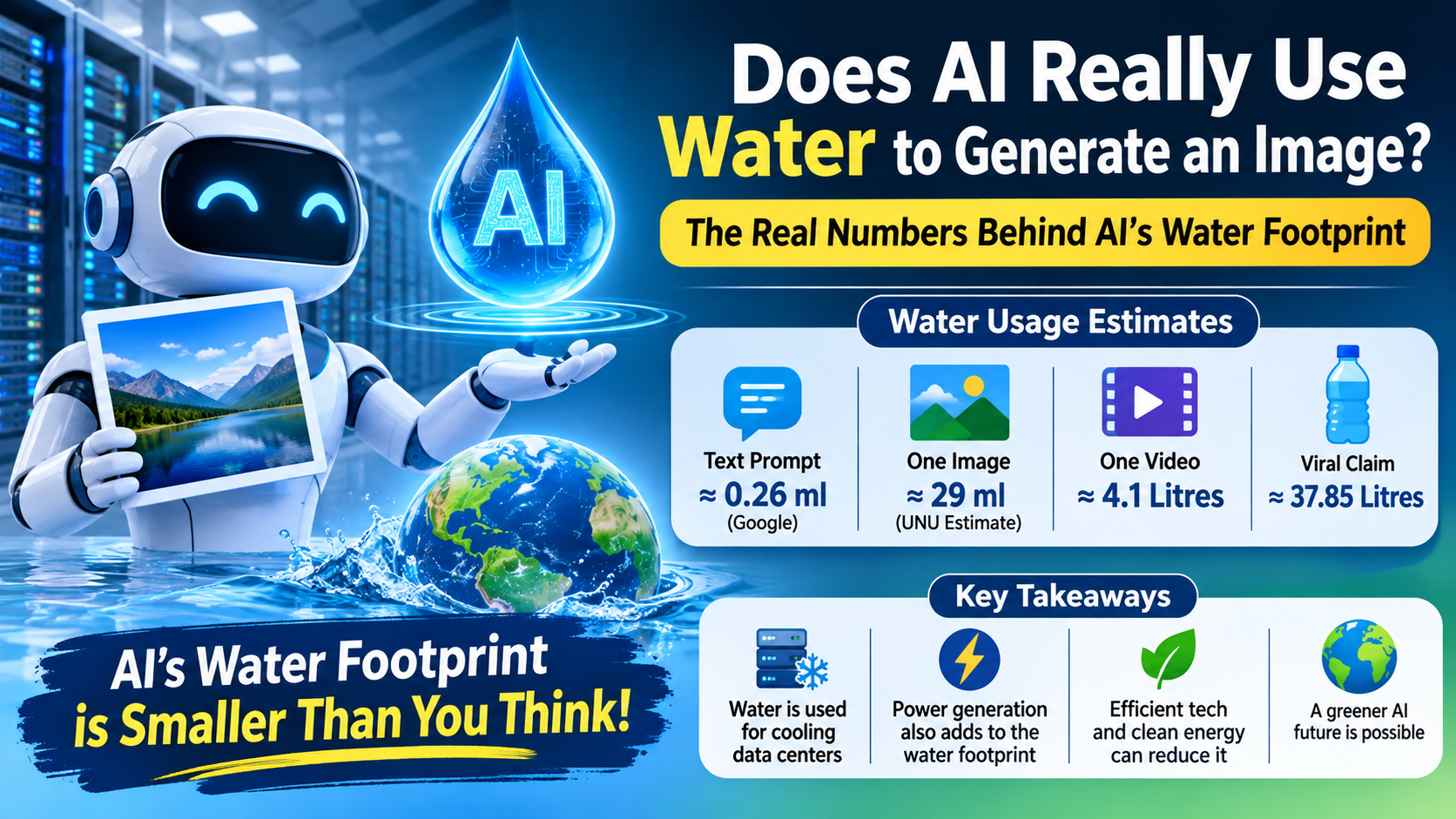
Does AI Use Water to Create an Image?
Yes, but indirectly. An AI model does not drink water. The water is used by data centers that cool the servers running the model, and by power plants that generate the electricity those servers consume. Estimates for a single image range from a few millilitres to far higher viral claims, because researchers measure different things.
Why Does AI Need Water at All?
Every time you type a prompt into an image generator, your request travels to a data center, a warehouse-sized building packed with powerful chips called GPUs. These chips do millions of calculations to turn your words into pixels, and that work produces a lot of heat.
Heat is the enemy of hardware. If servers overheat, they slow down or fail. So operators cool them, and one of the most common and energy-efficient methods is evaporative cooling, where water absorbs heat and evaporates into the air. That evaporated water is gone from the local supply, which is why engineers call it “consumed” rather than merely “used.”
So when people say AI “uses water,” they really mean the physical infrastructure behind AI uses water. The software itself is just maths.
Two Types of Water Behind Every AI Image
Researchers who study this topic usually split the water footprint into two parts.
1. On-site (direct) water. This is water evaporated in cooling towers or used by chillers inside the data center itself.
2. Off-site (indirect) water. Many power plants, especially thermal ones that run on coal, gas or nuclear fuel, use large amounts of water for steam and cooling. When a data center draws electricity from such a grid, part of that plant’s water use is reasonably attributed to the data center.
A third layer, sometimes called embodied water, covers the water used to manufacture chips and build the facility. Most everyday estimates leave this out, which is one reason numbers differ so much.
How Much Water Does One AI Image Actually Use?
This is the question everyone asks, and the honest answer is: it depends on who is counting and what they count.
A widely shared body of work from University of California, Riverside researchers, led by Shaolei Ren, was among the first to link AI computing with water metrics. It estimated that training a large model such as GPT-3 in advanced US data centers could consume up to roughly 700,000 litres of water. The same line of research suggested that a short conversation with a chatbot could account for about a bottle of water over a number of prompts, and some summaries describe a 100-word response as equal to roughly a 519 ml bottle.
On the other side, Google published its own methodology in 2025 and said the median text prompt on its Gemini apps uses only about 0.26 ml of water, roughly five drops, along with 0.24 watt-hours of electricity. Critics point out that this figure counts only on-site cooling and leaves out the water used in electricity generation, so it looks smaller than it would under a broader method.
For images specifically, a 2026 study from the United Nations University, as reported in public commentary, put the electricity-linked water footprint of a typical AI image at around 29 ml, and a complex AI video at about 4.1 litres. Separate energy research found that one image generation can use about 0.011 kWh, comparable to a good portion of a smartphone’s battery charge.
At the other extreme, social media posts have claimed that one AI image “drinks” 10 gallons (about 37.85 litres) of water. That number sits at the very top of the range and is based on broad assumptions, so treat it with caution.
| Activity | Rough water estimate | What it usually includes |
| One median text prompt (Google’s figure) | About 0.26 ml | On-site cooling only |
| One typical AI image | About 29 ml (UNU-linked estimate) | Water tied to electricity |
| One complex AI video | About 4.1 litres | Water tied to electricity |
| Viral claim for one image | Up to 37.85 litres | Very broad, disputed assumptions |
The takeaway: a single image probably costs somewhere between a spoonful and a small glass of water in realistic estimates, not a bathtub.
Why Do the Numbers Disagree So Much?
If you have seen wildly different claims online, you are not imagining it. Five factors change the answer.
- Scope of measurement. On-site only, or on-site plus power plants, or plus chip manufacturing?
- Model size and complexity. Bigger image models need more computation per picture.
- Hardware efficiency. Newer GPUs deliver more output per unit of energy.
- Cooling technology. Air-cooled, liquid-cooled and evaporative systems behave very differently.
- Local climate and grid mix. A data center in a cool region on a renewable grid has a far smaller footprint than one in a hot region on a thermal grid.
There is also the number of attempts. Most people regenerate an image several times before they are happy, so the real cost of one “final” picture is often a multiple of a single run.
Image vs Text vs Video: Which Uses More?
In general, the more computation a task needs, the more heat it creates and the more water is tied to it.
- Text is the lightest, because language models process relatively small chunks of data per request.
- Images need more GPU work, so they sit in the middle.
- Video is the heaviest. It can require tens of times more computation than an image, which is why researchers expect video to dominate AI’s resource footprint as it becomes mainstream.
Is AI Really Causing a Water Crisis?
This is where the debate gets nuanced, and where both extremes miss the mark.
On a national scale, AI is a small slice of total water use. One analysis by the Foundation for Economic Education estimated that US data centers account for around 0.02 percent of national water use, and that only a part of that is AI. Seen this way, AI is not the main driver of water scarcity, which is largely caused by climate change, agriculture, and poor water management.
But the picture changes locally. Water scarcity is a local problem. A large facility drawing drinking-quality water in a drought-hit town can strain communities in a way that a national average hides. And the growth curve matters: Morgan Stanley analysts have projected that AI data centers could consume around one trillion litres of water a year by 2028, an elevenfold jump from 2024 levels. A Nature Sustainability study from late 2025 estimated that AI servers in the US alone could carry an annual water footprint of roughly 731 to 1,125 million cubic metres between 2024 and 2030.
Both things can be true at once: AI’s water use is small today compared to farming or industry, yet it is growing fast and is concentrated in specific places.
What Are Tech Companies Doing About It?
Operators know cooling is a pressure point, and several approaches are gaining ground.
- Water-positive pledges. Many large companies have promised to return more water to the environment than they consume by 2030.
- Closed-loop and liquid cooling. Some newer designs recirculate coolant instead of evaporating it. Oracle and Microsoft have reported cooling designs that cut water use by up to 90 percent.
- Smarter siting. Building in cooler climates, or near abundant renewable power and non-potable water sources, lowers both water and carbon impact.
- More efficient chips and models. Smaller, optimized models reach similar quality using less computation.
- Better transparency. Researchers and policy groups are pushing companies to publish water figures with clear scope, so numbers can be compared fairly.
What Can You Do as a User?
You do not need to give up AI tools. Small habits help.
- Write a clear prompt first. Detailed instructions reduce the number of retries.
- Do not generate for the sake of it. Skip bulk runs you will never use.
- Use a lighter tool when it fits. A text answer or a stock image may do the job.
- Be careful with video. It is the most resource-heavy format.
- Support transparency. Prefer providers that publish environmental data.
Key Takeaways
- AI does not drink water; data centers and power plants do, mainly for cooling and electricity.
- Estimates for one AI image vary widely because of different measurement scopes.
- Realistic figures sit in the millilitre range, while viral claims of bathtubs of water are exaggerated.
- Video generation costs far more than images or text.
- Nationally the footprint is small, but local impact and fast growth are real concerns.
- Efficient cooling, better siting, and honest reporting are the real solutions.
Conclusion
The claim that AI “drinks” water is not a myth, but it is often told in a misleading way. Behind every generated image is real infrastructure that evaporates real water, directly through cooling and indirectly through electricity. A single picture, though, is closer to a few spoonfuls than a swimming pool. The bigger story is scale: billions of requests, growing video use, and data centers clustered in places already short of water. The path forward is not panic or denial, but better engineering, honest reporting, and mindful use.
Frequently Asked Questions
Yes, indirectly. Water is evaporated to cool the data center servers that process your request, and more is used by power plants that supply the electricity.
There is no single figure. Credible estimates range from a few millilitres to tens of millilitres per image depending on the method, while some viral claims go as high as 37.85 litres and are widely disputed.
Yes. Images need more GPU computation than text, which creates more heat and ties more electricity and cooling water to each request.
Yes. A complex AI video has been estimated at around 4.1 litres, far above an image, because video needs much more computation.
Water scarcity is local. A data center in a drought-prone area, or one using drinking-quality water, can stress nearby communities even if its national share is small.
Yes. Closed-loop cooling, liquid cooling, smarter locations, renewable power and more efficient models can reduce water use significantly.
Not necessarily. Using them thoughtfully, with fewer unnecessary retries and lighter tools where possible, keeps your footprint low, and pressure for transparent reporting does more good than guilt.
