










Blog
Gemini 4 Carbon Is Now Available: Features, Pricing, Access and What It Means for You
12 November 2026
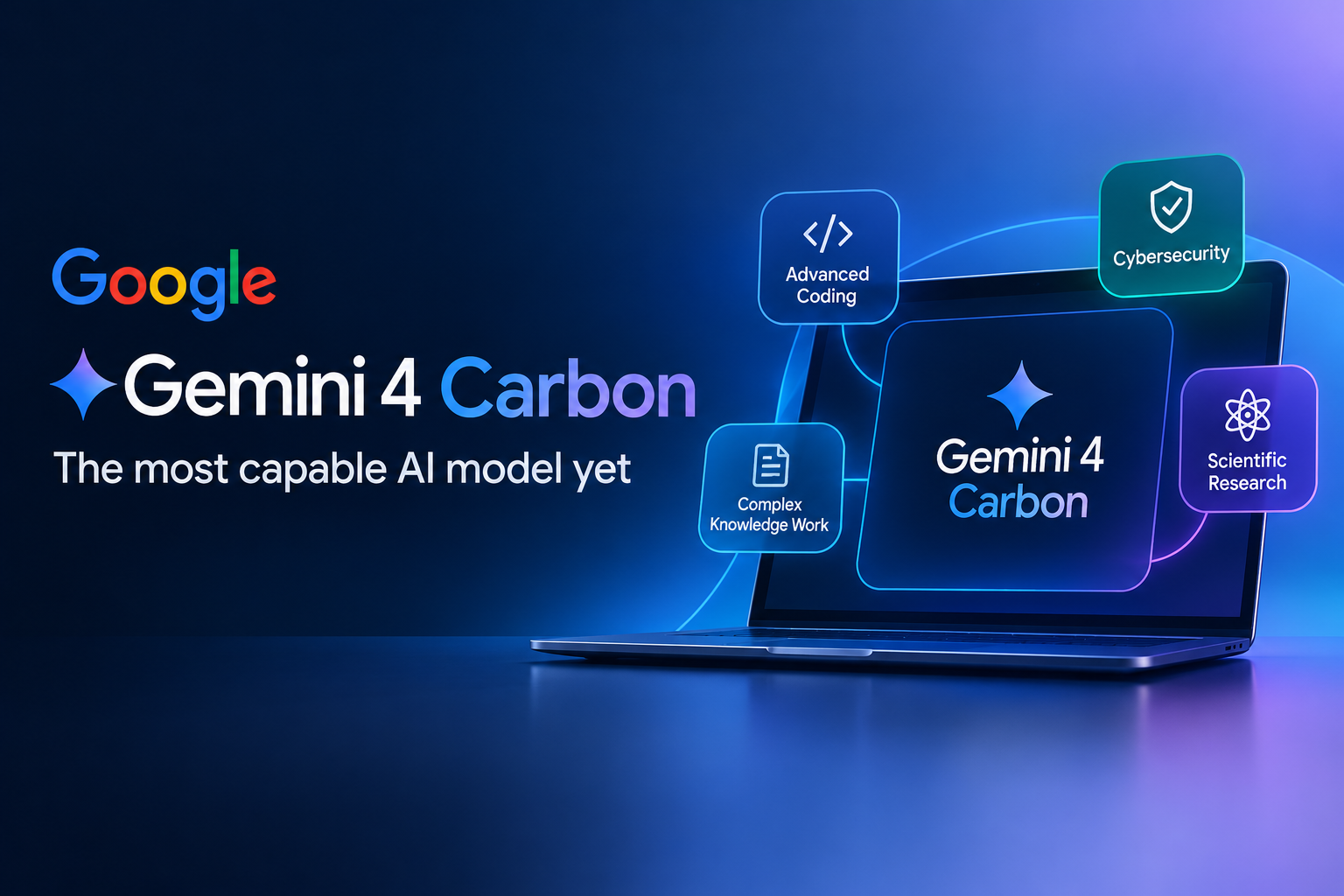
Gemini 4 Carbon is Google’s most capable AI model so far. Since November 10, 2026, it has been open to paying developers, businesses, Google AI Ultra subscribers and approved scientists. It is built for hard, long-running work such as multi-step coding, security research and scientific analysis. Until November 30, 2026, API pricing is $2 per million input tokens and $10 per million output tokens.
What Is Gemini 4 Carbon?
Gemini 4 Carbon is a frontier AI model from Google DeepMind, designed for tasks where ordinary chatbots run out of depth. Instead of answering a single prompt, it plans, uses tools, checks its own output and keeps going through a long workflow.
Google first released Carbon on October 28, 2026, but only to a small group of cybersecurity defenders through its Fairwind Program. The model arrived about two weeks after Gemini 4 Argon. On November 10, Google widened access to developers, enterprises, scientists and everyday paying subscribers.
Gemini 4 Carbon vs Gemini 4 Argon
Both models now sit in the same family, with different jobs.
- Argon is the everyday option. Google says it suits most software engineering and general knowledge work.
- Carbon is for the toughest problems. It spends more tokens thinking, exploring options and running verification loops, so it handles complex debugging, big migrations and open-ended research better.
The practical rule: use Argon for routine tasks and keep Carbon for work where accuracy matters more than speed.
Who Can Use Gemini 4 Carbon Today?
Access depends on who you are:
- Developers: Paying users can reach Carbon through the Gemini API in Google AI Studio. Android Studio is also supported.
- Businesses: Companies can use it in Gemini for business through the API or the model selector.
- Consumers: Google AI Ultra subscribers can use it in the Gemini app and in AI Mode in Search.
- Scientists: Google’s program offers free access for six months, aimed at 10,000 researchers, and Carbon has now been added.
- Security teams: Defenders can apply to the Fairwind Program for the cyber-focused version.
Free-tier Gemini users do not get Carbon yet.
Gemini 4 Carbon Pricing
Google is charging the same introductory rate for Carbon as for Argon:
| Period | Input (per 1M tokens) | Output (per 1M tokens) |
| Until Nov 30, 2026 | $2 | $10 |
| After Nov 30, 2026 | $4 | $20 |
Prices double after the introductory period, so teams planning large workloads should budget for the higher rate. Carbon also uses more tokens per task than lighter models, which affects real-world cost.
Key Features of Gemini 4 Carbon
1. Higher-precision knowledge work
Carbon is aimed at legal, finance and enterprise operations. It can read large sets of dense documents, including charts, images, tables and technical drawings, and then produce structured spreadsheets, presentations and reports that follow strict formats. Google also introduced a new Multimodal Knowledge Agent benchmark with Artificial Analysis to measure this kind of work.
2. Stronger agentic coding
Google says Carbon handles jobs that need several agents working together, such as multi-package migrations, root-cause investigations across systems and large architecture redesigns. For web apps, it builds, tests, fixes errors and inspects the rendered interface before calling a task done.
A preview feature called /swarm in Google Antigravity turns one prompt into a coordinated team of agents. Carbon takes the roles that need deep reasoning, such as design and auditing, while lighter models handle parallel work.
3. Frontier cybersecurity capability
Cybersecurity is the headline strength. In Google’s testing, the cyber version leads benchmarks for finding, exploiting and patching vulnerabilities. Reported results include:
- Project Fortify: 100% recall on scanning and 95% precision on triage in Google’s internal benchmark.
- Wiz: Researchers using Carbon found previously unknown vulnerabilities in two major SaaS providers in under two hours.
- Google’s Cloud Vulnerability Research team: It used Carbon to prove two bugs in popular open-source software were truly exploitable, which led to a critical rating and a quick patch.
4. Scientific and mathematical reasoning
Carbon improves reasoning across physics, maths and life sciences. Google highlights a few examples:
- Researchers used it to help prove security properties in the code behind the Signal protocol, work that normally takes expert teams years.
- In protein research, it retrieved about 40 times more related sequences on average for low-information protein families.
- A drug-toxicity company reported that it found toxicity mechanisms the team had not seen before.
How Does Carbon Perform on Benchmarks?
Google reports that Carbon ranks first on CursorBench 4.0, Perplexity’s WANDR and Zapier’s AutomationBench, at more than twice as low a cost per task as the next best external model. On the new Multimodal Knowledge Agent benchmark it ranks second, at over six times lower average cost than the top model.
These numbers come from Google’s announcement and its benchmark partners. Independent testing across your own workloads is still the best way to judge fit.
Safety and Security Results
Because Carbon is strong at cybersecurity, Google added extra safeguards against misuse. The company reports:
- Carbon blocked 99% of attack attempts from an adaptive red-teaming agent in simulated environments.
- The per-attempt breach rate fell to 0.8%, compared with 3.1% for Argon.
- On a 375-task honesty benchmark, Carbon passed 92% of tasks, against 70% for Argon.
- It achieved a 0% success rate for indirect prompt injection attacks on one benchmark, though Google admits prompt injection is still an area that needs work.
What Gemini 4 Carbon Means for Different Users
For developers: Carbon could reduce time spent on large refactors, debugging and test loops. The cost is higher token usage, so route only difficult tasks to it.
For businesses: Teams in finance, legal and operations can use it to analyze long document sets and produce structured outputs. A pilot on one workflow is wiser than a company-wide switch.
For security teams: Faster vulnerability discovery helps defenders, but the same capability is why access to the cyber version is gated.
For marketers and content teams: Carbon’s arrival in AI Mode in Search is worth watching. As Google’s search experience leans more on generative answers, clear, well-structured and factual content is more likely to be cited. That makes answer-first writing, FAQs and accurate data more valuable.
For researchers: The free access program lowers the barrier to using frontier AI in lab and data work.
Should You Switch to Gemini 4 Carbon?
Consider Carbon if your work involves long, multi-step tasks where mistakes are expensive. Stay with Argon or a lighter model for everyday writing, quick summaries and simple code. A sensible approach is to test both on a few real tasks and compare quality, speed and cost per result.
Limitations to Keep in Mind
- Carbon uses more tokens than Argon, so costs can rise.
- The most powerful cyber features are restricted to approved defenders.
- Consumer access in the Gemini app and AI Mode requires an Ultra subscription.
- Benchmark results are mostly reported by Google and partners.
- Prompt injection risk is reduced but not eliminated.
Final Thoughts
Gemini 4 Carbon shows where AI is heading: less chatting, more completing long and difficult jobs. Its biggest strengths are agentic coding, cybersecurity and research, and Google’s pricing keeps it within reach of paying teams, at least until the November 30 price change. Test it on your hardest tasks, watch the token costs, and keep Argon for the rest.
Frequently Asked Questions
It is Google’s most capable AI model, built for complex coding, cybersecurity, scientific reasoning and long, multi-step knowledge work.
It launched on October 28, 2026 for cybersecurity defenders, and opened more widely on November 10, 2026.
No. It is available to paying developers and businesses, Google AI Ultra subscribers and approved scientists. Free-tier users do not have access yet.
Until November 30, 2026, the API costs $2 per million input tokens and $10 per million output tokens. After that, it rises to $4 and $20.
Argon suits most everyday engineering and knowledge tasks. Carbon is for harder problems and spends more tokens reasoning and verifying.
In Google AI Studio, Gemini for business, Google Antigravity, the Gemini app and AI Mode in Search, depending on your plan.
Google reports strong results in red-team tests, including a 0.8% breach rate and a 92% score on its honesty benchmark. Some risks, like prompt injection, are still being improved.
