










BlogSEO
Technical SEO Audit Checklist for Australian Websites in 2026
12 October 2026
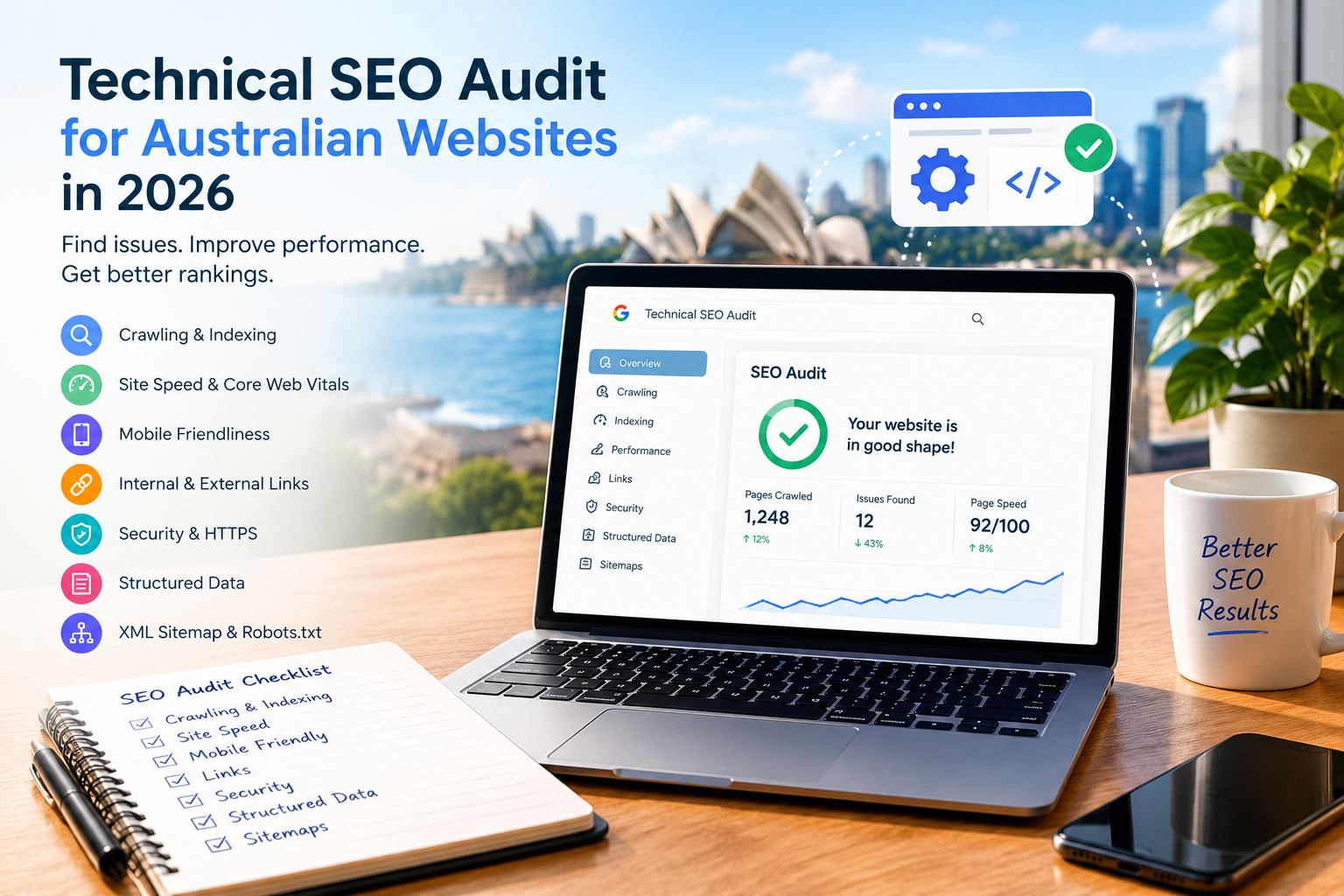
A technical SEO audit is the foundation that every other part of a search strategy is built on. No amount of great content or clever keyword targeting will help a website if search engines can’t crawl it properly, if pages load too slowly, or if structured data is missing entirely. For Australian businesses competing in increasingly crowded search results, a thorough technical SEO audit is no longer optional; it is the starting point for everything else.
This checklist walks through the technical elements that matter most in 2026, explains why each one affects visibility, and looks at how the broader search landscape, including Google’s growing use of AI across both organic and paid search, is reshaping what a genuinely effective audit needs to cover.
What Is a Technical SEO Audit?
A technical SEO audit is a systematic review of a website’s infrastructure to identify issues that prevent search engines from crawling, indexing, or ranking its pages effectively. Unlike content audits, which focus on relevance and quality, a technical audit focuses on the underlying mechanics of a site: site speed, mobile usability, crawl efficiency, indexation, structured data, and security.
Search engines rely on automated crawlers to discover and understand web pages. If those crawlers hit broken links, slow loading times, duplicate content, or confusing site architecture, they may index pages incorrectly or skip them altogether. A technical SEO audit identifies these barriers before they cost a business meaningful organic traffic.
Why Technical SEO Still Matters in an AI-Driven Search Landscape
Searching in 2026 looks very different from searching even a few years ago. Google’s AI Overviews now answer many queries directly inside the results page, and on the advertising side, Google has rolled out AI Max for Search, a campaign level feature that uses AI to automatically expand keyword matching, generate ad creative, and adjust targeting based on search intent. While AI Max for Search sits within Google Ads rather than organic search, its rise signals a broader shift: Google’s systems are becoming far more sophisticated at interpreting intent across both paid and organic channels.
This matters for technical SEO because the cleaner and more structured a website is, the easier it becomes for Google’s AI systems, whether powering organic AI overviews or informing how paid campaigns like AI Max for Search identify relevant landing pages, to understand what a page actually offers. A technically sound website supports stronger performance across the full search ecosystem, not just traditional blue link rankings. Businesses running both organic and paid strategies benefit from aligning their search engine optimisation work with their paid search setup, since a well optimised landing page tends to perform better in both contexts.
The Core Technical SEO Audit Checklist
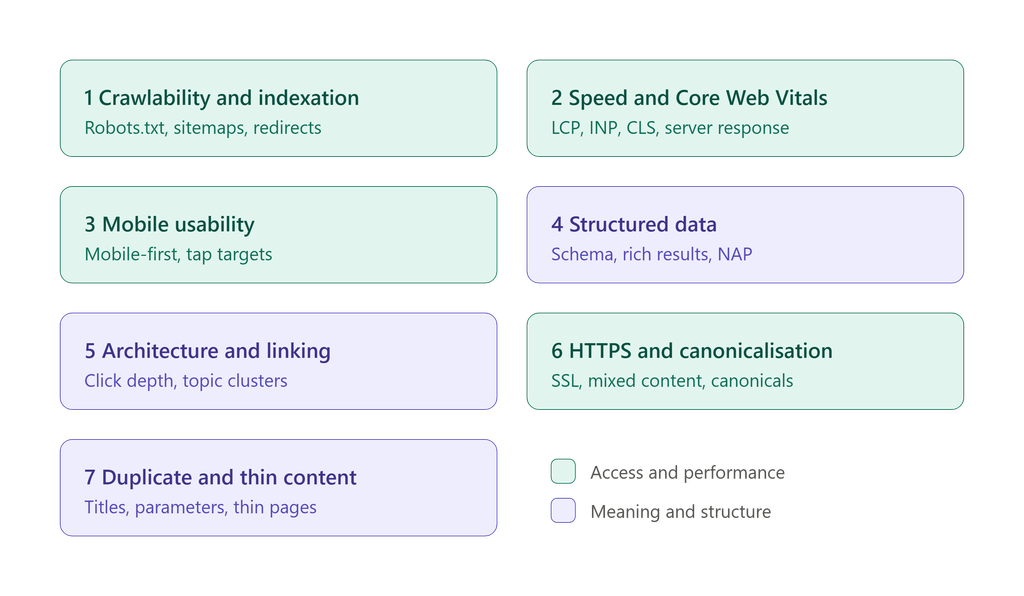
1. Crawlability and Indexation
The first step in any technical SEO audit is confirming that search engines can actually access and index a site’s important pages. This includes:
- Reviewing the robots.txt file to ensure it isn’t accidentally blocking important sections of the site
- Checking the XML sitemap for accuracy and submitting it through Google Search Console
- Identifying orphaned pages that have no internal links pointing to them
- Reviewing indexation status to spot pages that are indexed but shouldn’t be or important pages that are missing from the index entirely
- Auditing redirect chains and fixing broken (404) links that waste crawl budget
2. Site Speed and Core Web Vitals
Page experience remains a confirmed ranking factor, and Core Web Vitals, which measure loading performance, interactivity and visual stability, are central to this. A technical audit should assess:
- Largest Contentful Paint (LCP), which measures how quickly the main content of a page loads
- Interaction to Next Paint (INP), which measures responsiveness to user interaction
- Cumulative Layout Shift (CLS), which measures visual stability as a page loads
- Image compression and next-generation formats to reduce page weight
- Server response times, particularly important for Australian businesses hosting with international providers, where latency can affect load speed for local visitors
3. Mobile Usability
With the majority of Australian search traffic now coming from mobile devices, mobile usability is a non-negotiable part of any audit. This includes checking responsive design across screen sizes, confirming tap targets are appropriately sized, and ensuring mobile pages load at a similar speed to desktop versions. Google continues to use mobile-first indexing, meaning the mobile version of a site is the primary version used for ranking.
4. Structured Data and Schema Markup
Structured data helps search engines understand exactly what a page contains, from product details and reviews to FAQs and business information. A technical audit should check for:
- Valid schema markup using Google’s Rich Results Test
- Local business schema, particularly important for Australian businesses targeting location-specific searches
- FAQ, article and breadcrumb schema where relevant
- Consistent business details (name, address, phone number) across the site and external listings
Well implemented structured data also supports better performance in AI generated answers, since machine readable context makes it easier for AI systems to accurately summarise a page.
5. Site Architecture and Internal Linking
A logical site structure helps both users and search engines understand how content relates across a website. This part of the audit should assess whether important pages are reachable within a few clicks from the homepage, whether internal linking follows a clear topic cluster structure, and whether anchor text is descriptive rather than generic. Businesses building out a content marketing strategy should ensure new content is linked back into existing pillar pages, reinforcing topical authority rather than sitting as an isolated page with no internal links.
6. HTTPS, Security and Canonicalisation
Security remains a baseline trust signal. The audit should confirm the entire site runs on HTTPS with a valid SSL certificate, that there are no mixed content warnings, and that canonical tags are correctly implemented to avoid duplicate content issues, particularly common on e-commerce sites with filtered category pages or on sites with both www and non-www versions live simultaneously.
7. Duplicate Content and Thin Pages
Search engines can struggle to determine which version of near-identical content should rank, which dilutes authority across pages instead of concentrating it. A technical audit should identify duplicate title tags and meta descriptions, thin content pages that offer little genuine value, and parameter-based URLs that may be creating unintended duplicate versions of the same page.
Aligning Technical SEO With E-E-A-T
Google’s E-E-A-T framework, covering Experience, Expertise, Authoritativeness and Trustworthiness, isn’t purely a content consideration. Technical factors contribute directly to trustworthiness. A secure, fast, well-structured website signals reliability, while clear author information, accurate business details and properly implemented schema reinforce credibility. A technical SEO audit and a content quality review should be treated as two halves of the same process, not separate exercises, since a technically weak site can undermine even the strongest content.
How Often Should a Technical SEO Audit Be Done?
For most Australian businesses, a comprehensive technical SEO audit should be conducted at least twice a year, with lighter monitoring in between through tools like Google Search Console. Websites that undergo major changes, such as a redesign, platform migration or significant content expansion, should run a full audit immediately afterwards, since these changes are a common source of crawl errors, broken redirects and indexation issues.
Final Thoughts
A technical SEO audit is not a one-off task; it is an ongoing discipline that underpins every other part of a search strategy. As Google continues to weave AI deeper into both organic search and advertising products like AI Max for Search, the businesses that maintain clean, fast, well-structured websites will be best positioned to perform across every part of the search results page, not just traditional organic listings.
For Australian businesses that want a thorough, professionally managed audit as part of a broader strategy, Maninder Wave offers digital marketing services in Australia that combine technical SEO with content and paid search expertise to build sustainable, long-term visibility.
Frequently Asked Questions
A technical SEO audit typically covers crawlability, indexation, site speed and Core Web Vitals, mobile usability, structured data, site architecture, internal linking, HTTPS security, canonicalisation and duplicate content checks.
AI Max for Search is a Google Ads feature that uses AI to automate keyword matching, ad creative and targeting within paid search campaigns. It is separate from organic technical SEO, but both benefit from a well-structured, fast-loading website with clear, accurate page content.
Site speed affects both user experience and Core Web Vitals, which are a confirmed Google ranking factor. For Australian businesses, hosting location and server response time can meaningfully affect load speed for local visitors, making it an important part of any audit.
Technical SEO issues can affect websites of any size. Even a small business website can lose visibility due to blocked crawl paths, missing structured data or slow load times, so a basic audit is worthwhile regardless of site size.
Structured data provides clear, machine-readable context about a page’s content. This makes it easier for AI systems, including those powering AI Overviews, to accurately understand and summarise a page, which can improve the chances of being referenced in AI generated answers.
Common tools include Google Search Console for indexation and crawl data, PageSpeed Insights for Core Web Vitals, Screaming Frog for site-wide crawl analysis, and Google’s Rich Results Test for validating structured data.
