











Blog
AI Stocks Crash $3.2 Trillion After the Midterms: Why Wall Street Panicked and What Comes Next
16 November 2026
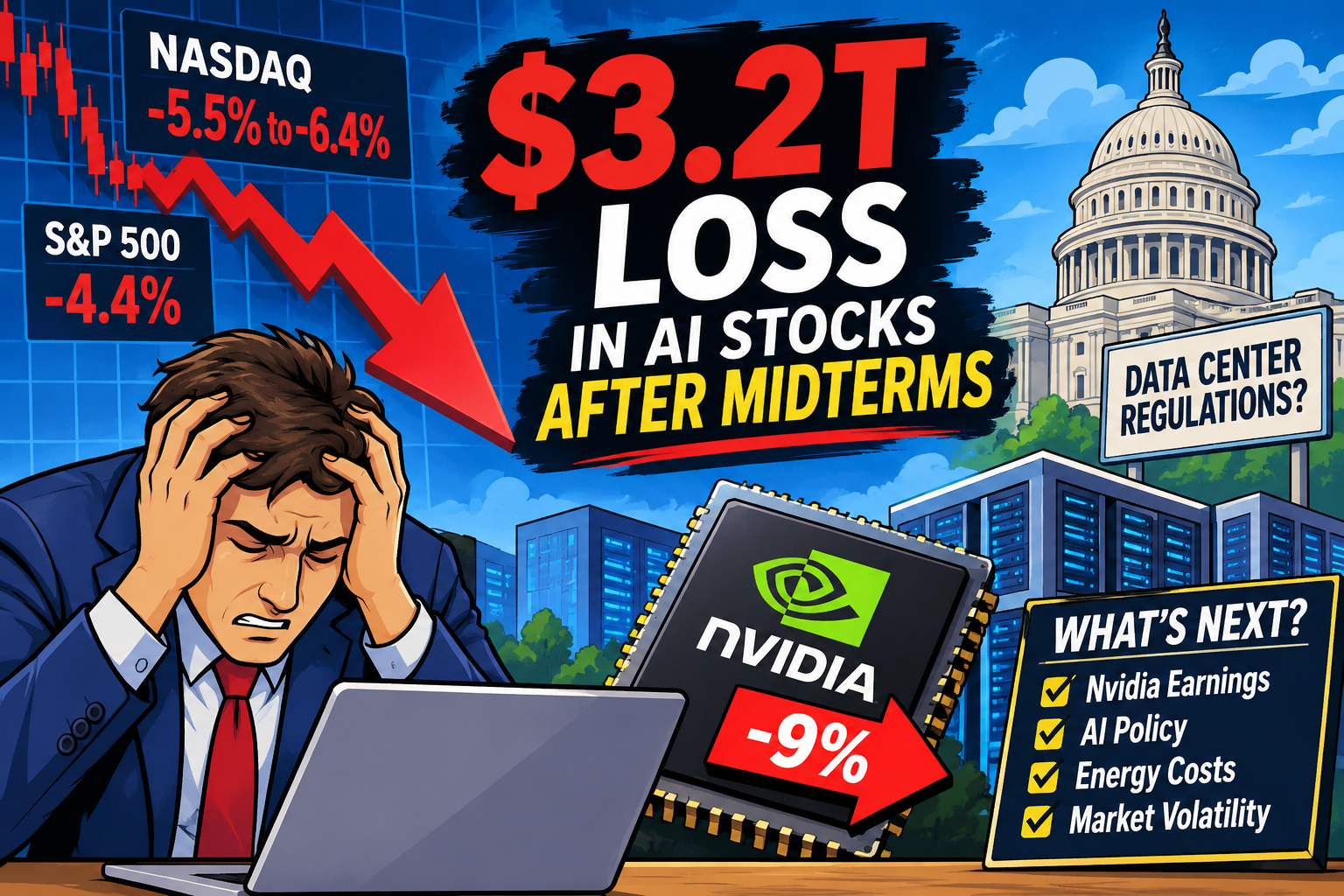
AI-linked stocks lost roughly $3.2 trillion in market value in a single trading day after Democratic gains in the 2026 US midterm elections. Investors feared that tougher politics around data centers could slow the construction boom behind artificial intelligence. Nvidia fell more than 9%, the Nasdaq had its worst day since April 2025, and analysts are split on whether this is a bubble bursting or a painful reset.
What Happened to AI Stocks After the Midterms?
On the day after the 2026 US midterms, Wall Street reversed course. Stocks had rallied right after the election results, but the mood flipped within hours. The next trading session, Thursday, November 5, brought one of the sharpest technology sell-offs in recent memory.
The Nasdaq Composite dropped by roughly 5.5% to 6.4%, depending on the measurement. The broader S&P 500 slid about 4.4%, more than wiping out the previous day’s gains. Market-value losses were counted in the trillions. Headline totals vary by outlet: some report about $2.5 trillion lost on the Nasdaq, while others put the wider US and AI-linked damage near $3.2 trillion.
Whichever number you pick, the message was the same. Investors were suddenly pricing in a slower AI future.
Why Did Politics Hit AI Stocks So Hard?
The answer comes down to one word: data centers.
Modern AI runs on enormous buildings packed with chips, cooling systems and power equipment. Training and running large AI models takes huge amounts of electricity and water. Over the last two years, tech giants have poured hundreds of billions of dollars into constructing these facilities, and chipmakers, utilities, construction firms and equipment suppliers have all ridden that wave.
The election put that wave at risk. Several newly elected officials campaigned against rapid data center expansion, and voters in many communities have complained about higher power bills, water use and land pressure. Surveys and reporting suggest this wariness crosses party lines. With Democrats gaining ground in Congress and local opposition growing in key states, investors started asking a hard question: what if building AI infrastructure becomes slower, costlier and more heavily regulated?
Markets do not wait for answers. They price fear first.
Why Did Nvidia and Chipmakers Fall the Hardest?
Chipmakers sit at the front of the AI supply chain. If fewer data centers get built, fewer chips get ordered.
Nvidia, the central company of the AI rally, fell more than 9% in one session, erasing over $400 billion in market capitalization. Other semiconductor and data-center-related names also took heavy losses. Qualcomm dropped sharply too, although part of its decline came from its own weak quarterly results, which shows that not every move that day was political.
Nvidia’s weight explains why the damage spread. A single percentage move in Nvidia shifts the S&P 500 more than a move in almost any other US company. When Nvidia stumbles, index funds, retirement accounts and pension portfolios feel it.
Is This the AI Bubble Bursting?
This is the question everyone is asking, and honest analysts disagree.
The “bubble” argument: Supporters of this view say AI valuations had climbed far beyond what current revenues justify. Spending forecasts kept growing, yet clear profits from many AI products were still limited. The election, in this reading, only gave nervous investors a reason to sell what they already doubted.
The “correction” argument: Others say the technology is real, adoption is spreading, and demand for computing power remains strong. For them, this was a necessary reality check, not the end of the boom. One data point supports that view: on a following day, the Nasdaq actually rose, which suggests the pain was concentrated in AI infrastructure stocks and not the whole market.
The fair conclusion is that both can be partly true. Prices may have run ahead of fundamentals, and politics may have lit the match.
Warning Signs Were Already There
The crash did not come from nowhere. For weeks before the election, AI stocks had been swinging on worries about the cost of borrowing money to fund new data centers. The Nasdaq had already suffered several large daily drops since mid-October, and it ended the week of the sell-off with its fourth straight weekly decline.
So the midterms acted as an accelerant. Investors were already nervous about huge AI spending, and the election added a new risk on top: regulation and local resistance.
What Does This Mean for Different Groups?
For investors: Volatility in AI stocks is likely to continue. Concentrated portfolios built around a handful of AI names face bigger swings than diversified ones. This is a good moment to review risk, not to panic.
For tech companies: Building data centers may now require more community engagement, clearer energy plans and stronger environmental commitments. Companies that solve power and water concerns early could gain an advantage.
For businesses using AI tools: Day-to-day AI products will not vanish. But if infrastructure grows more slowly, computing costs and availability could shift over time. Companies should avoid depending on a single AI provider and should plan budgets with some flexibility.
For workers and job seekers: Slower construction could affect hiring in chip design, data center building and related trades. At the same time, AI skills remain in demand across industries.
For local communities: The debate gives residents more leverage over how, where and under what conditions data centers get built.
What to Watch Next
Several signals will show whether this is a short shock or a longer trend:
- Nvidia’s upcoming earnings report, expected around November 17, which will reveal whether chip demand is truly weakening.
- State and local decisions on data centers, including pauses, new permitting rules and power-use requirements.
- Federal policy discussion on AI infrastructure, energy supply and tech regulation.
- Borrowing costs, since expensive credit makes giant data center projects harder to finance.
- Big Tech spending plans, because any cut or delay in capital spending would hit chipmakers directly.
Key Takeaways
- AI-linked stocks lost about $3.2 trillion in a single day after the 2026 midterms.
- Nvidia fell over 9%, and the Nasdaq suffered its worst day since April 2025.
- The core fear is that data center construction, which powers AI growth, could slow.
- The sell-off built on earlier worries about AI spending, valuations and borrowing costs.
- Experts disagree on whether this is a bubble burst or a temporary correction.
- The next few weeks of earnings and policy news will show which view is right.
Final Thoughts
The $3.2 trillion drop shows how closely AI, energy, politics and financial markets are now tied together. AI is no longer only a technology story. It is an infrastructure story, a power-grid story and a political story.
Whether this turns out to be the start of a long slowdown or just a sharp reset, one lesson is clear: the future of AI will depend as much on electricity, land and public trust as on clever algorithms. Investors, businesses and everyday users who understand that link will be better prepared for whatever comes next.
Frequently Asked Questions
Investors worried that new political leadership and local opposition would slow the construction of data centers, which power AI growth. Less construction means lower demand for chips and related equipment.
Reports put the one-day loss at roughly $3.2 trillion across AI-linked and US stocks, while some outlets cite about $2.5 trillion for the Nasdaq alone. Totals differ depending on what each outlet measures.
Nvidia dropped more than 9% in one session, wiping out over $400 billion in market value.
A data center is a large facility housing servers and chips that store data and run applications. AI models need very large data centers because training and running them takes massive computing power, electricity and cooling.
Nobody can say for certain. Some analysts see signs of an overheated market. Others believe it is a temporary correction in a technology that is still growing.
Not immediately. Existing AI services continue to run. Over the longer term, slower infrastructure growth could affect pricing and capacity, but that depends on how policy and spending evolve.
That depends on your goals, timeline and risk tolerance. This article is general information, and a licensed financial advisor can guide decisions based on your situation.
Watch Nvidia’s earnings, Big Tech spending announcements, state-level data center rules, federal AI policy and interest rate trends.
