








Blog
Anthropic’s New AI Spending Tools: How US Businesses Can Finally See What Their AI Budget Is Buying
29 October 2026
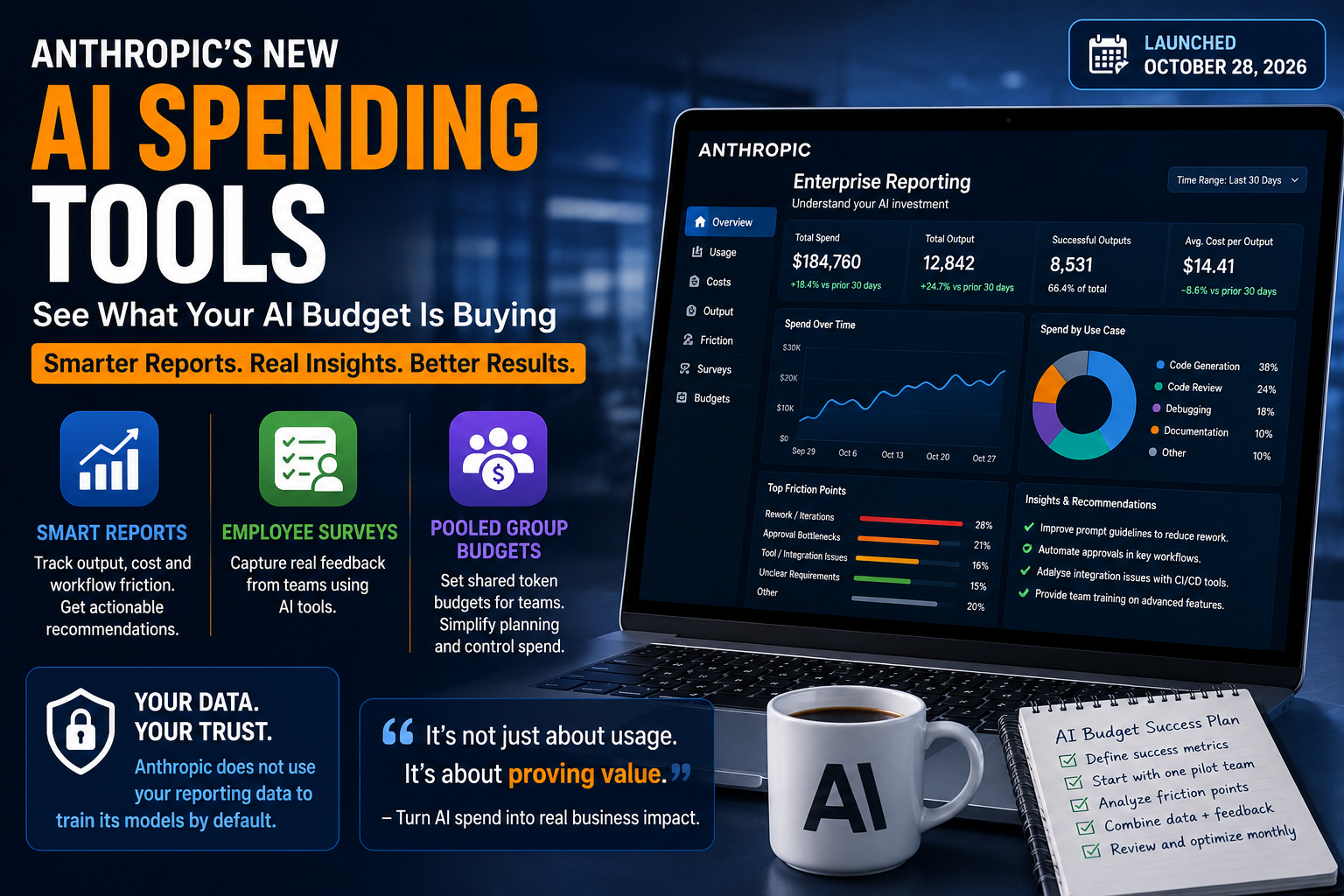
Quick answer: On October 28, 2026, Anthropic released a set of enterprise reporting tools that show what its AI products cost, what teams produce with them, and where work gets stuck. The package includes smart reports, employee surveys and pooled group budgets. Its goal is to help companies, especially American enterprises running Claude Code at scale, prove a return on their AI spend.
Why AI spending became a boardroom problem
Two years ago, most companies treated AI as a small experiment. Today it is a real line item. Engineering leaders are rolling out coding agents across entire departments, and finance teams are asking a fair question: what are we getting for this money?
Usage numbers alone don’t answer it. A dashboard can tell you that thousands of sessions happened last month. It cannot tell you whether those sessions produced working software, saved hours, or simply created rework. That gap between activity and proof is exactly what Anthropic is trying to close.
What Anthropic launched
According to coverage of the announcement, the release has three connected parts.
1. Smart reports. These pull from internal usage analytics and show output, cost and workflow friction across a time period you choose. They also flag where AI sessions led to usable results and where they ran into rework, approval bottlenecks or tool failures. The reports end with suggestions for improving results.
2. Employee surveys. Numbers from a system only tell half the story. Survey feedback adds the human side: whether people find the tools useful, where they feel slowed down, and what they would change.
3. Pooled group budgets. Instead of every person or team holding a separate allowance, managers can set a shared token budget for a group. This makes spending easier to plan and harder to overshoot.
Anthropic also stated that it does not use this reporting data to train its models by default, which matters for any US company with strict data-governance rules.
The numbers behind the push
Timing is not an accident. A recent report from developer-productivity firm Jellyfish, covering data from 276,000 customers’ use of agentic coding tools, found that spending on these tools has grown roughly tenfold since the start of the year. They now account for about 2% of total engineering cost, and tools built on Anthropic’s models were behind close to a third of proposed code changes.
Small share of cost, fast growth, and heavy dependence: that combination is exactly what makes finance leaders want tighter oversight.
Why this matters beyond Anthropic
Anthropic is not alone. Finance and HR platforms have also begun building dashboards that pull AI costs from several vendors into one view, so the market is clearly moving toward “AI financial management” as its own discipline. What stands out here is that the reporting lives inside the product where the spending happens, so managers don’t have to stitch together separate invoices.
Analysts have also pointed out a fair limit: reports can reveal where value gets stuck, but they can’t prove business returns on their own. Your organization still has to decide what “useful work” means for each team.
How US companies can use these tools well
Here is a practical way to approach it:
- Define success first. Pick two or three outcomes per team, such as faster releases, fewer bugs or shorter turnaround on content, before you read any report.
- Start with one pilot group. Use a pooled budget for a single team for a month and compare cost against output.
- Read friction, not just totals. The most valuable insight is often where sessions stall, because that points to a fix such as better prompts, clearer approval rules or training.
- Combine data with feedback. If reports look strong but survey scores are weak, people may be working around the tool.
- Review monthly. AI pricing, models and habits change quickly, so a quarterly look is too slow.
What this means for marketing and growth teams
This isn’t only an engineering story. Marketing teams across the US now use AI for keyword research, content drafts, ad copy, reporting and creative testing. The same rule applies: measure the return, not the activity. Track what each tool costs against rankings gained, leads generated or hours saved.
If you’re building an AI-assisted growth strategy and want it tied to real traffic and lead goals, a digital marketing agency experienced in SEO, PPC and social media can help you decide which AI workflows are worth paying for and which are just noise.
The bottom line
Anthropic’s new reporting tools reflect a shift in how companies buy AI. The question is no longer “should we use it?” but “can we show it’s working?” Smart reports, surveys and pooled budgets give managers a clearer picture, but the real value comes from acting on what they reveal. Teams that set clear goals, measure honestly and adjust often will get the most from every dollar.
Frequently Asked Questions
They are enterprise reporting features that show the cost, output and workflow friction of using Anthropic products such as Claude Code. They include smart reports, employee surveys and shared group budgets.
Anthropic announced and made them available on October 28, 2026.
Mainly enterprise customers, including engineering managers, finance leaders and IT teams that need to justify and control AI token spending.
It is a shared token allowance for a team or group. Managers set one limit for everyone instead of tracking separate allowances for each person.
Anthropic has said it does not use this data for model training by default.
Not by themselves. They show output, cost and where work breaks down, but your company must define what counts as valuable results and compare against its own goals.
Agentic coding tools are spreading across engineering teams. Jellyfish data shows spending on them up about tenfold this year, now near 2% of engineering cost.
Yes. Marketing, sales and operations teams can apply the same approach by comparing what each AI tool costs with results such as leads, rankings or time saved.
