










Blog
Mistral Large 4 Goes Open-Weight: What It Means for Cybersecurity and Company Control of AI
30 October 2026
Quick Answer: What Is Mistral Large 4?
Mistral Large 4, shortened to ML4 and nicknamed “Le Chonk”, is the newest flagship model from French AI company Mistral. On 29 October 2026 the company published its weights, which means any organisation can download the model and run it on its own computers and servers instead of renting access from someone else’s cloud. Mistral says the model is strong at agentic coding and at cyber defence, including spotting, studying and reacting to threats in software and IT systems.
If you only have thirty seconds, here is the short version:
- What changed: the model is no longer only a hosted service; its weights can be downloaded.
- Who benefits: companies and public bodies that handle sensitive code or data and want tighter control.
- The catch: running a model this size securely takes serious hardware and skilled people.
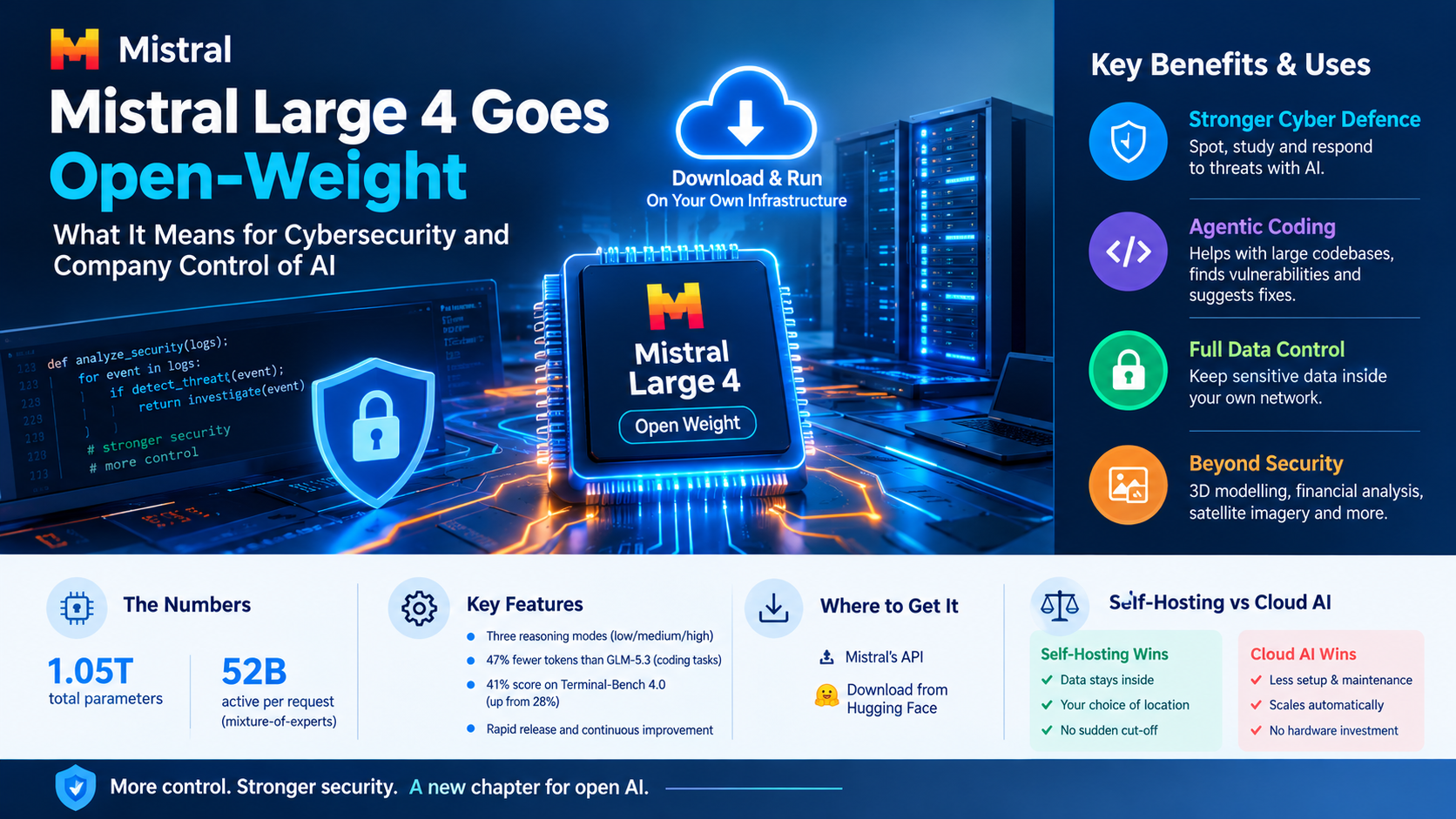
- Where to get it: through Mistral’s own API, and as a download from Hugging Face.
Why This Release Matters Right Now
Most people meet advanced AI through a chat window or an API call. Behind that convenience sits an uncomfortable fact: your prompts, your documents and sometimes your source code travel to a server owned by another company, often in another country. For a hobby project that is fine. For a bank, a hospital, a defence contractor or a software firm guarding unreleased code, it is a real concern.
Open-weight releases change the equation. When the weights are in your hands, the model can sit inside your own network. Nothing has to leave the building, and nobody outside can switch it off.
The timing also matters. Europe has been dealing with a run of security incidents lately, including a major programming-language flaw uncovered with the help of AI that knocked websites offline, and attacks on government agencies in Belgium and Norway. Pair that with a growing worry about depending on foreign AI providers, and you can see why a European lab pushing a cyber-focused model into customers’ hands is landing with a lot of attention.
Inside the Model: The Numbers Behind ML4
Mistral describes ML4 as a very large model with roughly 1.05 trillion parameters in total. The trick is that it does not use all of them at once. For each request, only about 52 billion are active. This design, usually called a mixture-of-experts approach, lets the model deliver big-model quality while spending less compute on each answer.
A few other details stand out:
- Three reasoning modes. Users can choose low, medium or high depth. A quick everyday question does not need the same effort as a tangled debugging task, so you can dial thinking up or down.
- Efficiency claims. Mistral says that on coding tasks ML4 matches leading open models while using about 47 percent fewer tokens per task than the Chinese model GLM-5.3. Fewer tokens usually means lower cost and faster results.
- Agentic coding progress. On Terminal-Bench 4.0, a test of how well AI agents handle coding jobs in a command-line environment, the score reportedly climbed from 28 percent to 41 percent after further training.
- Fast iteration. A preview appeared on 6 October. Over roughly three weeks the team kept training with reinforcement learning, folded in customer feedback and added two extra reasoning modes before the full release.
As always with vendor benchmarks, treat these as claims to verify. Run your own tests on your own codebase before you commit.
How ML4 Is Meant to Help With Cyber Defence
Mistral positions ML4 as a tool that organisations can fully own for defending their systems. In practical terms, that points to jobs such as:
- Reading code for weaknesses. An AI that understands large codebases can flag risky patterns, outdated libraries and logic mistakes before attackers find them.
- Analysing suspicious activity. Security teams drown in logs and alerts. A model that can summarise and cluster them saves hours.
- Suggesting responses. Once a threat is identified, the model can help draft containment steps, patches or detection rules for a human to review.
The key phrase is “for a human to review”. An AI assistant can speed up a skilled analyst, but it does not replace one. Treat its output as a strong first draft, not a final verdict.
Because the model runs on your own infrastructure, the code and logs you feed it never have to reach an outside provider. For teams working with proprietary software, that alone can be the deciding factor.
Beyond Security: Other Uses Mistral Highlights
The company also points to uses outside the security world. According to Mistral, ML4 can convert flat 2D blueprints into usable 3D models inside computer-aided design software, sift through large volumes of data to support financial decisions, and work with satellite and aerial imagery to spot wildfires, track the health of crops and watch for hazards near power lines. Mistral adds that this is the first of a new generation of models covering several modalities, with more releases planned over the coming months.
Self-Hosting vs Cloud AI: An Honest Comparison
Downloading a model sounds liberating, yet it moves responsibility onto you. Here is a plain comparison.
Where self-hosting wins
- Data stays inside. Sensitive code, contracts and customer records never leave your network.
- Choice of location. You decide where the model runs and how it plugs into your tools.
- No sudden cut-off. Because the weights are on your machines, an outside provider cannot restrict or disable your access. Earlier this year, disruptions to some US AI services showed European firms how quickly access can change.
- Customisation. You can tune the model to your own workflows and terminology.
Where cloud AI still wins
- Lower upfront cost. No GPUs to buy, no cooling, no power bill.
- Less maintenance. The provider handles updates, scaling and uptime.
- Faster start. An API key gets you going in minutes.
A model with over a trillion parameters is not something a small office can casually host. You need suitable hardware and people who know how to deploy and lock it down. A badly secured self-hosted model can create new risks instead of removing old ones.
For many teams, a hybrid plan makes sense: use the hosted API for low-risk tasks and keep the downloaded model for anything touching secrets.
The Bigger Picture: Europe’s Push for AI Independence
Europe trails the United States and China in building giant AI models and in the money and computing power needed to train them. Mistral is among the continent’s leading labs, yet it works with far fewer resources than the biggest American companies. Its leadership argues that efficiency can close part of that gap. Chief executive Arthur Mensch has said open source is essential so that cutting-edge AI does not end up in the hands of a few players, and has pointed out that Mistral raised roughly six billion dollars over three years while rivals gathered hundreds of billions.
The training story holds a nuance worth noting. Mistral says ML4 was trained at its European data centres on about 3,800 Nvidia Grace Blackwell GPUs. European infrastructure gives customers more say over operations, but the dependence on a US chip supplier shows how tangled the global AI supply chain remains. True independence would require progress on hardware as well as on software.
What Businesses Should Do Next
If this announcement has you curious, a sensible path looks like this:
- List your sensitive workloads. Decide which tasks involve data you would never want to leave your network.
- Check your capacity. Do you have the GPUs, budget and engineers to run a large model safely? If not, consider managed or smaller options.
- Run a pilot. Test ML4 on a narrow task, such as reviewing one repository, and measure accuracy against your current process.
- Compare real costs. Include hardware, electricity, staff time and security hardening, not only licence fees.
- Set guardrails. Decide who can use the model, what it can access and how its suggestions get approved.
- Keep humans in charge. Use AI to speed up experts, not to replace their judgement.
Key Takeaways
- Mistral has released the weights of Large 4, so organisations can run it on their own systems.
- The model has about 1.05 trillion parameters but activates roughly 52 billion per task, and offers low, medium and high reasoning modes.
- Mistral highlights coding and cyber defence, and says the model is efficient compared with rivals.
- Self-hosting brings control and privacy, but it demands hardware, skills and strong security practices.
- The launch fits a wider European effort to reduce reliance on foreign AI providers, even though chip supply still depends on Nvidia.
Final Thoughts
The arrival of a downloadable, cyber-focused flagship model marks a meaningful step for companies that want powerful AI without handing their most sensitive material to an outside service. The benefits are clear, yet so are the responsibilities. Test carefully, secure thoroughly, and keep people in the loop. Do that, and open-weight AI can become a genuine part of a modern defence strategy rather than just another headline.
Frequently Asked Questions
Mistral Large 4, or ML4, is the French company’s latest flagship AI model. It is built for advanced coding and cyber defence tasks, and its weights are now available for download.
Open-weight means the trained model files are published so anyone can download and run them. It is not always the same as fully open source, since training data and every detail of the process may not be shared.
You can reach it through Mistral’s API, or download the weights from Hugging Face.
It has around 1.05 trillion parameters in total, with about 52 billion active at any moment, which helps it work efficiently.
Low, medium and high. They let you balance speed and cost against depth of thinking, depending on how hard the task is.
Not automatically. It keeps your data inside your network, which is a major benefit, but you become responsible for securing the servers, access controls and updates.
Probably not directly. A model of this scale needs powerful hardware and expertise. Smaller companies may do better using the hosted API or a lighter model.
No. The model can speed up code review and threat analysis, but people still need to check its findings and make final decisions.
