











Blog
Apple Health AI Study App: How Apple Is Testing AI for Everyday Health Questions
16 November 2026
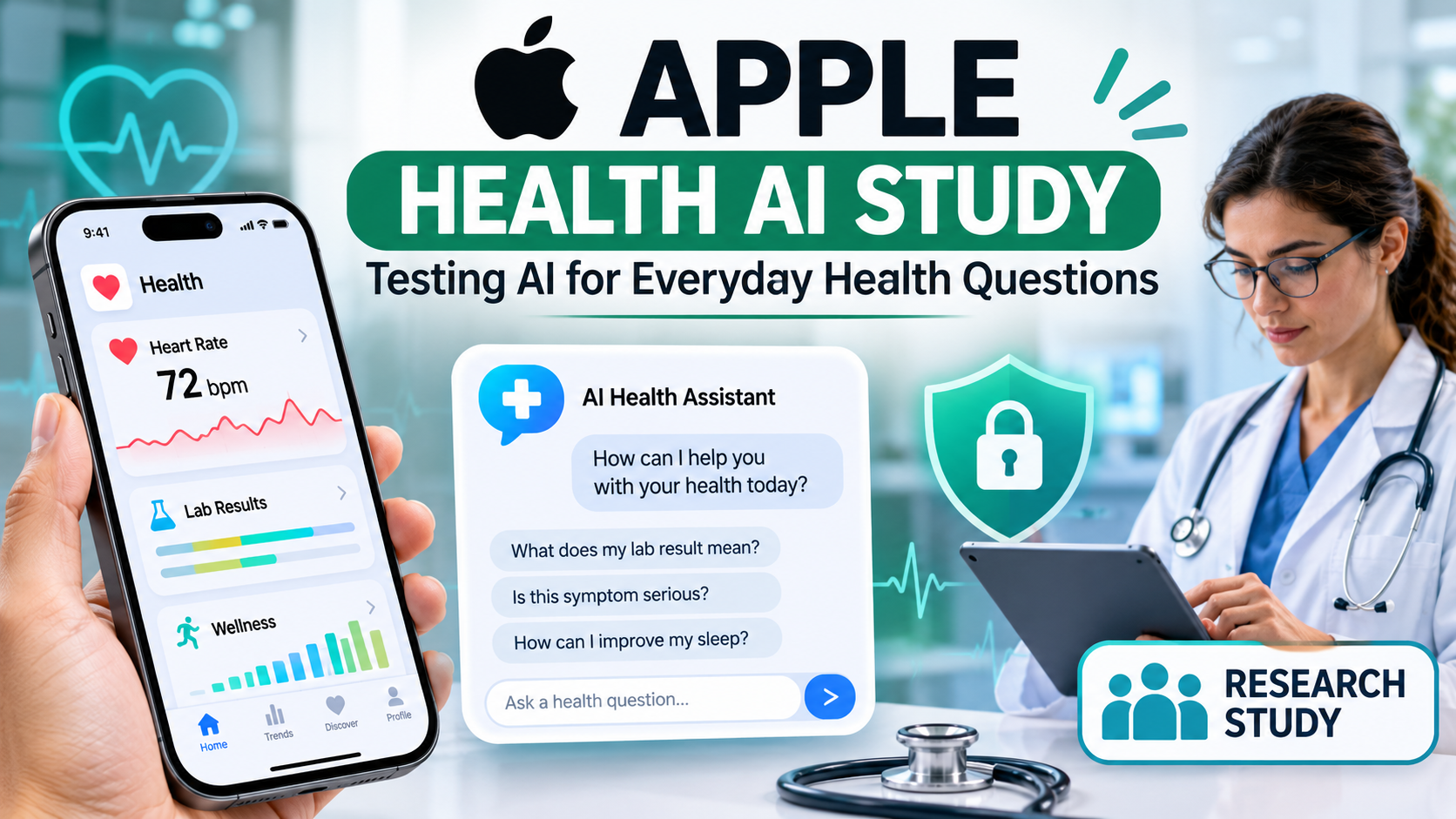
Millions of people already type symptoms, lab results and wellness worries into AI chatbots. Apple has now decided to study that habit properly. The company has launched the Apple Health AI Study App, a research tool built with the healthcare-focused AI company OpenEvidence, to understand how people use AI for health information and whether the answers actually help them.
This guide covers what the study is, how it works, who can join, how it connects to Apple’s wider health plans, and what it means for you.
Quick Answer: What Is the Apple Health AI Study App?
The Apple Health AI Study App is a research app, not a finished consumer product. Participants can ask health questions to an AI assistant powered by OpenEvidence, and Apple observes how those conversations unfold. The goal is to learn how people use AI for health queries, how good the responses are, and whether the tool changes the decisions people make about their care.
Key facts at a glance:
- Developed with: OpenEvidence, an AI platform used by doctors
- Purpose: Studying how people use AI for health information
- Availability: United States only, at launch
- Eligibility: Adults aged 21 and above
- Capacity: Up to 200,000 participants
- Important note: Participants are told to confirm medical information with a doctor or clinician
Why Apple Is Running a Study Instead of Just Launching a Product
Health is a high-stakes category. A wrong answer about a recipe is a minor annoyance. A wrong answer about a medication, a chest pain or a blood test can cause real harm. By running a large research study first, Apple gets real-world evidence on how people behave with AI health tools before it commits to a full product.
A study also lets the company ask questions that lab testing cannot answer:
- Do people trust AI answers too much, or too little?
- Do they understand the information they receive?
- Does the AI push them to see a doctor when they should?
- Do personalized answers feel more useful than generic ones?
That last question is central to the project, and it leads to the next point.
The Role of Personal Health Data
One of the most interesting parts of the research is whether giving an AI access to your own health information makes its answers better. A generic reply to “Is my resting heart rate normal?” is far less useful than one that knows your age, your usual range and your recent trend.
Apple’s study explores whether this kind of personal context makes AI responses more relevant and easier to understand. If the answer turns out to be yes, it supports the idea of connecting AI assistants to the data already stored in the Health app. It also raises the privacy question that every health AI must answer: how is that sensitive data handled, and who can see it? Anyone considering joining should read the study’s consent and privacy information carefully before sharing anything.
Who Is OpenEvidence and Why Does It Matter?
OpenEvidence is an AI tool built for clinicians. It is trained on medical sources such as peer-reviewed journals, which many general-purpose chatbots cannot fully access. That makes it a different kind of partner from the broad AI assistants most people know.
The choice signals something about Apple’s thinking. Instead of relying only on a general model, Apple is pairing its device ecosystem with a medical-grade knowledge source. For users, that could mean answers grounded more firmly in published research. It does not mean the answers are infallible, and Apple itself advises participants to verify information with a healthcare professional.
How the Study Fits Into Apple’s Bigger Health Strategy
This study does not appear out of nowhere. For more than a year, reports have suggested Apple is building AI-driven health features around the Health app, with internal names such as Health+ circulating in the press. Those reports describe an AI coach that draws on data from the iPhone, Apple Watch and other connected devices to offer tailored guidance on sleep, activity, nutrition and heart health, and describe physicians helping to train the system.
More recently, tech outlets have reported a redesigned Health app with AI features appearing in an iOS 27.3 developer beta, with Siri playing a larger role. Treat these as reports and beta observations rather than confirmed final features, since Apple can change or drop anything before public release.
Seen together, the pattern is clear. The study gathers evidence on human behavior, the beta tests the interface, and the reported Health+ concept points toward a possible full product. The research app is likely one piece of a much larger puzzle.
What This Means for Everyday Users
Even if you are outside the United States or under 21 and cannot join, the study matters to you because its findings may shape the AI health tools you use in the future.
Potential benefits:
- Clearer explanations of health terms and test results
- Faster answers to routine wellness questions
- Better preparation for doctor visits, since you can arrive with informed questions
- More personalized guidance when your own data is part of the picture
Potential risks:
- Over-reliance on AI instead of professional care
- Confident-sounding answers that are incomplete or wrong
- Privacy concerns around sensitive health records
- A false sense of security that delays real treatment
The healthiest approach is to treat AI as a well-informed assistant that helps you understand, not as a doctor that diagnoses.
What Doctors and Health Providers Should Watch
For clinicians, patients who arrive with AI-generated information are becoming normal. Apple’s study may produce valuable data on how those conversations influence patient expectations, adherence and anxiety. Healthcare providers should watch for published findings, because they could reveal where AI helps patients and where it misleads them.
Tips for Using AI for Health Questions Safely
Whether you join the study or use any other AI tool, a few habits reduce risk:
- Ask for explanations, not diagnoses. “What does this term mean?” is safer than “What disease do I have?”
- Check important answers with a professional. Anything about medication, dosage, pregnancy, children or serious symptoms should go to a clinician.
- Never ignore emergency symptoms. Chest pain, trouble breathing, sudden weakness or severe bleeding need emergency care, not a chatbot.
- Protect your privacy. Read what data a tool collects and how it is stored before you upload records.
- Cross-check with trusted sources. Compare AI answers with reputable medical organizations.
- Keep a record. Save the questions you asked so you can discuss them with your doctor.
Why This Matters for AI Search and Content Creators
The Apple Health AI Study also highlights a shift in how people find health information. Instead of scrolling through ten search results, users increasingly ask an AI and get one synthesized answer. For publishers and health brands, this means content must be accurate, clearly structured and trustworthy enough to be cited by AI systems. Clear question-and-answer formats, expert review and transparent sourcing are becoming essential for visibility in AI-driven search.
The Bottom Line
Apple’s Health AI Study App is a careful, research-first step into a sensitive field. By partnering with OpenEvidence, limiting the launch to adults in the United States and openly reminding participants to consult clinicians, Apple is signaling that it wants evidence before ambition. The results could shape not only Apple’s future health features but also how the wider industry designs AI for personal health.
For now, the smartest move for readers is simple: stay curious about AI health tools, stay cautious about their limits, and keep your doctor in the loop.
Frequently Asked Questions
It is a research app from Apple, built in collaboration with OpenEvidence, that studies how people use AI to find health information and how that affects their decisions.
At launch, it is open to eligible adults aged 21 and above in the United States, with room for up to 200,000 participants.
It is a research study rather than a paid product. Check the app’s enrollment details for any terms before joining.
No. Participants are advised to consult a doctor or clinician about health concerns and to verify any medical information they receive.
OpenEvidence is a healthcare-focused AI company whose tool is used by doctors and is trained on medical sources such as journals.
Apple is studying whether access to personal health information makes AI answers more relevant and understandable. Review the study’s consent and privacy terms to see exactly what is collected.
Not confirmed. Health+ is a name from media reports about a possible AI health coach. The study app is a separate research effort, though the two may be related to Apple’s wider strategy.
Currently the study is launched in the US only. Availability elsewhere has not been announced.
