











Blog
Google DeepMind and Springer Nature Build an AI Peer Review Assistant
27 October 2026
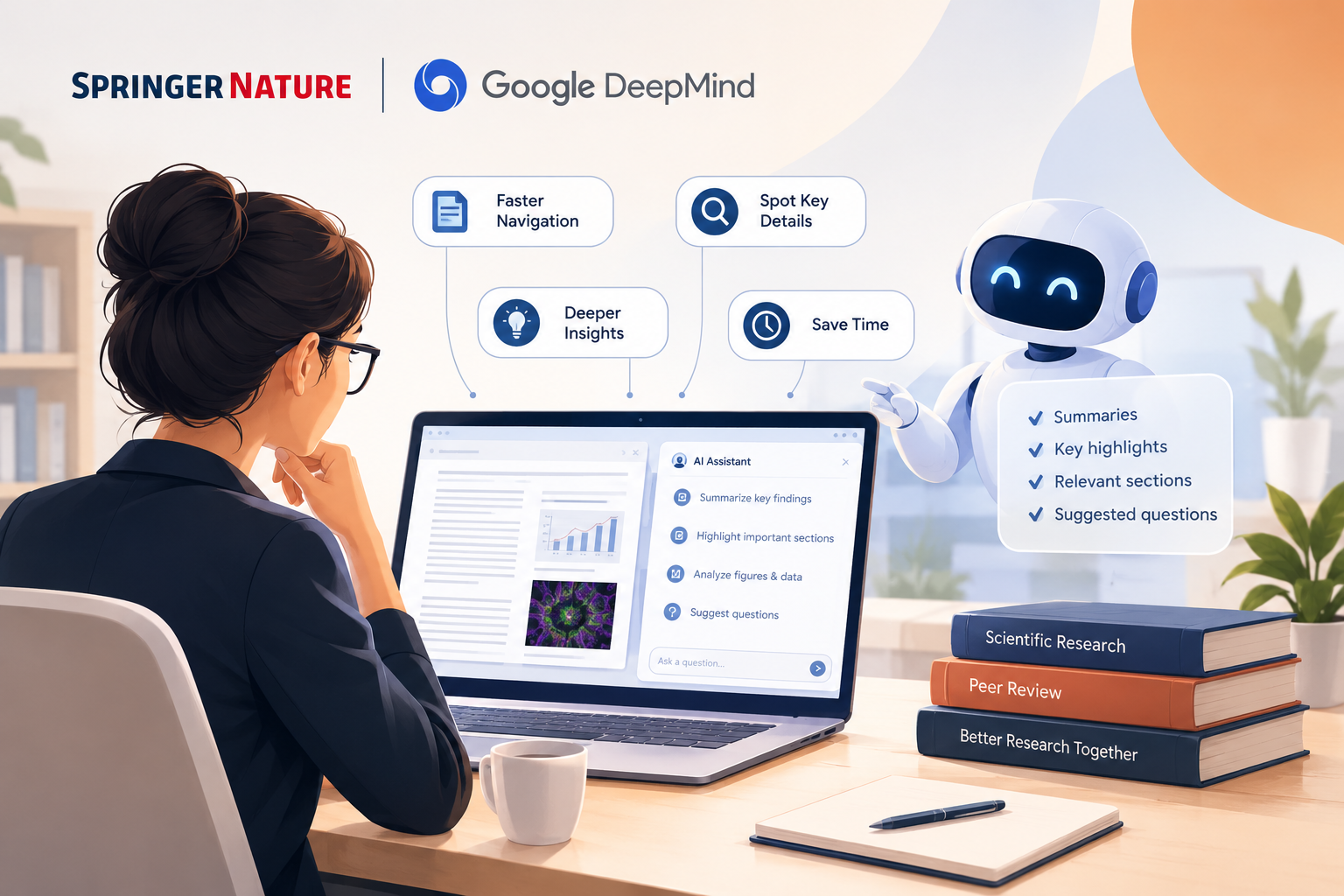
On 26 October 2026, Springer Nature and Google DeepMind announced a research partnership to co-design an AI assistant for peer reviewers. A prototype is being tested, and the goal is to make peer review a more interactive experience while keeping expert human judgment at the centre. The tool is meant to help reviewers, not replace them.
Key Takeaways
- Springer Nature, a major research publisher, is working with Google DeepMind, the AI lab behind the Gemini models.
- The assistant is a prototype under testing, not a finished public product.
- It runs only inside Springer Nature’s private, secure Gemini Enterprise platform, so author and reviewer confidentiality is protected.
- Human experts remain responsible for the final review decision.
- The partnership is a response to rising submission volumes and growing pressure on reviewers.
What Is the AI Peer Review Assistant?
The AI peer review assistant is a tool designed to support scientists who evaluate research papers before they are published. Peer review is the process where independent experts check whether a study is sound, original and honestly reported. The new assistant aims to make that job easier.
According to reports on the announcement, the project looks at how AI could help reviewers get through large volumes of text and figures more efficiently, freeing up their time for the questions that need specialist knowledge. In plain terms, the AI handles some of the heavy reading and navigation, and the human reviewer does the thinking and judging.
The partners also describe the project as “co-designed.” That means the tool is being shaped with input from the people who will use it, rather than being built in isolation and handed to reviewers afterwards.
Why Is Peer Review Under Pressure?
Peer review has always depended on busy researchers giving their time for free. That arrangement is now strained for several reasons.
1. Submissions keep rising. Researchers around the world are dealing with a surge in AI-assisted scientific output, and this is putting the peer review process under threat. When writing and analysis become faster, more papers get submitted, but the number of qualified reviewers does not grow at the same speed.
2. Reviewing is unpaid and time-consuming. Most reviewers have full-time research, teaching or clinical duties. A careful review of a complex manuscript can take many hours.
3. Papers are becoming more complex. Modern studies often include large datasets, many figures, supplementary files and detailed methods. Checking all of that properly takes real effort.
Google’s own research echoes the concern. In a recent paper about its separate Paper Assistant Tool, the authors argue that traditional human peer review cannot scale to match the influx of AI-assisted science.
Who Are the Two Partners?
Springer Nature
Springer Nature is one of the largest publishers of scientific journals and books in the world. It has been adding AI to its workflows for some time. The company says it now uses nearly 60 AI tools to support manuscript screening, editorial evaluation, author retention and research integrity checks. It also runs its own peer review platform, called Snapp, which is used by more than half of its journals.
Integrity is a big part of this work. Springer Nature reports that its AI-based integrity tools flagged around 25,000 papers for possible problems such as image manipulation, fabricated text or fake references.
Google DeepMind
Google DeepMind is Google’s AI research lab and the team behind the Gemini family of models. The project builds on DeepMind’s Gemini models and on Google’s experience developing agentic research tools such as ScholarPeer and Deep Review.
Seshu Ajjarapu, a senior director at Google DeepMind, described the goal as building a platform that eases the strain of growing submission volumes while strictly upholding the editorial standards of leading journals.
How Could the Assistant Help Reviewers?
The partners have shared the broad idea, not a feature list, so it is important not to overstate what the tool can do today. Based on the announcement, the assistant is expected to help reviewers in these ways:
- Navigating a manuscript: Helping a reviewer move through a long paper and its figures more quickly.
- Highlighting areas for attention: Using Gemini models to help reviewers analyse manuscripts and spot areas that need closer attention.
- Making review interactive: Turning review from a one-way reading task into a back-and-forth experience where the reviewer can explore the paper with AI support.
- Saving time: Reducing routine effort so reviewers can focus on scientific judgment.
Springer Nature’s chief product officer, Saskia Steinacker, summed up the company’s position by saying that innovation and trust have to go hand in hand. That idea runs through the whole announcement.
How Will Confidentiality Be Protected?
Confidentiality is the first question many researchers ask. Papers under review are unpublished and sensitive. Uploading them to a public AI chatbot could expose ideas, data and results before the authors are ready, and most journals forbid it.
The partners say the new assistant avoids that risk by design. It runs solely in Springer Nature’s private, secure Gemini Enterprise platform, which means any content used to develop and test it stays inside the publisher’s secure environment.
This is an important difference from reviewers privately pasting manuscripts into consumer AI apps. A controlled, publisher-run tool gives editors more visibility and more control over how AI is used.
Will AI Replace Human Peer Reviewers?
No. Both organisations are clear that the assistant is a support tool. Springer Nature describes its broader approach to AI as “human first, AI second.”
There are good reasons for this. Peer review is not only about spotting errors. It also needs knowledge of the field, awareness of what is genuinely new, ethical judgment and the ability to weigh evidence. These are areas where human experts are still essential, and where responsibility has to sit with a person who can be held accountable.
What Are the Concerns and Criticisms?
The idea of AI in peer review is still debated. Researchers, funders and commentators have raised several concerns.
Misuse and enforcement. If reviewers use AI tools in ways publishers have not approved, it is difficult to detect and difficult to police. Questions remain about what happens when a review turns out to be AI-generated.
Manipulation of AI reviewers. Reports from 2025 described preprints that contained hidden text trying to push AI reviewers into giving only positive feedback. Any AI review tool needs to be resistant to tricks like this.
Over-reliance. If reviewers lean too heavily on AI summaries, they might miss subtle flaws that only careful reading would catch.
Concentration of power. One analysis of Google’s separate Paper Assistant Tool pointed out that a company building AI-driven research could also end up shaping the systems that check that research.
Funder caution. Funders such as UK Research and Innovation are trialling AI in peer review, but the subject remains controversial.
These concerns do not mean the project is flawed. They show why testing, transparency and clear rules will matter as much as the technology itself.
What Does This Mean for Researchers, Authors and Publishers?
For reviewers: Less time spent on routine reading and more time for deep scientific thinking, if the tool works as intended.
For authors: Potentially faster review cycles, since reviewers may complete their work sooner. Authors should still expect human experts to make the decisions about their papers.
For editors and publishers: A possible way to handle rising submission numbers without lowering quality standards.
For the public: Stronger checks before research enters the scientific record, which supports trust in published findings.
What Happens Next?
The assistant is still a prototype, and no public release date has been announced. The next things to watch are:
- Results from the current testing phase.
- Rules about how reviewers can and cannot use the assistant.
- Whether other major publishers launch similar partnerships.
- How funders and conferences respond to AI-supported review.
The wider direction is already clear. Google’s own research on automated scientific review proposes a four-level taxonomy of collaboration between human reviewers and AI verification systems, which suggests the industry is thinking carefully about how much responsibility AI should take on.
Conclusion
The partnership between Springer Nature and Google DeepMind marks a clear shift in how the research world thinks about AI. The question is no longer whether AI will touch peer review, but how it can be used safely and fairly.
The early answer is cautious and sensible: keep the technology inside a private, secure platform, keep humans in charge, and test openly before scaling. If the prototype delivers, it could ease the strain on reviewers and help journals keep pace with rising submissions. If it falls short, the lessons will still shape how the next tools are built.
Either way, this announcement shows that peer review is entering a new phase, and researchers, editors and readers will all want to watch how it develops.
Frequently Asked Questions
On 26 October 2026, they announced a research partnership to co-design an AI assistant that supports peer reviewers.
Not yet. A prototype is being tested, but it has not been released publicly.
It uses Google DeepMind’s Gemini models.
No. Expert human judgment stays at the centre of the process, and the AI only assists the reviewer.
The partners say the tool runs only on Springer Nature’s private Gemini Enterprise platform, so content stays within a secure environment.
Submission volumes are rising and reviewers are overloaded. AI is being explored as a way to reduce routine workload.
Yes. It uses many AI tools for screening, editorial support and integrity checks, including detection of image manipulation and fake references.
The main risks are misuse, manipulation through hidden prompts, over-reliance on AI summaries and weak confidentiality if public tools are used.
No change to submission has been announced. The focus is on helping reviewers, not changing what authors must do.
Springer Nature published a press release on its group media site, and the story was covered by Times Higher Education and other industry outlets.
