








Blog
Moonshot AI Cuts Cyber-Offense Skills in Kimi K3.1 Pro Before Its Open-Weight Release: What It Means
26 October 2026
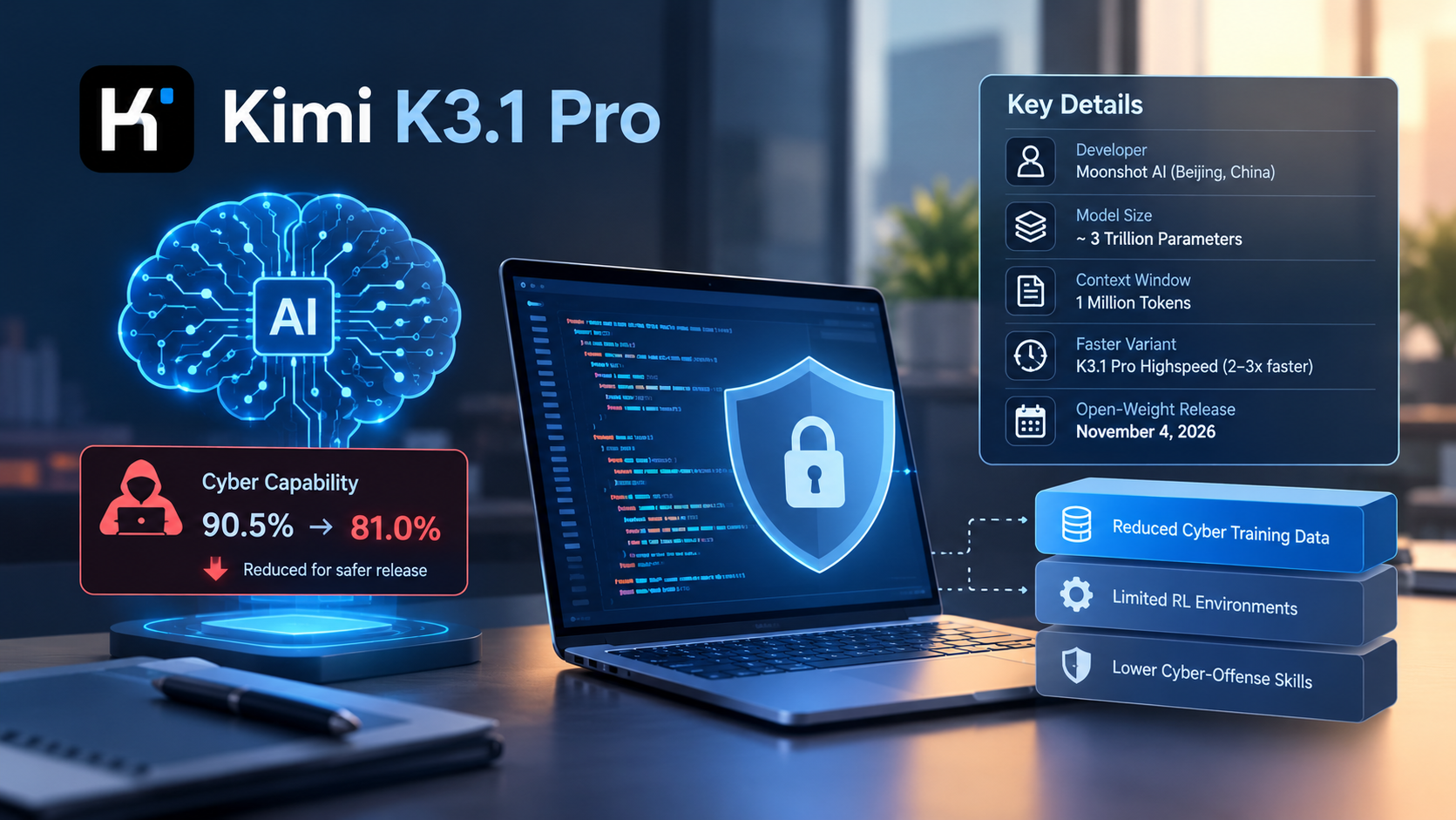
Moonshot AI, a Beijing-based AI company, has deliberately reduced how well its new Kimi K3.1 Pro model can find and exploit software vulnerabilities. The company plans to publish the model’s weights on November 4, 2026, so developers can download and run it themselves. Moonshot’s internal benchmark shows the cyber score falling from 90.5% to 81.0%. These figures are company-reported and have not been independently verified.
What Is Kimi K3.1 Pro?
Kimi K3.1 Pro is the latest large language model from Moonshot AI. According to the company, it belongs to the three-trillion-parameter class, which makes it one of the largest systems Moonshot has described publicly.
Key specifications reported so far:
- Developer: Moonshot AI (Beijing, China)
- Model class: About three trillion parameters
- Context window: One million tokens
- Faster variant: K3.1 Pro Highspeed, which Moonshot says runs two to three times faster than the standard version
- Planned open-weight release: November 4, 2026
A one-million-token context window means the model can handle very large inputs, such as long codebases or document collections, in a single session.
What Is an Open-Weight AI Model?
An open-weight model is one whose trained parameters (the “weights”) are published, so anyone with enough computing power can run, test and fine-tune it on their own systems.
This differs from a hosted model, which you can only reach through the creator’s servers. Open weights offer more freedom, lower dependence on one vendor and room for customization. They also mean the creator can no longer monitor usage or change safety controls after release.
Why Did Moonshot AI Reduce the Model’s Hacking Ability?
Moonshot says it did not want to release an open-weight system that pushes offensive cyber capability further than what is already available. Once a model’s files are public, they cannot be recalled, and anyone can modify them.
That is the core dilemma. A hosted service lets its operator watch for abuse, block accounts and update safeguards. A downloaded model offers none of that. So Moonshot chose to limit the risk during training instead of relying on controls it can no longer enforce.
How Did Moonshot Limit the Cyber Capabilities?
According to the company, the changes happened at the training stage. Moonshot removed cyber-related material from two places:
- The training dataset: the text and code the model learns from
- The reinforcement learning environments: the simulated tasks where the model practices and receives feedback
Reinforcement learning improves a model through feedback on its actions. If the practice scenarios involving vulnerability discovery and exploitation are removed, the model gets less practice at those tasks and tends to perform worse at them.
Moonshot says the broader programming ability was preserved and that the modified model still outperforms its predecessor.
How Much Did the Cyber Performance Drop?
On Moonshot’s internal cybersecurity benchmark:
| Model version | Score |
| Kimi K3.1 Pro (with risk-reduction measures) | 81.0% |
| Comparable version without those measures | 90.5% |
The gap is 9.5 percentage points. The benchmark tests identifying and exploiting software weaknesses in a controlled setting. These are Moonshot’s own numbers, not independent results.
A single benchmark also cannot show how the model would behave against different targets, attack techniques or real operating environments.
Does Limiting Hacking Skills Actually Make the Model Safe?
Not necessarily, and this is the most important caveat.
General coding and cyber-offensive work overlap heavily. A model that writes, reads and debugs code well can also help spot flaws an attacker might use. Removing specialized material reduces the capability but may not eliminate every skill that could be repurposed.
Several open questions remain:
- No independent proof yet. Moonshot has not published independently verified evidence of how well the changes prevent misuse in real conditions.
- Durability is untested. Once the weights are public, outside developers could fine-tune the model, and it is unclear whether the reduction would hold up.
- Benchmarks are narrow. A lower score on one test does not map directly to lower real-world risk.
Independent testing after the November 4 release will be needed to judge how durable the reductions are.
Why Does This Matter for Cybersecurity?
Advanced AI can lower both the cost and the technical skill needed for cyberattacks. Models that can write code, operate software tools and complete multi-step tasks can automate parts of vulnerability research and exploitation.
At the same time, the same abilities can help defenders. Moonshot argues that open access can strengthen security because organizations can use accessible models to:
- Examine their own software for weaknesses
- Find flaws before attackers do
- Improve protection in older applications that get little maintenance
This is the dual-use problem: the capability that helps a defender audit code can help an attacker probe it. The industry has not settled how to keep the defensive benefits while shrinking the offensive ones.
What Is China Doing About AI-Powered Cyber Threats?
The announcement came shortly after China proposed draft export controls covering AI-related cyber capabilities. Per the reports, the draft focuses on:
- AI-powered malware generation and mutation
- AI-assisted vulnerability discovery
The proposals cite risks to critical infrastructure, defence-related industrial systems and core government networks, as well as the possibility of using such technologies to get around security protections. The draft is still open for public comment, so the final rules could change.
Moonshot’s training changes and the draft controls point the same way: governments and developers are both treating cyber-capable AI as something that needs guardrails.
Why Is This Important for the Wider AI Industry?
Moonshot’s decision is a case study in a problem every open-weight developer will face. Three lessons stand out.
1. Safety work is shifting earlier in the pipeline. When post-release controls are impossible, the training stage becomes the main place to manage risk.
2. There is a trade-off between capability and caution. Moonshot accepted a lower cyber score in exchange for a lower-risk release. How many developers will make the same choice is uncertain.
3. Transparency and verification matter. Self-reported benchmarks are a starting point. Trust will depend on independent evaluation, especially for models that anyone can download.
What Should Developers and Security Teams Do?
If you plan to work with Kimi K3.1 Pro or similar open-weight models, some practical steps make sense:
- Wait for independent evaluations before relying on Moonshot’s own benchmark claims.
- Test in isolated environments and avoid connecting a new model directly to production systems.
- Treat the model as dual-use. Even a weakened model can assist with code analysis, so apply access controls and logging in your own deployment.
- Track regulation. Draft rules on AI-assisted vulnerability discovery and malware generation may affect how such tools are shared or used.
- Plan for fine-tuning risk. If you modify an open-weight model, you take on responsibility for its safety behavior.
Key Takeaways
The real test comes after release, when independent researchers can check whether the limits hold.
Moonshot AI deliberately weakened the offensive cyber performance of Kimi K3.1 Pro ahead of a planned November 4, 2026 open-weight release.
Its internal benchmark fell from 90.5% to 81.0%, a company-reported result that is not yet independently verified.
The changes came from removing cyber-related data from training and reinforcement learning environments.
Coding and hacking skills overlap, so reducing one may not remove the other entirely.
China’s draft export controls show regulators moving in the same direction.
Frequently Asked Questions
Moonshot AI has planned the open-weight release for November 4, 2026.
Moonshot AI, a Beijing-based AI developer.
Moonshot says it is in the three-trillion-parameter class, with a context window of one million tokens.
A separate version that Moonshot says runs two to three times faster than the standard Kimi K3.1 Pro.
Moonshot says so. Its internal benchmark shows 81.0% for the modified model versus 90.5% for a comparable version without the risk-reduction measures. The results have not been independently validated.
By removing cyber-related content from the training data and from the reinforcement learning environments.
This is an open question. With open weights, the developer loses control over how the model is deployed or modified, and independent testing will be needed to show how durable the reductions are.
Both, depending on use. Defenders can audit their own software, while attackers might misuse the same capabilities. That is why developers are experimenting with limits like Moonshot’s.
China has proposed draft export controls on AI-powered malware generation and mutation and on AI-assisted vulnerability discovery. They are open for public comment.
